Construction Daily Report Template: 9+ Free Bulletproof Job-Site Documentation

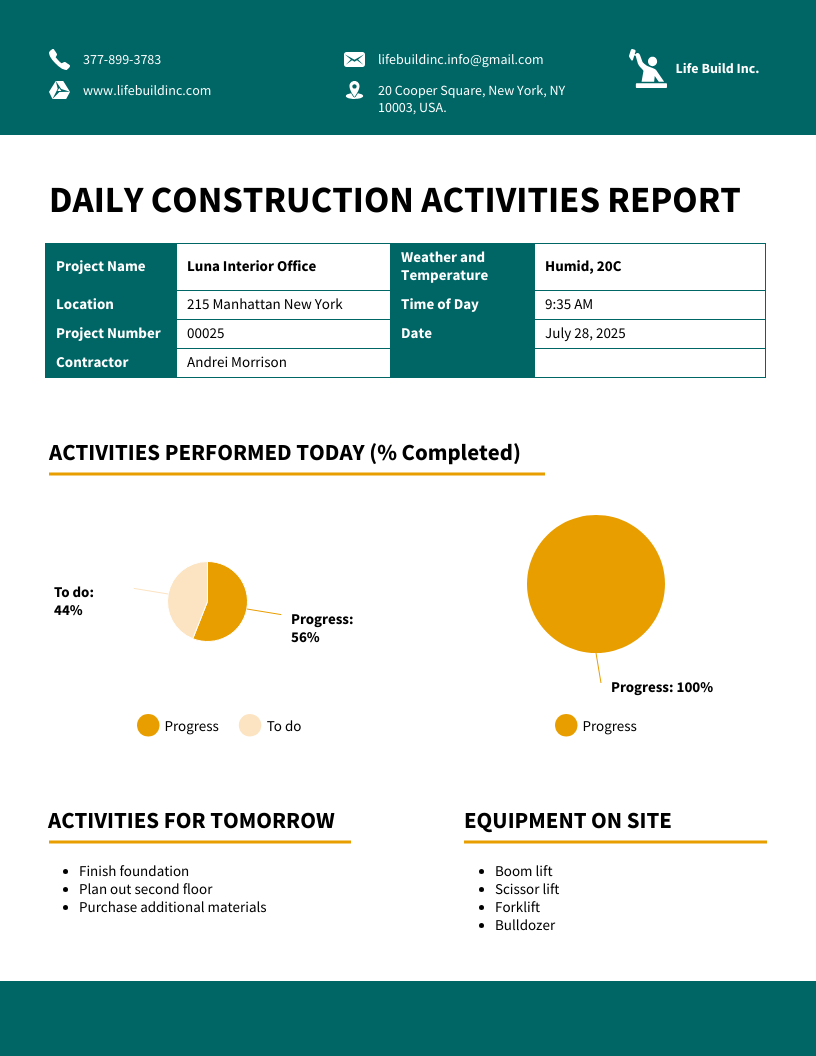
Construction Daily Report Template – Extraordinary Ways It Eliminates Guesswork on Every Project | A Construction Daily Report Template is the central hub of clarity on a job site. It captures essential day-to-day updates—labor, equipment, materials, progress, setbacks, and on-site conditions—into one unified record. When construction gets chaotic (and let’s be honest, it always does), this template becomes the anchor that holds communication steady between the field and the office.

Instead of relying on scattered conversations, photo dumps, or “I thought that was done yesterday,” a Construction Daily Report Template ensures every stakeholder sees the same story with the same details. It boosts productivity, sharpens accountability, and builds a reliable trail of daily insights that leads to smarter weekly and monthly planning.

A well-structured daily report doesn’t just document what happened—it reveals why it happened and what needs attention next. That’s where its real value unfolds.

Construction Daily Report Template – Unlock the Unexpected Power Behind Consistent Reporting

A powerful reporting rhythm is built on structure, clarity, and consistency. When a Construction Daily Report Template is optimized, the ripple effects touch productivity, communication, risk control, and even financial accuracy.

Below is a deeper look at how this reporting backbone supports day-to-day construction operations.

It Strengthens Job-Site Visibility

At any moment, the template shows:

  • Who’s on-site
  • What work was performed
  • Which equipment is operating
  • What delays are developing
  • How the weather is impacting operations
  • What safety observations occurred

This visibility keeps project managers, superintendents, subcontractors, and clients aligned without requiring excessive calls or site visits.

It Reduces Miscommunication

Many issues in construction don’t come from poor planning—they come from incomplete information. Daily reports eliminate blind spots by presenting:

  • Changes in manpower
  • Unplanned tasks
  • Field adjustments
  • Material delays
  • Important decisions made onsite

Clarity leads to smoother coordination between trades.

It Creates a High-Value Documentation Trail

Daily logs protect projects when:

  • Clients request justification for delays
  • Inspectors want proof of compliance
  • Claims or disputes arise
  • The weather needs to be documented for time extensions

Daily documentation is the quiet insurance policy every project depends on.

General Guidance for Building a Strong Daily Reporting Ecosystem

The daily reporting process should be straightforward, repeatable, and accessible. A strong ecosystem includes:

  • Clear categories
  • Easy data entry
  • Consistent formatting
  • Logical sequence of details
  • Space for notes, attachments, and photos

Below are the secondary templates that enhance the system even further and support the main Construction Daily Report Template in different areas of job-site management.

Contractor Daily Report Template – Uncharted Insights That Improve Decision-Making

A Contractor Daily Report Template is often used by general contractors or prime contractors managing multiple trades. It condenses the essential field information into a daily high-level summary.

It usually tracks:

  • Trade-by-trade manpower
  • Daily accomplishments
  • Equipment hours and breakdowns
  • Material deliveries and shortages
  • Requests for information (RFIs) triggered by field issues
  • Site conditions impacting the schedule

Its strength lies in providing a clear snapshot that office teams can use for:

  • Work sequencing adjustments
  • Budget alignment
  • Manpower forecasting
  • Client communication

Picture this: a concrete subcontractor completes less cubic yardage than expected due to rebar congestion. This is logged automatically in the contractor’s daily report—giving project managers the chance to shift schedules before the issue grows into a multi-day delay.

It’s not just paperwork; it’s operational foresight.

Construction Daily Progress Report Template – Extraordinary Clarity for Tracking What’s Done vs. What’s Planned

A Construction Daily Progress Report Template zeroes in on actual productivity. Instead of showing who was on-site, it highlights what they accomplished.

Key sections include:

  • Planned tasks for the day
  • Actual tasks completed
  • Percent of completion
  • Productivity roadblocks
  • Work requiring re-inspection
  • Notes for next steps

This template creates factual, numerical progress visibility.

For example:
If electricians complete only 30% of rough-ins instead of the projected 60%, the progress report makes that gap impossible to ignore. It supports better forecasting, helps eliminate schedule surprises, and gives everyone a realistic sense of momentum.

In short, it answers the question, “Are we truly moving forward at the pace we think we are?”

Get also: Construction Monthly Report Template

Construction Daily Activity Report Template – Secret Ways It Reveals On-Site Realities

A Construction Daily Activity Report Template provides a granular, activity-level breakdown. It shows not just progress—but how that progress unfolded minute-to-minute or task-by-task.

Typical contents include:

  • Trades and crews on-site
  • Work areas accessed
  • Equipment operated
  • Safety toolbox talks
  • Visitor logs
  • Field decisions
  • Minor incidents
  • Work interruptions

This micro-level detail is crucial for projects with:

  • Multiple overlapping trades
  • High activity density
  • Confined work zones
  • Strict safety oversight
  • Tight inspection cycles

Get also: Daily Activity Report Template Free Download

Imagine a steel crew cannot finish decking because the crane was tied up longer than expected, lifting HVAC units. The activity report captures that dependency—a detail that may not appear clearly in a progress report.

These activity-level insights make root-cause analysis easier and prevent repeating the same issues on subsequent days.

Get also: Monthly Report Template Free Download

How These Templates Work Together

All three secondary reports—contractor, progress, and activity—enhance the accuracy and reliability of the Construction Daily Report Template.

They feed different layers of information:

  • Activity report → granular task details
  • Progress report → measurable advancement
  • Contractor report → consolidated project summary

Combined, they build a reporting ecosystem that:

  • Boosts cross-functional communication
  • Increases predictability in scheduling
  • Improves coordination between trades
  • Reduces risk by identifying small issues early
  • Creates strong documentation for claims, billing, and inspections

By capturing the “what,” “who,” “why,” and “how,” these reports give a complete operational picture—something no single document can achieve alone.

What an Ideal Construction Daily Report Template Should Include

To maximize clarity and value, a high-quality Construction Daily Report Template usually includes:

  • Project name, date, location
  • Weather impacts
  • Labor by trade with headcounts
  • Subcontractor presence
  • Equipment usage and downtime
  • Materials delivered and quantities
  • Planned vs. actual work
  • Job-site observations
  • Delays, disruptions, and causes
  • Safety notes and incidents
  • Site photos (optional but beneficial)
  • Notes for office follow-up
  • Signature or verification section

A consistent structure ensures that no matter who fills out the report, the output remains uniform and reliable.

Real Use Cases That Show Its Power

  1. Avoiding schedule slips
    An activity report shows that plumbing rough-ins are consistently slow due to material delays. This insight flows into the main daily report, prompting procurement to expedite supplies immediately.
  2. Improving trade coordination
    Progress reports reveal that drywallers began early, blocking electricians from finishing conductors. The contractor’s report highlights the sequencing issue, enabling better planning for the next day.
  3. Supporting weather-related claims
    Daily reports document three consecutive afternoons of heavy rain, justifying two extensions and avoiding penalties.
  4. Enhancing safety oversight
    Activity logs show multiple near-misses involving a specific forklift. Safety teams intervene before a major incident occurs.

These are not hypothetical benefits—they’re everyday examples from real job-site operations where accurate daily reporting changes outcomes.

Final Thoughts

A strong Construction Daily Report Template doesn’t just help teams stay organized—it drives better decisions, stronger communication, clearer forecasting, and smoother project execution. When supported by reliable contractor, progress, and activity report templates, it becomes the information backbone that construction projects depend on to run safely, efficiently, and predictably.

Construction Monthly Report Template – 2026 Extraordinary Insights

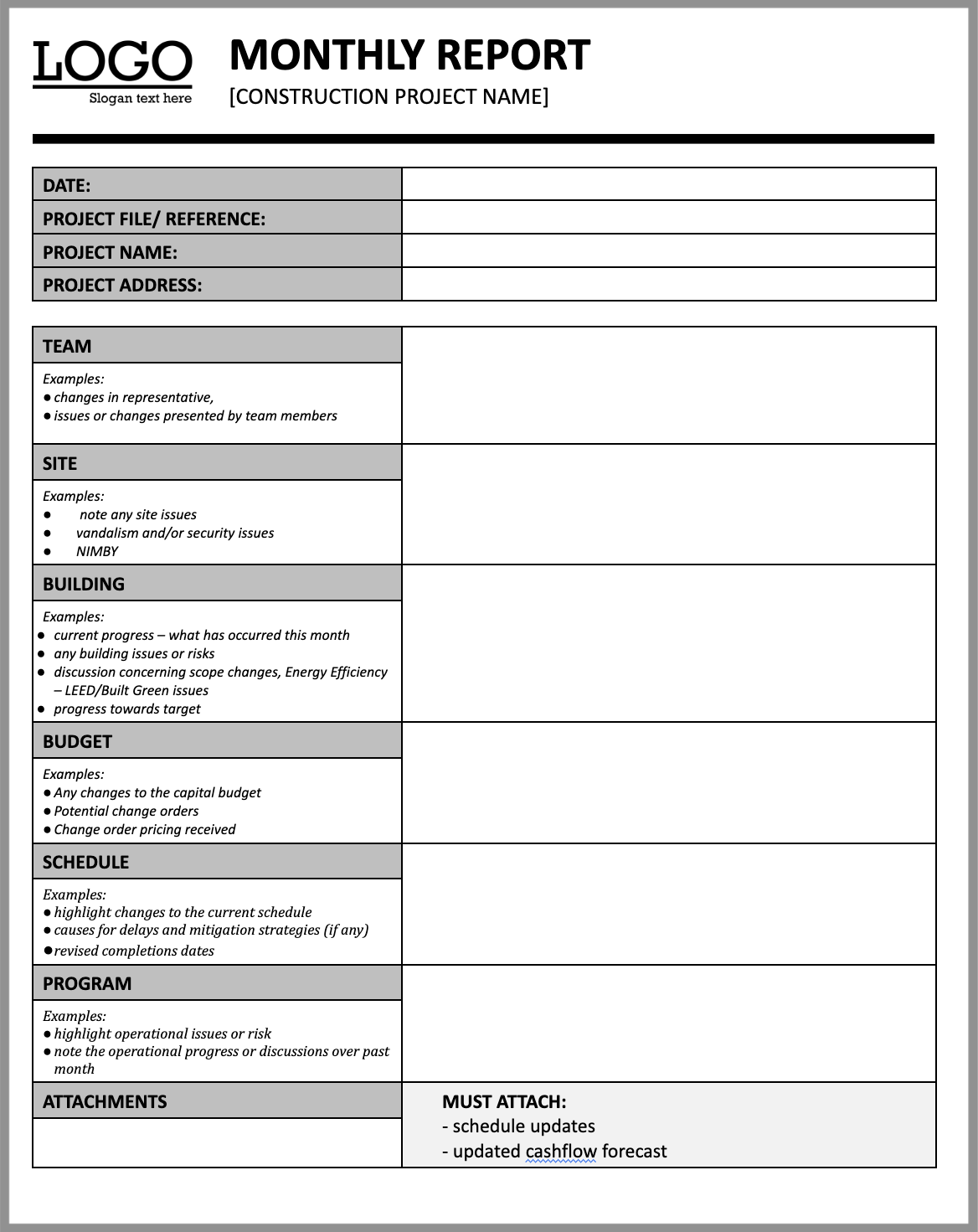
Construction Monthly Report Template – Extraordinary Insights for Better Project Control | A Construction Monthly Report Template plays a pivotal role in how teams, contractors, and stakeholders stay aligned in an industry where even a small delay can ripple into massive setbacks. The right template helps transform scattered updates into a coherent narrative of progress, challenges, cost movements, resource usage, and upcoming priorities. When structured correctly, it becomes more than documentation—it becomes a project health dashboard that prevents misunderstandings, protects budgets, and supports timely decision-making.

Construction work is dynamic, full of moving parts, and occasionally full of surprises—like discovering the “simple renovation” you priced turns out to have plumbing installed by someone who apparently studied engineering from a cereal box. A polished Construction Monthly Report Template helps teams navigate all that chaos in a steady, predictable way. With clarity, consistency, and strong documentation, everyone from project managers to site supervisors benefits from a monthly report designed for accuracy and clarity.

Construction Monthly Report Template – Unique Project Clarity

A great Construction Monthly Report Template brings order to the natural unpredictability of building environments. Instead of chasing updates from team to team, a well-crafted structure compiles all key information—resource allocation, milestone achievements, safety notes, financial figures, timeline accuracy, and major decisions—into a single unified document.

The Construction Monthly Report Template typically includes sections for daily progress logs, material inventory, delays, subcontractor updates, financial tracking, labor utilization, and risk assessments. With the right formatting, it becomes the backbone of routine communication. It ensures that project leaders always understand what’s on schedule, what’s drifting, and what needs immediate attention.

Equally important is the ability to detect trends early. When project reports follow a consistent structure, teams can spot recurring obstacles—like bottlenecks caused by late deliveries, tasks that consistently take longer than estimated, or cost spikes linked to specific stages of work. Identifying these patterns earlier means avoiding expensive surprises later.

A strong Construction Monthly Report Template also aids cross-functional communication. Teams working on design, procurement, operations, and field execution can get the same version of the truth. Instead of relying on spoken interpretation or text messages from the foreman, everything sits in a standardized document ready for review.

From a practical standpoint, this Construction Monthly Report Template keeps everyone aligned with the project’s broader goals. It supports transparency, avoids misunderstandings, and ensures accountability in areas where precision matters—such as inspections, material usage, and regulatory compliance. Even subtle changes in the timeline become easier to track and discuss.

Supporting Structure for Better Reporting Flow

Beyond layout and formatting, a well-designed monthly report template helps reinforce workflow discipline. It encourages team members to document updates thoroughly, track progress accurately, and think critically about delays or risks. This consistency builds a reliable historical record for future planning, budgeting, and forecasting.

Many construction firms rely heavily on monthly reports for validating invoices, updating clients, preparing for audits, and reviewing subcontractor performance. A structured template strengthens all those processes. The more polished the format, the easier it becomes to compare progress month-to-month—especially when a build spans long timelines.

The monthly structure is particularly useful for large-scale projects involving multiple contractors and large budgets. Consistent documentation ensures that nothing slips through the cracks. It also helps maintain accountability among different teams or subcontractors, since progress is evaluated in clear, measurable terms.

Keeping the Construction Monthly Report Template intuitive matters just as much as keeping it thorough. Overly complex formats often cause confusion, while overly simple ones fail to capture the data needed for meaningful analysis. The goal is a balanced design—comprehensive yet manageable, detailed yet readable.

Below are deeper dives into the three major specialized report types that relate to the monthly reporting cycle. Each serves a unique purpose in capturing project health from different angles.

Monthly Project Status Report Template – Premium Clarity

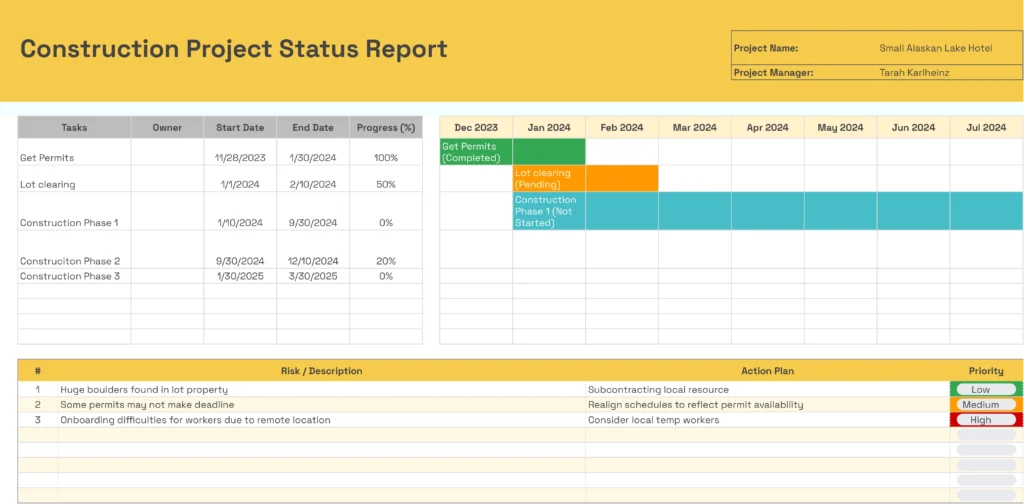
A Monthly Project Status Report Template provides a consistent snapshot of where the project stands at a given point in time. This version is ideal for teams that need a high-level but structured view of achievements, milestones, issues, and next steps. It simplifies conversations with stakeholders who want a clear understanding of the project’s direction without getting lost in overly technical details.

This version of the report typically includes an executive overview, current progress versus planned progress, updated timelines, procurement status, upcoming milestones, safety notes, and identified risks. It’s especially useful for project managers who must routinely evaluate whether the build is on pace or at risk.

One overlooked benefit of this template is how it supports early risk detection. By documenting progress in a standardized format, the team can easily identify early warning signs—such as delays in site preparation, slower-than-expected labor output, or dependencies that may impact subsequent stages. The structured layout enables faster decision-making, allowing leaders to pivot strategies before issues escalate.

In real-world construction environments, this report acts as the backbone of monthly management meetings. It brings together updates from architects, engineers, foremen, suppliers, and supervisors into one readable summary. With clarity baked into every section, discussions stay focused, productive, and anchored to factual updates rather than assumptions.

Construction Monthly Progress Report Template – Incredible Detail

A Construction Monthly Progress Report Template presents a deeper and more granular view of site activity. While the monthly status report highlights direction, the monthly progress report shines a spotlight on execution—what teams did, what materials were used, what equipment was active, and what challenges emerged along the way.

This template often includes detailed progress logs, photographic evidence, percentage completion charts, inspections completed, material usage data, subcontractor reports, and assessments of site conditions. These granular elements help transform the abstract notion of “work completed” into a tangible record backed by measurable data.

Teams use this report for operational planning, resource coordination, equipment scheduling, and validating the amount of progress required for staged payments. Because it captures day-to-day effort in aggregated form, it becomes a critical reference for both project performance reviews and contractual evaluations.

Realistically, this template also helps teams guard against scope creep. When progress is documented clearly each month, it becomes harder for unplanned tasks or unauthorized modifications to slip past unnoticed. The detailed structure highlights any deviations from the original scope and supports structured discussions on adjustments or change orders.

In complex builds involving heavy machinery, structural work, or multiple simultaneous crews, the monthly progress report becomes indispensable. It provides an evidence-based narrative that supports safety assessments, operational planning, and timeline reviews—making it a strategic asset, not just an administrative task.

Construction Project Monthly Status Report Template – Exclusive Insights

A Construction Project Monthly Status Report Template serves as a bridge between high-level leadership expectations and on-field execution. It builds on the concepts of both status and progress reports, combining summary-level insights with enough detail to make decisions confidently.

This version usually includes timeline updates, current work phases, completed deliverables, major risks, contractor performance, equipment allocation, and upcoming tasks. Because it blends strategic and operational insights, it becomes the go-to document for clients and senior management who need periodic updates without being overloaded.

One of the key advantages of this Monthly Status Report Template is how it enhances communication. With structured sections for accomplishments, challenges, and upcoming focus points, conversations between client representatives and project managers become more efficient. Rather than trying to interpret anecdotes or verbal updates, stakeholders can refer to written evidence aligned with the project plan.

The Construction Monthly Report Template also supports data-backed accountability. When teams track progress consistently across months, patterns emerge—such as recurring delays linked to specific workflows or opportunities where efficiency improvements could drastically reduce future time or cost. These insights become valuable fuel for strategic planning, risk mitigation, and forecasting.

In client-facing environments, this monthly report helps maintain trust. Clear, transparent, and structured updates demonstrate professionalism and strong project management discipline—qualities that matter deeply in the construction sector.

Final Thoughts: The Value of Structured Reporting

A strong Construction Monthly Report Template is more than paperwork—it’s a decision-making instrument. Whether used to track site activity, communicate with stakeholders, compare planned versus actual progress, or anticipate potential bottlenecks, it provides structure in an industry that thrives on precision and coordination.

Monthly reporting supports better planning, clearer communication, and stronger project control. With well-organized templates such as the Monthly Project Status Report Template, the Construction Monthly Progress Report Template, and the Construction Project Monthly Status Report Template, teams gain clarity, confidence, and continuity throughout the lifecycle of any project.

Monthly Status Report Template – 9+ Extraordinary Insights

Monthly Status Report Template: Extraordinary Insights for Clearer Monthly Progress | A Monthly Status Report Template is more than just a reporting tool—it’s the backbone of a team’s clarity, alignment, and month-to-month progress visibility.

When crafted properly, it helps leaders track project movement, understand departmental workloads, and evaluate resource needs without chasing separate updates from every direction. Teams rely on it to communicate accomplishments, upcoming tasks, risks, and dependencies in a way that feels structured and easy to digest. For organizations that operate across multiple functions, having a dependable template turns reporting into a streamlined rhythm rather than a fire drill at the end of every month.

Many businesses use a Monthly Status Report Template to maintain accountability and transparency. It gives project managers, department heads, and construction supervisors a consistent structure for documenting work completed, pending tasks, and any obstacles requiring escalation. Whether the context involves a small team or a large cross-functional environment, consistency in reporting builds trust and makes evaluations far more reliable. Even better, it helps eliminate the classic “I thought someone else handled it” moment—which, as many managers know, is both timeless and universal.

Monthly Status Report Template: Remarkable Clarity for Any Workflow

A reliable Monthly Status Report Template brings order to otherwise chaotic monthly recap meetings. Teams can align faster, managers can make decisions with fewer blind spots, and stakeholders can assess progress without digging through scattered notes.

The best Monthly Report Templates follow a simple structure: accomplishments, challenges, upcoming milestones, resource needs, dependencies, and commentary. When teams follow the same pattern each month, trends become obvious—such as repeated bottlenecks or recurring productivity spikes.

Within most organizations, reporting needs differ between projects, departments, and field operations. Yet the value of a consistent template remains the same: fewer misunderstandings, more transparency, and better coordination. When a team uses a standardized structure, supervisors spend less time interpreting scattered updates and more time enabling progress. A well-built template becomes a quiet backbone of operational excellence, helping reduce delays and highlight opportunities long before they become urgent.

The strength of a Monthly Status Report Template also lies in its ability to highlight resource allocation. It’s easier to justify additional headcount, extended timelines, or new tooling when the monthly summary presents evidence clearly. Instead of relying on anecdotal complaints, leaders can present trends and patterns captured over several months. A structured template also encourages better documentation habits—which means important context doesn’t get lost between hectic work cycles.

Expanded Use-Cases for Modern Teams

Beyond simple project updates, monthly reports also support performance evaluations, interdepartmental collaboration, budgeting, and compliance. Finance teams use them to forecast expenditures, while operations teams use them to verify task completion and risk mitigation. HR departments may integrate highlights into broader organizational reviews, crafting a narrative around team performance. Meanwhile, construction firms depend on structured monthly reporting to track site progress, completion percentages, weather delays, and subcontractor activities.

Monthly Status Report Templates reduce ambiguity. They help teams avoid last-minute scrambling. And they create a predictable communication format that everyone can follow, even when individual writing styles differ drastically.

Supporting Templates for Different Reporting Needs

Monthly Project Status Report Template Extraordinary Breakdown

A Monthly Project Status Report Template Extraordinary Breakdown is ideal for teams coordinating timelines, deliverables, and dependencies. It ensures that every project update fits into a repeatable structure that decision-makers can scan quickly. For teams juggling multiple initiatives, this version of the template prevents information gaps by requiring clear updates on milestones achieved, items postponed, and risks identified during the reporting period.

Project-focused templates often include progress bars or percentage completion indicators. These visual cues help stakeholders grasp the bigger picture at a glance, especially when projects span several months. Teams can also include a quick assessment of resource usage, such as budget utilization, contractor hours, or software tool licensing. While it’s not uncommon for teams to underestimate the number of small tasks they completed, this structure encourages them to break accomplishments into measurable, traceable outputs.

This version is also exceptionally helpful for organizations with distributed teams. Instead of relying on ad-hoc reports, managers receive uniform updates across all projects—making variance analysis much more straightforward. It also ensures smoother handoffs when team responsibilities shift, since historical records are structured and easy to review.

Get also: Monthly Financial Report Template Free Download

Department Monthly Status Report Template: Astonishing Utility

A Department Monthly Status Report Template gives leadership the clarity needed to understand how each department contributes to broader company objectives. Unlike project-based reporting, department reports capture both recurring activities and special initiatives. This includes staffing updates, training progress, operational improvements, backlog data, workload distribution, and upcoming priorities.

Departments benefit from emphasizing key challenges and the level of impact they have on company operations. A structured template guides them to highlight measurable accomplishments—for instance, completed audits, resolved tickets, new system implementations, or training sessions delivered. This makes performance trends easier to spot over time.

Another value point is alignment across departments. For example, operations may report increased workload due to seasonal demand, while procurement highlights equipment shortages in the same period. When both reports follow a standardized template, it becomes easier to connect the dots and adjust plans accordingly. This format also strengthens accountability, ensuring every department presents updates based on evidence rather than improvisation.

Construction Project Monthly Status Report Template: Hidden Advantages

A Construction Project Monthly Status Report Template focuses on field progress, contractor productivity, site logistics, and safety reporting. Construction environments generate high variability, so the Monthly Project Status Report Template helps maintain consistency across project supervisors, subcontractors, and site managers. The clear structure ensures updates include completed work sections, weather impacts, delays, change orders, material shortages, and upcoming site requirements.

One unique strength of construction reporting is visual documentation. Many teams incorporate photos, diagrams, or annotated site maps into their monthly summaries. These help stakeholders verify real-world progress without physically visiting multiple sites. The template also supports compliance requirements, including safety observations, inspection results, and incident tracking.

This version is especially effective for large developments involving multiple contractors. The structure ensures every contributor reports using the same categories, reducing confusion and making end-of-month coordination smoother. By following a unified reporting format, construction teams reduce the risk of miscommunication—an essential factor in managing both budgets and timelines.

How a Monthly Status Report Template Shapes Stronger Workflows

Whether used by project teams, cross-functional departments, or construction sites, a well-designed Monthly Status Report Template enhances alignment. Teams understand what information is required, managers know where to focus attention, and leadership gains transparency into operational health across the organization. It also strengthens strategic planning, since reliable monthly data highlights emerging trends long before they impact long-term outcomes.

A strong template encourages clarity. Instead of lengthy narrative reports, teams distill their updates into structured sections that emphasize impact and progress. This reduces meeting time, smoothens escalations, and ensures that everyone shares the same understanding of priorities. Most importantly, it keeps the reporting rhythm predictable—making it easier for teams to maintain consistent documentation.

Another advantage is that templates reduce transition friction. When new managers join, or team members rotate, the historical sequence of monthly summaries provides a clear timeline of decisions, challenges, and accomplishments. This enhances continuity across projects and departments, keeping institutional knowledge accessible.

Final Thoughts

A Monthly Status Report Template remains an essential tool for guiding effective communication, minimizing misunderstandings, and ensuring teams maintain alignment with organizational goals. Regardless of industry, a dependable Monthly Status Report Template transforms complex monthly updates into structured insights. Through project summaries, department recaps, or construction overviews, these templates reinforce accountability while supporting smarter decisions.

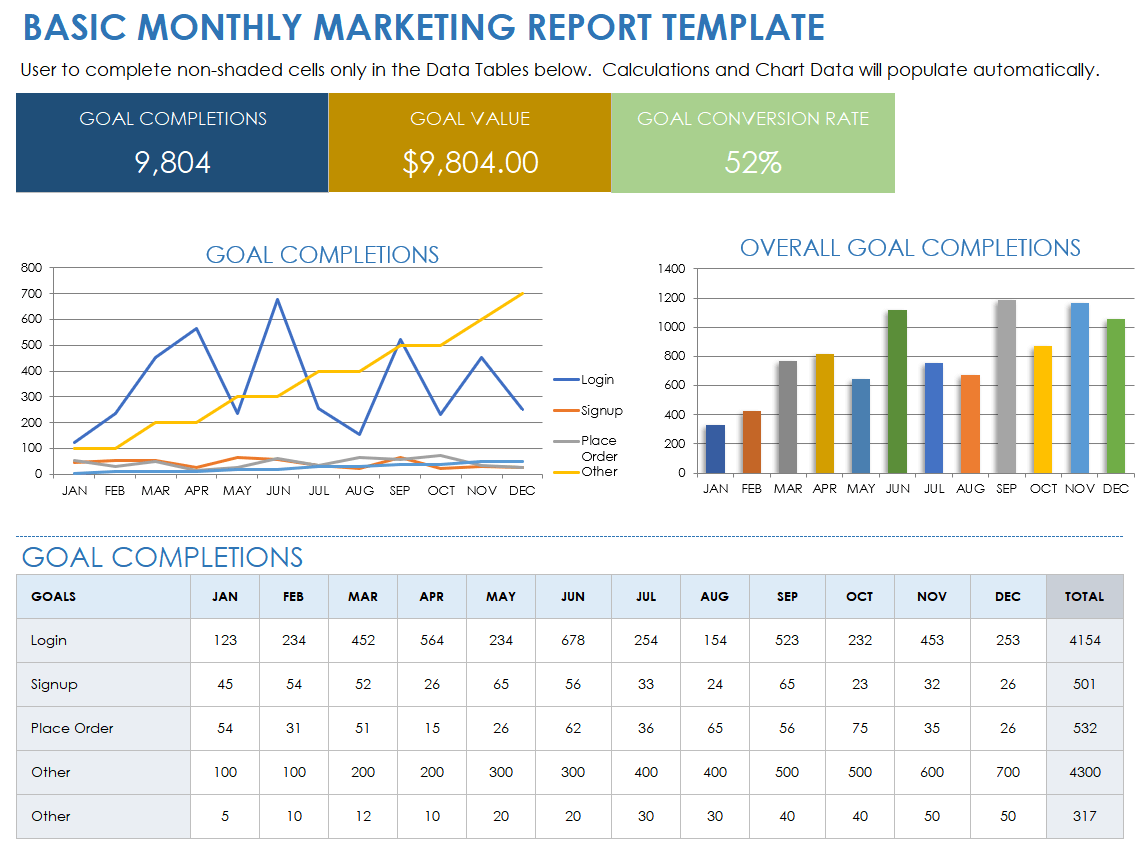
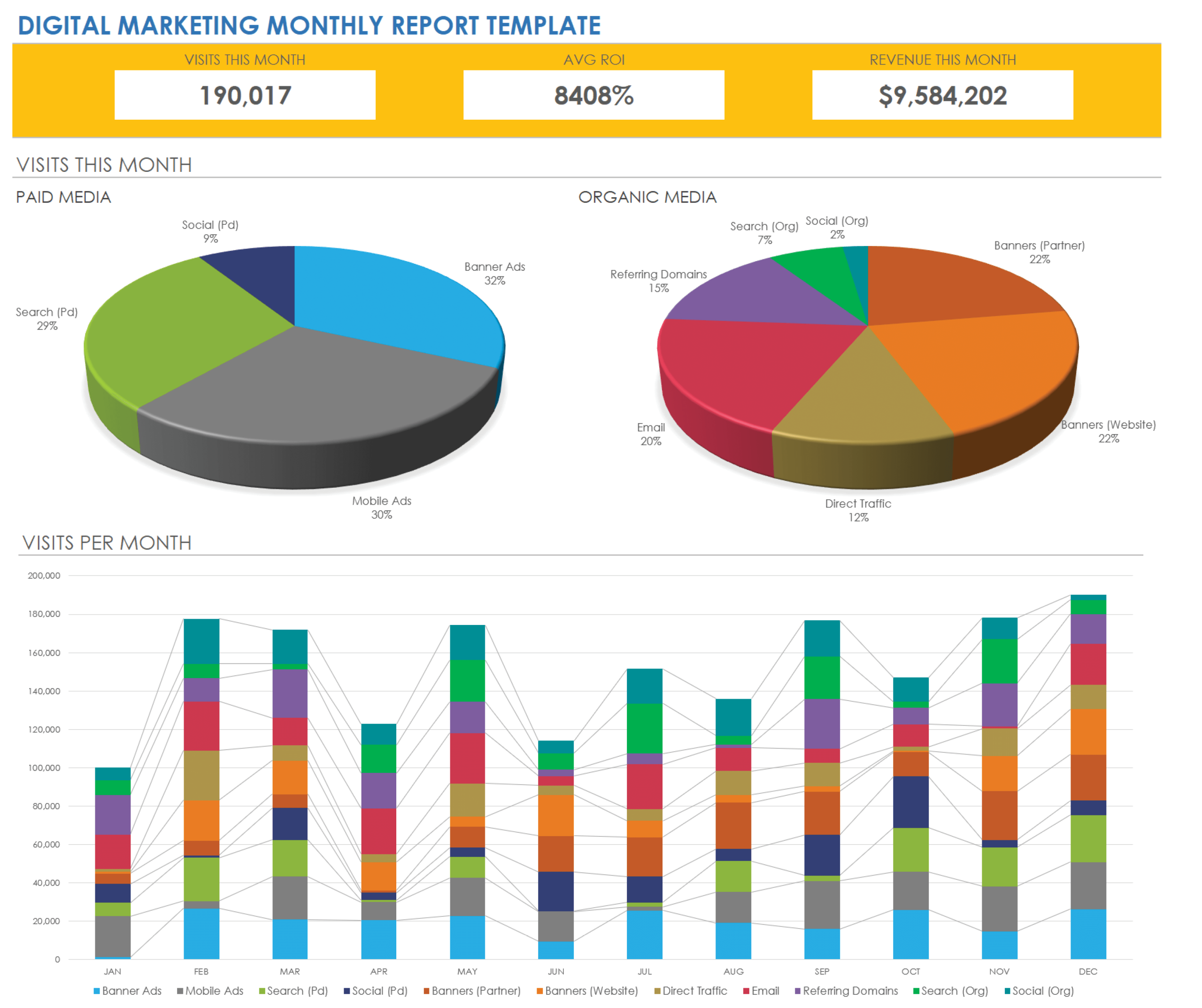
Digital Marketing Monthly Report Template – 8+ Hidden Insights for Smarter Growth

A Digital Marketing Monthly Report Template gives structure to what can sometimes feel like a tornado of ads, analytics, campaigns, impressions, and one too many coffee-fueled creative ideas. When a team runs multiple initiatives across platforms, the need for clarity becomes louder than a notification spike after launching a viral post. A reliable template keeps everything organized, consistent, and genuinely useful for decision-making—not just a collection of charts that look pretty but explain nothing.

This kind of template exists to help brands understand their progress, spot odd patterns, uncover opportunities, and communicate performance without drowning in data. When used well, it becomes a core operational tool, supporting every upcoming campaign, strategy, and content overhaul.

Digital Marketing Monthly Report Template Classified Structure for Better Clarity

A dependable Digital Marketing Monthly Report Template serves as a roadmap—a way to track what happened, why it happened, and what needs to come next. It keeps the entire marketing ecosystem aligned, whether the focus is paid campaigns, social media content, email sequences, or a mix of everything.

The strength of a structured Digital Marketing Monthly Report Template lies in consistency. When teams review the same format each month, they no longer need to decode unfamiliar layouts or search endlessly for buried insights. Everything is laid out logically, helping stakeholders focus more on decisions and less on deciphering reports.

A well-designed Digital Marketing Monthly Report Template typically includes high-level metrics, channel-specific breakdowns, top-performing content, month-over-month comparisons, and recommendations for future actions. This setup makes it easy for leaders to identify growth areas and for teams to refine their work without needing to comb through endless raw data.

It also helps pinpoint whether shifts in numbers come from strategy changes, seasonal variations, platform trends, or the occasional surprise result that nobody planned for—but everyone claims they “totally expected.”A Comprehensive Framework for Monthly Marketing Reports

A polished monthly reporting system doesn’t rely solely on numbers; it depends on context. Every spike, dip, or steady line has a reason behind it. A powerful reporting template builds that context directly into the structure, ensuring everything remains understandable even for stakeholders who aren’t deep in daily execution.

This second section outlines supporting elements that elevate a report from “functional” to “strategically essential.”

Monthly Marketing Report Template: Uncharted Breakdown

A Monthly Marketing Report Template works best when it captures details across all ongoing marketing activities. Because monthly cycles often include multiple campaigns, events, or product pushes, the report should highlight:

  • Campaign timelines showing what ran and when
  • Performance metrics for each marketing channel
  • Cost allocation and how efficiently the budget was used
  • Audience behavior shifts driven by seasonality or targeting
  • Creative performance of visuals, captions, messaging, or hooks

This helps the team understand not just results, but why those results surfaced.

A strong Digital Marketing Monthly Report Template also spotlights channel relationships. For example, if social media content boosted organic search activity, or if an email campaign nudged more people toward retargeting ads. These connections build awareness of how the broader marketing machine works together.

In many cases, teams discover that minor changes—like switching posting formats or adjusting delivery times—produce disproportionately strong outcomes. The Digital Marketing Monthly Report Template helps capture and replicate that success.

Social Media Monthly Report Template: Lost Analysis

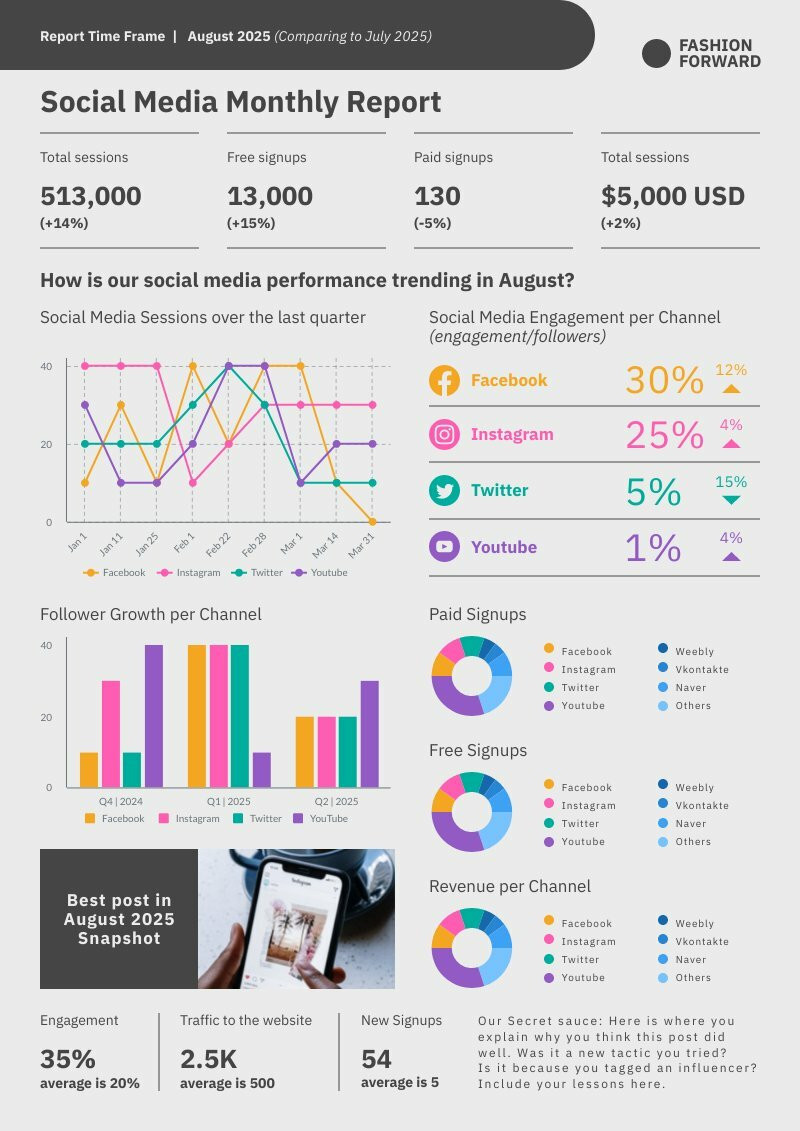
A Social Media Monthly Report Template brings order to the lightning-fast environment of timelines, feeds, and algorithms. Social performance can swing wildly depending on trends, formats, and even random external factors nobody controls. A monthly template stabilizes that chaos by providing consistent insights across:

  • Engagement rates (which posts sparked the most conversation)
  • Reach and impressions (how widely the content traveled)
  • Follower growth and what may have influenced it
  • Top-performing content categories
  • Audience demographics and behavior patterns

The value lies in identifying patterns—like which content types consistently outperform, or which platforms deliver predictable returns.

This report doesn’t just summarize performance; it supports decisions like where to invest creative effort, which platforms deserve more attention, and when it’s time to retire formats that have overstayed their welcome.

It also gives teams an honest view of platform behaviors. Sometimes, the content that took the longest to produce barely gets a reaction, while a simple post made in five minutes suddenly blows up. The template captures these surprises without judgment—only useful information for future planning.

Get also: Free Digital Marketing Report Template

Social Media Marketing Performance Report Template: Hidden Opportunities

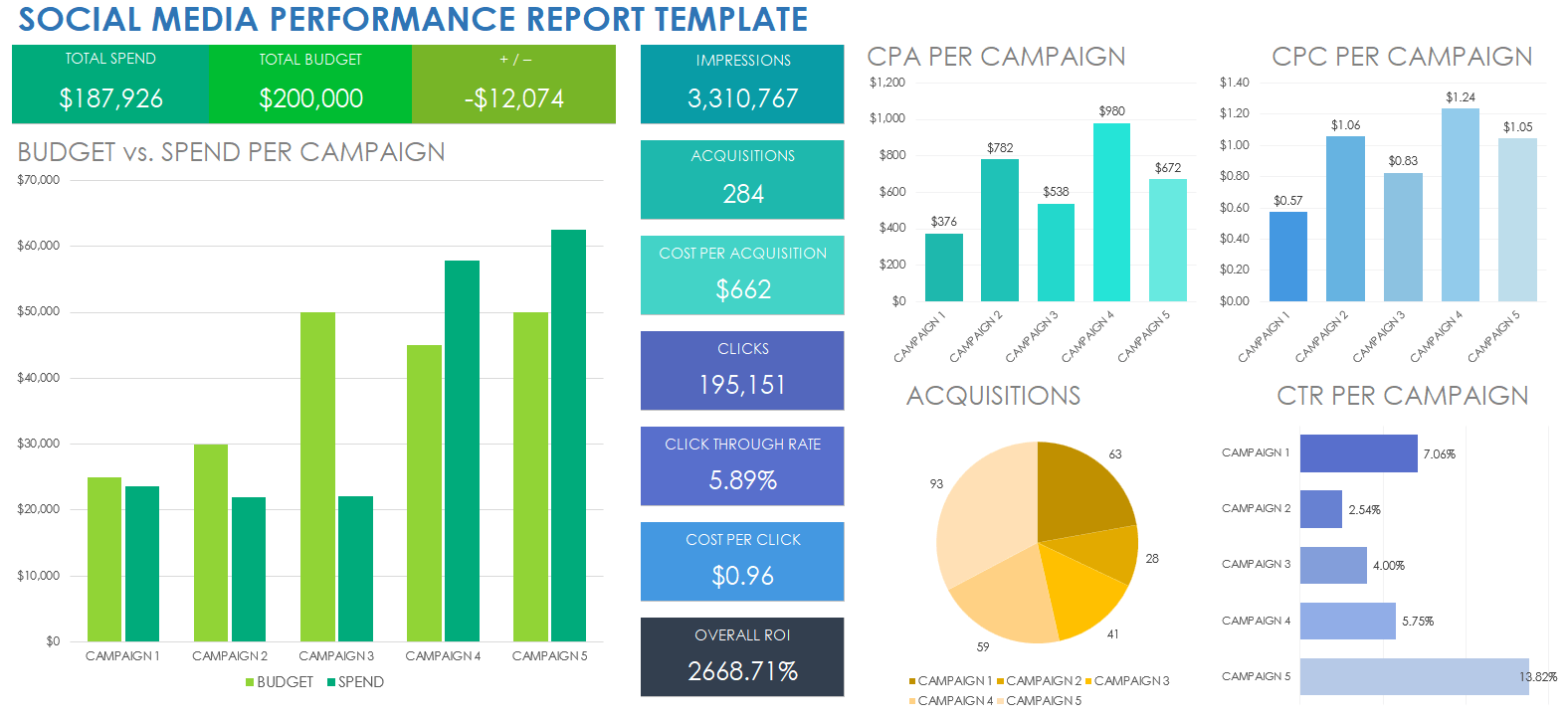
A Social Media Marketing Performance Report Template focuses on the deeper layer of performance: How well did social content support broader marketing goals?

While general social reports focus on engagement and visibility, performance-focused templates dive into:

  • Click-through trends and which messaging led users to act
  • Conversion behavior is influenced by social content
  • Audience pathways from post → landing page → action
  • Retention signals based on recurring interactions
  • Content and campaign A/B test insights

These sections make it clear whether social activities are just entertaining the audience or genuinely contributing to growth.

Teams can use this performance layer to improve campaign messaging, refine offers, and adjust how content supports the overall customer journey. The Digital Marketing Monthly Report Template prevents teams from guessing what worked and instead provides a grounded understanding.

How a Digital Marketing Monthly Report Template Strengthens Decision-Making

A strong Digital Marketing Monthly Report Template reduces uncertainty and increases confidence when planning upcoming campaigns. Without a clear reporting structure, decision-makers often rely on anecdotal evidence or personal assumptions. A dependable monthly template replaces guesswork with clarity.

It creates a narrative that traces the full month of activity—from planning to execution to outcomes. The result is a document that communicates what changed, why it changed, and what to adjust next.

The consistency of using the same structure month after month creates a historical archive, enabling year-over-year pattern discovery and long-term performance predictions. Over time, the template becomes more than a reporting tool; it becomes a foundational part of strategic planning.

A well-built marketing report template also increases internal communication quality. When all departments review the same structure, misunderstandings shrink. Marketing, product, sales, and leadership operate with the same information, reducing the number of “Wait, why did this happen?” meetings and allowing teams to focus on action rather than confusion.

Get also: Free Monthly Sales and Marketing Report Template

Making Monthly Reports More Actionable

Actionable reports require more than charts; they need context, recommendations, and the reasoning behind decisions. A thoughtful template encourages this by guiding the team toward reflection, not just reporting.

Many teams enrich their monthly reports by including:

  • Highlights of major wins or milestones
  • Challenges and unexpected outcomes
  • Learning points from successful or unsuccessful campaigns
  • Next-step recommendations informed by data trends

These elements ensure the report leads to insight-driven change, enabling better planning for the next monthly cycle.

Including comparisons—month-over-month, quarter-over-quarter, or year-over-year—helps identify meaningful shifts. For example, a spike in engagement may look promising, but the underlying cause might be seasonal. A long-term template exposes these patterns.

The Role of Templates in Cross-Channel Alignment

Most marketing operations involve several platforms working together. A monthly report template aligns these channels by putting their performance into a unified structure. Paid ads, social media, email marketing, content marketing, and influencer activity can be reviewed side-by-side.

This creates a complete picture, making it easier to understand:

  • Which channels drove the strongest results
  • How cross-channel interactions influenced outcomes
  • Where budget allocation produced the best returns
  • What message themes consistently resonated

When these insights are reported consistently, planning becomes smoother. Teams can double down on winning strategies, refine weaker areas, and retire campaigns that no longer perform.

Tracking Performance Trends Over Time

Monthly reporting templates are essential for identifying longer-term patterns. While weekly or daily reports capture short-term shifts, monthly reports capture overarching trends that influence strategy at a broader level.

Over time, these patterns reveal:

  • Platform algorithm shifts
  • Seasonal engagement curves
  • Content fatigue or emerging formats
  • Budget efficiency changes
  • Conversion rate fluctuations

This allows teams to make informed decisions about future campaigns, channel investment, and creative direction.

Why a Digital Marketing Monthly Report Template Creates Stronger Teams

A team aligned under a reliable reporting structure communicates more effectively, collaborates more smoothly, and moves with shared clarity. It minimizes unnecessary friction caused by misinterpretation or inconsistent updates.

Regular reporting also encourages accountability—not in a restrictive way, but through transparency. Everyone knows what’s happening, why it’s happening, and how their work contributes to the whole.

Templates also speed up onboarding for new team members. With a fixed reporting structure, newcomers quickly learn what matters, how to measure success, and what defines strong performance.

Final Thoughts

A well-crafted Digital Marketing Monthly Report Template does more than present numbers; it builds understanding. It supports better decisions, aligns teams, and enables organizations to recognize what moves the needle. With the right structure, monthly reporting becomes smoother, more consistent, and far more impactful.

Monthly Sales and Marketing Report Template for 2026 Stronger Business Momentum

Monthly Sales and Marketing Report Template – Hidden, High-Impact Insights for Stronger Business Momentum | A well-built Monthly Sales and Marketing Report Template is more than just a routine document—it’s the backbone of month-end clarity, goal alignment, and strategic decisions that determine whether your team moves forward with confidence or keeps guessing in the dark.

A Monthly Sales and Marketing Report Template designed with the intention to help teams track key metrics, evaluate campaigns, understand customer behaviour, and assess overall performance without drowning in scattered data or inconsistent reporting formats.

Businesses of all sizes rely on structured monthly reporting to keep growth steady and predictable. When teams use a consistent layout, comparing monthly progress becomes easier, campaign outcomes feel less ambiguous, and future decisions carry far more precision. A strong template doesn’t simply “record numbers”; it builds a clear picture of momentum—what’s working, what’s slowing down, and where hidden opportunities might be waiting.

And while sales teams tend to focus on conversions, forecasts, and close rates, marketing cares deeply about reach, engagement, and campaign impact. Putting both sides into one cohesive structure ensures the organization works with unified information, reducing blind spots and giving leadership a single source of truth. The right framework keeps everything neat, visual, and easy to interpret—something every decision-maker secretly dreams of.

Monthly Sales and Marketing Report Template – Uncharted Breakdown for Modern Teams

A Monthly Sales and Marketing Report Template organizes complex performance data into a structured, visually clear format that team members can update consistently every month. It’s designed to help companies keep track of revenue, lead generation, customer acquisition, campaign effectiveness, and pipeline health while ensuring information remains comparable across time.

The core benefit lies in standardization. Without a unified layout, teams often produce mismatched documents that turn monthly analysis into guesswork. Metrics shift positions, definitions change, and the story behind the numbers becomes fragmented. A standardized Monthly Marketing Report Template eliminates that chaos and replaces it with a reliable rhythm.

However, the usefulness of this structure extends beyond just monthly reporting. It influences cross-functional communication, improves forecasting accuracy, and brings transparency to the decision-making process. When leadership sees both sales momentum and marketing performance in a single template, alignment becomes almost effortless.

Another important aspect is how this template supports accountability. Consistent comparisons highlight trends. From sudden dips in conversions to surprising peaks in engagement, a good layout spotlights what deserves attention. It’s like turning on the lights in a dimly lit room—you suddenly notice the details that were always there but never fully visible.

Different organizations customize their Monthly Sales and Marketing Report Templates depending on goals, industries, and workflows. Some add sections for channel-specific marketing analysis, while others include deep dives into pipeline stages, retention performance, or geographic segmentation. But regardless of complexity, the template’s main purpose remains constant: clarity.

Key Elements That Elevate the Template’s Impact

A well-designed Monthly Sales and Marketing Report Template usually includes these core building blocks:

  • Performance overview
    A high-level summary covering essential outcomes—from revenue figures to campaign achievements. It helps readers grasp the general direction of the business without diving too deep.
  • Sales metrics section
    Monthly revenue, conversion rates, client acquisition, average deal size, sales cycle length, and pipeline updates typically live here.
  • Marketing metrics section
    Campaign performance, lead quality, traffic patterns, engagement statistics, and cost-per-lead. Marketing teams often break this section down by channel.
  • Cross-functional alignment segment
    This portion highlights how sales and marketing supported each other—lead handoff, shared initiatives, feedback loops, and collaborative results.
  • Challenges and opportunities
    A condensed list of issues that slowed momentum and opportunities that could unlock new growth avenues.
  • Action steps for the next month
    Concrete recommendations that turn insights into a clear direction.

Each element works like a puzzle piece. Individually, they’re useful—but together, they create a full landscape of business performance.

Supporting Insights That Strengthen Monthly Reporting

Not every metric matters equally every month, but consistency in structure ensures teams can analyze patterns with much more accuracy. Teams often underestimate how valuable this consistency becomes over time. By month six or seven, the accumulated insights start revealing deeper patterns—seasonality, channel efficiency, evolving customer habits, and campaign strengths that weren’t immediately obvious early on.

A Monthly Sales and Marketing Report Template also improves efficiency. Instead of reinventing a report from scratch, teams can plug in updated data and focus more energy on interpreting results. It encourages better discussions during monthly check-ins, where people spend less time explaining the formatting and more time analyzing the meaning behind the numbers.

It also supports teams that work remotely or across multiple locations. A shared, predictable structure ensures everyone updates the report with the same understanding, reducing discrepancies and misinterpretations.

With all of that in place, let’s break down each secondary keyword category and see how they enhance the overall reporting strategy.

Get also: 2026 Best Monthly Report Template

Monthly Sales Report Template – Hidden Breakdown for Clear Financial Insight

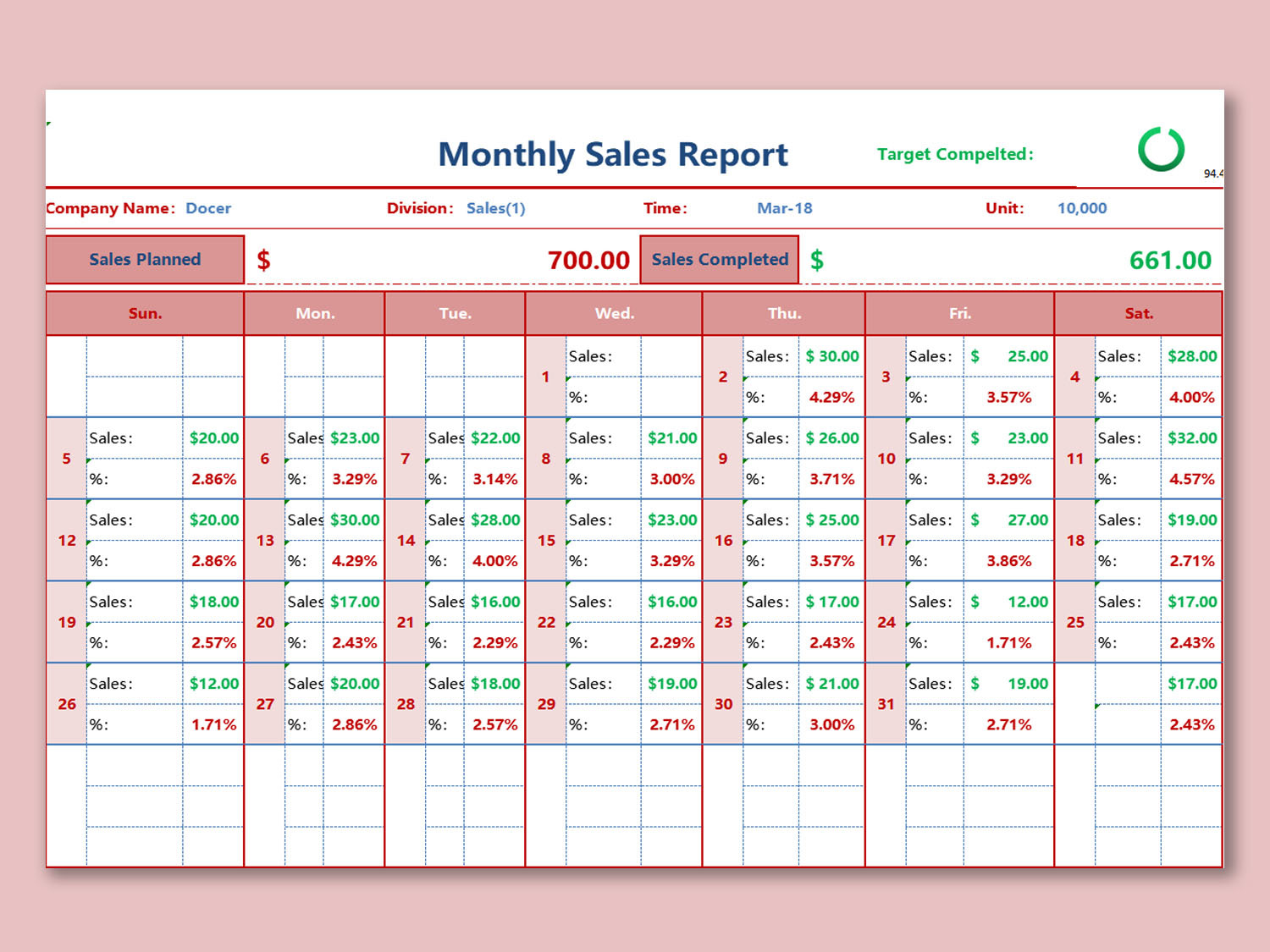
A Monthly Sales Report Template focuses strictly on sales-driven metrics, giving teams a refined view of how monthly efforts translate into revenue and growth. It usually includes numeric breakdowns, trend lines, and sections that assess whether targets were reached or missed.

This type of Monthly Sales and Marketing Report Template often highlights:

  • Revenue performance
  • Units sold
  • New customers
  • Customer retention metrics
  • Lead-to-close conversion
  • Average deal value
  • Sales rep activity summaries

What makes it invaluable is consistency. Keeping monthly formatting identical helps teams instantly detect performance spikes or dips. It also helps reduce subjective interpretations by presenting uniform data every month.

Real-world usage scenarios include:

  • Monthly executive meetings
  • Sales pipeline forecasting sessions
  • Performance evaluations for sales reps
  • Year-end compilation for annual reviews

Even though it focuses on one function, this Monthly Sales Report Template becomes even more powerful when paired with marketing metrics. Sales rarely happen in isolation, and this report establishes the foundation for interpreting the bigger picture.

Get also: Monthly Financial Report Template Excel Free

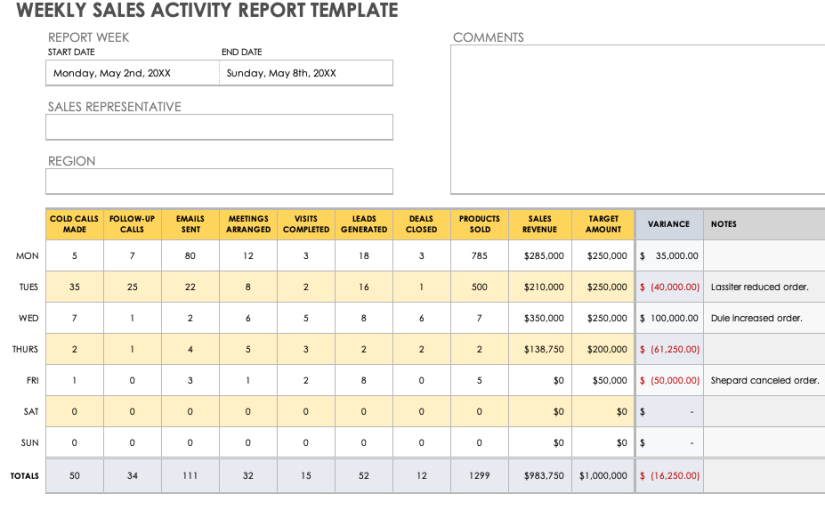
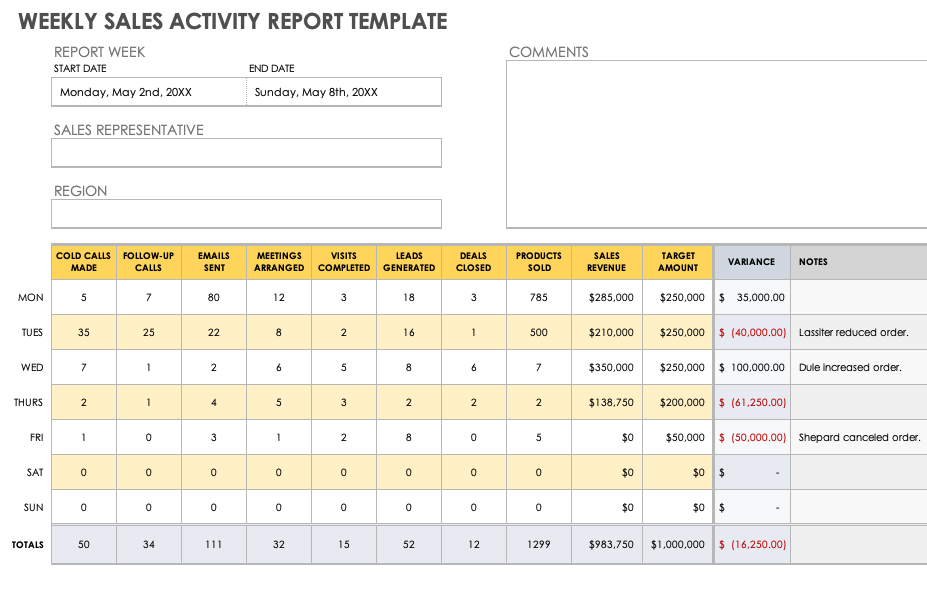
Monthly Sales Activity Report Template – Unbelievable Clarity for Internal Alignment

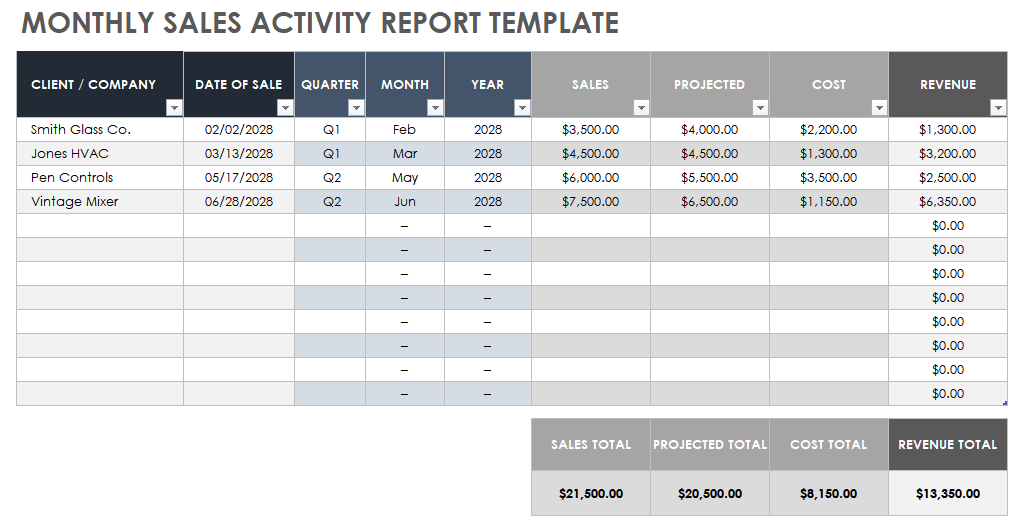
A Monthly Sales Activity Report Template emphasizes actions rather than strictly results. It examines tasks, outreach, communication volume, and interactions that contribute to eventual sales outcomes.

Key elements include:

  • Number of calls made
  • Emails sent
  • Meetings scheduled
  • Product demos conducted
  • Follow-up activities
  • Time allocation
  • Task completion breakdown

This version is especially helpful for understanding productivity levels. Sometimes sales numbers may fluctuate because activity volume changes, not because the market shifts. This template exposes those hidden influences.

The activity-based layout also strengthens coaching efforts. Managers can identify gaps—like low outreach frequency or prolonged follow-up cycles—and guide their teams toward better habits. It’s also useful for identifying top performers’ patterns so that successful behaviours can be replicated across the team.

Organizations often rely on this Monthly Sales Activity Report Template when:

  • Training new teams
  • Scaling sales operations
  • Optimizing workflows
  • Identifying process bottlenecks

By spotlighting the work behind the numbers, companies get a far more accurate interpretation of performance.

Get also: Digital Marketing Monthly Report Template

Monthly Sales Call Report Template – Confidential Insight into Customer Conversations

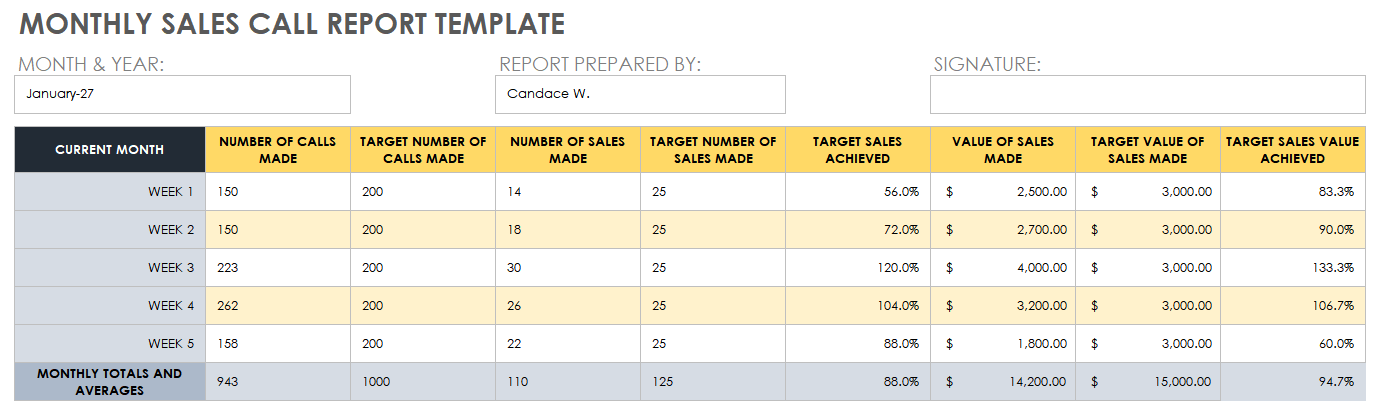
A Monthly Sales Call Report Template brings unique clarity to one of the most important—but often overlooked—areas of sales performance: conversations. Calls reveal customer intent, objections, interests, and buying signals long before deals close.

Typical features include:

  • Volume of calls
  • Types of calls (intro, follow-up, negotiation, closing)
  • Outcomes and summaries
  • Common customer objections
  • Lead quality analysis
  • Customer sentiment
  • Notes for future engagement

Because conversation quality often dictates conversion results, this report acts as a spotlight on communication effectiveness. Leaders can assess whether messaging resonates, whether prospects respond well to certain offers, and which objections repeatedly appear.

It also assists marketing. Insights from call patterns help refine messaging, landing pages, campaign targeting, and lead qualification strategies. When sales and marketing share this type of structured data, improvements take shape much faster.

Real-world use cases include:

  • Customer behaviour analysis
  • Alignment between sales and marketing teams
  • Identifying needs for updated scripts or materials
  • Testing new outreach approaches

By analyzing the human element of the sales process, organizations upgrade their entire communication strategy.

Final Thoughts on Making Monthly Reporting Meaningful

A reliable Monthly Sales and Marketing Report Template transforms scattered data into an actionable, unified document that supports consistency, transparency, and alignment across teams. It breaks down the complexities of monthly performance into a digestible, visually clear structure that leadership can depend on.

More importantly, it encourages ongoing improvement. Month after month, businesses gain a deeper understanding of performance patterns, customer behaviour, campaign impact, and operational efficiency. This clarity drives stronger forecasting, sharper decision-making, and smoother collaboration.

Whether teams rely on a standard layout or a more advanced, customized version, using a unified template ensures that growth stays predictable and progress never feels ambiguous. When sales and marketing share the same reporting rhythm, momentum becomes much easier to sustain.

Monthly Expense Report Template – 8+ Hidden Advantages for Smarter Financial Tracking

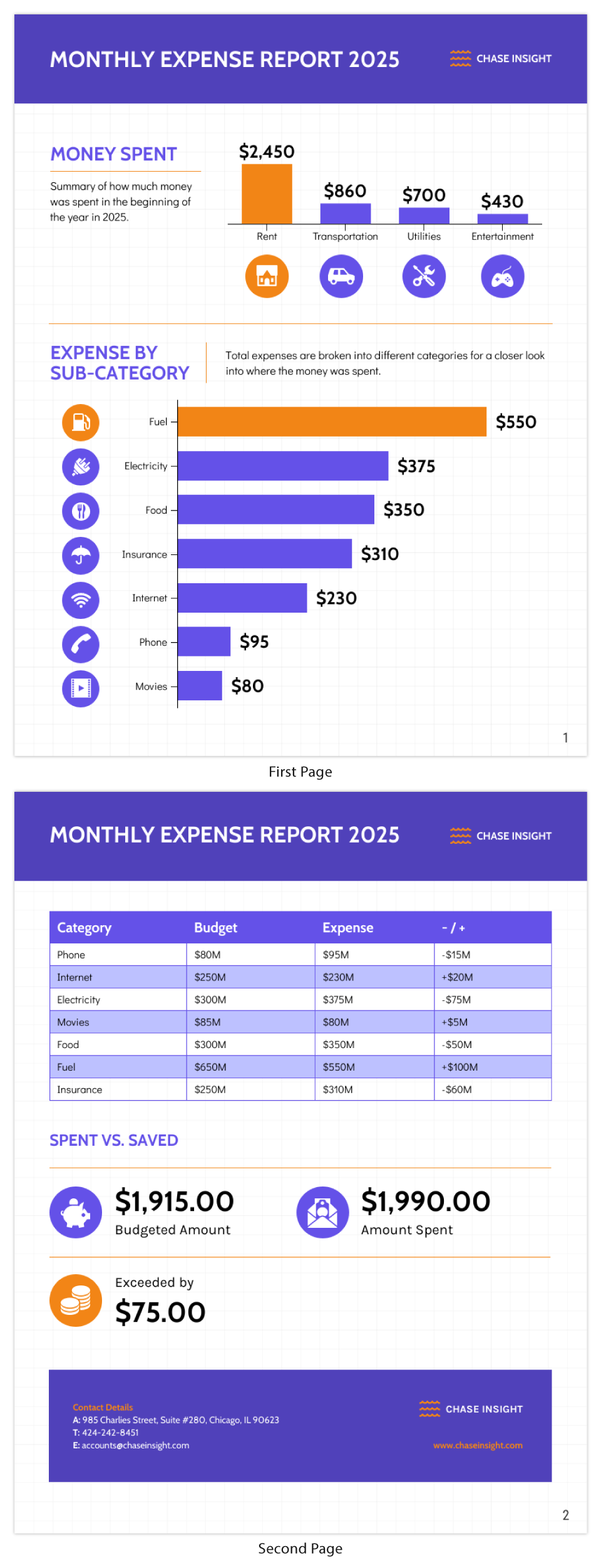
Monthly Expense Report Template | Managing monthly expenses isn’t exactly the most glamorous part of running a business, but it sits right at the core of sustainable growth. A well-structured Monthly Expense Report Template makes the entire process easier, clearer, and far more reliable. Instead of chasing random spreadsheets, emails, and handwritten notes that somehow always disappear at the worst moment, a solid template gives you a consistent and dependable way to capture financial activity every month.

An organized monthly expense system doesn’t just record numbers—it shapes better decision-making. When every detail is presented cleanly, teams can understand spending patterns, identify budget leaks, and map out future allocations without the usual guesswork. That level of clarity becomes even more important as companies grow and pockets of spending begin to multiply across teams, departments, and projects.

Visualizing financial movements in one place also minimizes the friction of reporting. People take action faster when the format is familiar and predictable. Instead of inventing a new structure every month, the template becomes the standard language for reporting, ensuring that everyone—from employees to managers to stakeholders—knows how to read and interpret the information instantly.

Monthly Expense Report Template – Hidden Benefits

A thoughtfully designed Monthly Expense Report Template does much more than tally numbers. It delivers structure, reduces ambiguity, and elevates the way financial information moves through a team. When reporting becomes easier, consistency naturally follows. And consistency is what makes trends obvious, risks visible, and decisions more informed.

Using a centralized format also prevents the “creative accounting” chaos that arises when every department submits reports using its own preferred layouts. Instead of 10 different spreadsheets with 10 different styles, the organization works with a cohesive framework. The result is a streamlined approval flow and fewer clarification emails that begin with, “What does this column mean?”

Templates also make onboarding simpler. New employees don’t need to learn the history of past reports—they simply follow a structure that already works. Over time, that uniformity becomes the backbone of predictable budgeting and smoother audits.

A structured monthly reporting rhythm also encourages financial discipline. When teams know exactly what will be examined at the end of each cycle, they become more mindful of how money moves. It’s not about restricting spending—it’s about improving visibility so decisions feel responsible rather than reactive.

A Clearer Approach to Breakdown and Reporting

A polished monthly report template works because it removes unnecessary decisions: What columns should be included? Where should totals go? Which categories matter most? When those questions are already answered, people can focus on documenting information accurately instead of worrying about formatting.

At its core, the Monthly Expense Report Template typically highlights:

  • Spending categories
  • Amounts allocated and amounts used
  • Notes or justifications
  • Dates, receipts, and supporting information
  • Comparisons with previous months

These sections turn raw expenses into readable patterns. Over time, they reveal the operation style of the business—where money consistently goes, which months spike, and which areas become unexpectedly resource-heavy.

Some businesses use the Monthly Expense Report Template purely for internal review, while others rely on it for cross-functional communication. When several teams collaborate on shared goals, having one unified financial reporting system makes planning much easier. Misunderstandings shrink, and the team can focus on outcomes instead of sorting through mismatched financial data.

Supporting Insights for Effective Monthly Documentation

Financial reporting sounds dry, yet a well-structured Monthly Expense Report Template adds a surprising level of clarity that teams genuinely appreciate. The standardized approach builds confidence because people know they’re tracking information the right way and can trust the accuracy of what they see.

A strong monthly system also enables:

  • Clearer spending accountability
  • Faster budget adjustments
  • Better alignment between team leads
  • A more realistic view of operational costs
  • Less confusion when preparing quarterly or annual summaries

Even small businesses benefit from this discipline. When monthly data is precise, larger financial reports—whether annual or departmental—become much more manageable.

A Monthly Expense Report Template isn’t just a tool for recording; it’s a tool for improving decision-making. It keeps teams aware of their habits, helps prevent waste, and encourages more responsible use of resources.

Detailed Insights and Template Extensions

A refined Monthly Expense Report Template can expand into more specific formats based on operational needs. Some teams need deeper tracking for reimbursements. Others need clearer visuals for financial presentations. Many need an easy-to-share file that plugs seamlessly into systems like Excel or cloud-based reporting software.

These extensions often include:

  • Automated totals
  • Built-in comparison charts
  • Category breakdowns
  • Receipt attachment fields
  • Notes for explanation and justification

The more intuitive the layout, the easier it is to use consistently—and consistency is what generates reliable financial patterns.

Now, let’s break down how each specialized version of the Monthly Expense Report Template functions and where it builds the most value.

Get also: Weekly Expense Report Template

Specialized Template Variations for Different Reporting Needs

Monthly Business Expense Report Template – Essential Enhancements

A Monthly Business Expense Report Template Essential Enhancements offers structure tailored specifically for company-wide spending. This variation helps businesses keep a clean log of operational costs, departmental expenses, and activity-based spending that occurs throughout the month.

It typically includes:

  • Fields for each department
  • Line items for recurring vs. one-time costs
  • Optional notes for vendor details or unusual expenses
  • Summary sections for management review

This version works particularly well for organizations with multiple teams contributing to shared budgets. The consistency helps finance departments reconcile records without unnecessary back-and-forth. Managers also gain clearer visibility into spending behavior, allowing them to adjust budgets in real time when needed.

It’s also common for this Monthly Business Expense Report Template to be used during presentations or oversight meetings, since the structured layout simplifies discussions around cost optimization and upcoming operational needs.

Monthly Income Expense Report Template – Hidden Structure

A Monthly Income Expense Report Template Hidden Structure blends income tracking with expense documentation, giving a complete view of financial inflow and outflow in one convenient layout. This dual-format approach is ideal for teams that need to evaluate profitability or monitor financial health across short cycles.

Its structure often includes:

  • Gross and net income fields
  • Separate expense categories
  • Automatic balance calculations
  • Comparative sections for previous months

This Monthly Income Expense Report Template is particularly useful for small businesses, freelancers, or departments managing their own budgets. By combining income and expenses, it highlights patterns that might be easy to overlook when they’re tracked separately.

Teams can quickly spot months with unusually high spending, irregular earnings, or mismatched balance patterns. Over time, this consistent visibility helps guide decisions for upcoming projects, resource needs, or investment adjustments.

Monthly Expenses Report Excel Template: Unexpected Advantages

A Monthly Expenses Report Excel Template brings flexibility to the reporting process, especially for teams familiar with spreadsheet-based systems. Excel allows formulas, conditional formatting, automated graphs, and built-in checks—all of which increase accuracy and reduce manual work.

Key advantages include:

  • Automatic calculations
  • Color-coded categories
  • Dynamic charts for visual summaries
  • Option to lock formulas to prevent edits
  • Flexible exporting options for PDF or shared folders

This type of Monthly Financial Report Template works flawlessly for organizations that rely heavily on data-driven evaluations. It’s also ideal for teams preparing financial summaries for leadership, since visual structures can communicate information much faster than raw numbers alone.

Even non-technical users benefit from the intuitive layout—fields are already set, totals compute automatically, and categories remain consistent month after month.

Final Thoughts on Practical Monthly Reporting Frameworks

A reliable Monthly Expense Report Template isn’t just a form—it’s a strategic tool that influences how businesses plan, allocate, and evaluate their spending. With the right layout, teams gain clarity, structure, and confidence in their financial decisions. Supplementary versions like business-focused templates, income-expense hybrids, and Excel-based formats expand these benefits even further.

When financial documentation becomes predictable and easy to follow, companies operate with more stability. Small details—like consistent categories and automated calculations—stack up into habits that shape better financial discipline across the entire organization.

If the goal is smoother operations, clearer insights, and a stronger understanding of monthly financial patterns, adopting a refined monthly expense reporting system becomes an invaluable step.

Monthly Marketing Report Template – 7+ Best References

Monthly Marketing Report Template – Stunning Insider Breakdown for Clearer Results | A Monthly Marketing Report Template can feel like the difference between navigating with a GPS or relying on the stars—sure, both can eventually get you somewhere, but one of them doesn’t require guessing constellations or pretending you’re an ancient sailor. A well-designed template gives teams clarity, alignment, and visibility into what’s working, what’s wasting budget, and what needs immediate fixing before it turns into the office version of a sinking ship.

Modern marketing moves quickly. Campaigns shift, audiences respond (or don’t), and trends evolve almost overnight. A structured monthly reporting tool ensures every team—growth, content, sales, social, paid media, analytics—can understand the story behind the numbers. And more importantly, act on it. That’s where a Monthly Marketing Report Template becomes an essential piece of operational gear, offering consistency, accuracy, and a reliable format that keeps everyone from interns to executives on the same page.

Below is a deeper, structured dive into what makes a strong reporting framework, how it actually functions in practical scenarios, and why a dependable template turns monthly chaos into an organized narrative that teams can use to improve performance every cycle.

Monthly Marketing Report Template – Hidden Advantages That Transform Your Workflow

A Monthly Marketing Report Template does more than simply store metrics. It frames them. It guides interpretation. It prevents scattershot reporting that mixes vanity metrics with irrelevant details. And unlike ad-hoc presentations that feel like last-minute patchwork, a repeatable template forms a predictable rhythm that leadership trusts.

The value begins with consistency. When every month uses the same format, performance trends become easier to spot. Instead of flipping between mismatched spreadsheets and random PowerPoint slides, the template connects content performance, channel progression, traffic sources, revenue contribution, and customer behavior in one narrative. The end result is clarity. Not the vague “we think things are going okay” clarity, but concrete, structured visibility.

A marketing report template also improves accountability. People are less likely to hide weak performance beneath walls of unrelated data when the structure forces measurable transparency. It becomes clear which campaigns are thriving, which experiments are stagnating, and which channels are quietly draining budget in the background like a subscription forgotten on a credit card.

The hidden magic? Time saved. Nobody wants to spend the first week of the new month wrestling with scattered analytics tabs. With a solid template, much of the process becomes rinse-and-repeat—update data, compare results, summarize insights, recommend next steps.

Practical Use Cases That Prove Its Importance

There’s no single marketing team that doesn’t benefit from organized monthly reporting, but a few environments stand out:

Growing companies
They need predictable communication between departments. Reporting templates prevent misalignment as teams scale.

Agencies
Clients love clarity. They love understanding where their money goes even more. Templates help agencies deliver polished updates that inspire confidence.

In-house performance teams
Paid search, paid social, and growth channels move fast. Monthly reports help spot patterns too subtle to catch day-to-day.

Content and social teams
Monthly Marketing Report Templates give them visibility into how their campaigns actually contribute to conversions and revenue, not just likes and impressions.

Sales-led organizations
A monthly marketing structure helps bridge the communication gap between marketing efforts and pipeline outcomes.

No matter the team structure, the Monthly Marketing Report Template acts like a compass—quiet, consistent, and always pointing in the right direction.

What Strong Monthly Marketing Reports Usually Contain

A strong Monthly Marketing Report Template typically uses a narrative flow. It doesn’t just dump charts onto a page. It walks readers through performance step by step.

1. Summary Overview
A concise snapshot summarizing the biggest wins, challenges, and notable changes across the marketing landscape for that month.

2. Goals vs. Outcomes
Metrics only have meaning when placed in context. This section aligns planned objectives with actual results.

3. Channel Performance Breakdown
Traffic sources, paid media results, content engagement, email performance, social outcomes, and more.

4. Budget Allocation & Efficiency
Shows where money went, what it returned, and which campaigns delivered the best ROI.

5. Audience Behavior Trends
Shifts in user engagement, demographics, and customer patterns.

6. Campaign Highlights & Learnings
List high-impact actions and the reasoning behind future course corrections.

7. Recommendations for the Next Month
Data-backed direction that helps leadership make smarter decisions.

Every element works together to tell a cohesive story. Not a random collage.

Why Teams Rely on This Template Month After Month

Marketing reports can be dull. It’s true. But when a Monthly Report Template is designed well, it becomes far more than a routine deliverable. Teams rely on it because:

  • It brings order to the wide world of campaign data.
  • It creates a communication bridge between creatives, analysts, strategists, and executives.
  • It breaks down silos and makes individual contributions visible.
  • It builds historical context, which is essential for forecasting.
  • It motivates action, especially when teams clearly see which areas are bottlenecks.
  • It reinforces discipline, preventing random reporting styles that confuse more than they clarify.

People don’t love marketing reports. But they definitely love good ones—especially those that actually drive decisions and fix problems.

Monthly Marketing Report Template – Uncharted Strengths for Improving Consistency

A Monthly Marketing Report Template becomes more powerful over time. The longer a team uses it, the more patterns emerge, causing insights to sharpen and strategies to mature.

One of the template’s biggest strengths is how it centralizes diverse performance indicators into a unified picture. Modern marketing spans countless touchpoints—organic content, paid ads, PR, partnerships, email, influencer collaborations, video campaigns, and more. Without a structured reporting system, it becomes incredibly easy to miss something important.

This unified format keeps every stakeholder aligned. Creatives understand what messaging works best. Media buyers see which audiences deliver the strongest ROI. Content strategists recognize which topics consistently draw conversions. Executives finally see the full picture rather than disjointed updates.

The result is long-term clarity. And consistency drives better decisions, better planning, and better growth cycles.

Supporting Insights and Deep-Dive Evaluation

Monthly Digital Marketing Report Template – Confidential Metrics Framework for Smarter Planning

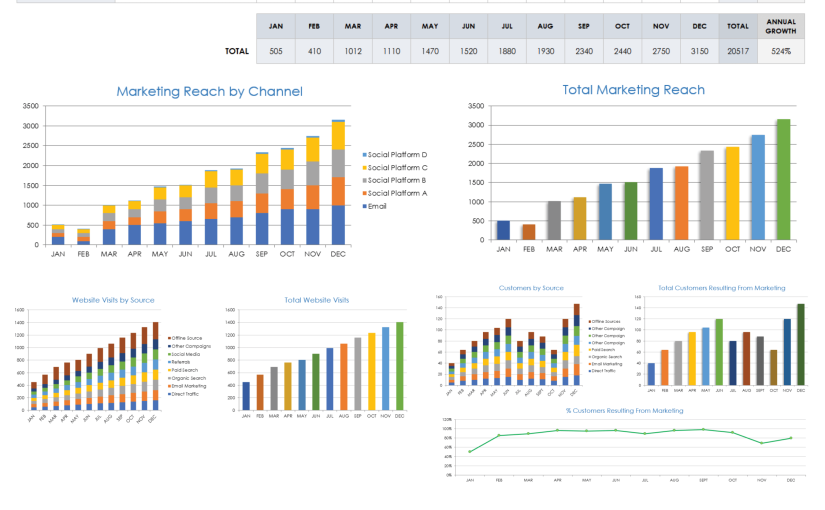
A Monthly Digital Marketing Report Template helps teams make sense of everything happening across digital channels—search, email, social, paid media, video platforms, and landing pages. What makes it especially useful is the compartmentalized view of digital behavior: impressions, clicks, conversions, drop-off patterns, device usage, and content interactions.

Digital landscapes move quickly. One month’s hero campaign can become next month’s underperformer. That’s why a structured format helps teams detect subtle shifts—like rising acquisition costs, new audience clusters gaining traction, or sudden declines in retargeting efficiency.

This kind of Monthly Marketing Report Template also helps teams evaluate their omnichannel strategy. Instead of treating every platform like an isolated island, the report connects them. Maybe email drives more high-quality leads than expected. Maybe video content indirectly lifts organic traffic. A structured digital report uncovers connections people usually overlook.

With its compartmentalized yet integrated structure, this Monthly Digital Marketing Report Template helps guide budget allocation and campaign adjustments with precision—not guesses.

Get also: Free Monthly Financial Report Template

Monthly Sales and Marketing Report Template – Shocking Alignment Blueprint for Revenue-Focused Performance

A Monthly Sales and Marketing Report Template is the bridge between two teams that often speak similar concepts with vastly different accents. Marketing talks about impressions, leads, and engagement. Sales talks about qualified opportunities, close rates, and revenue. This monthly sales report template unifies both sides into one narrative.

It highlights which marketing initiatives influence the upper funnel—and how those contributions flow into conversion activities. Sales teams get clarity on which campaigns produce the best-quality leads. Marketing teams get direct visibility into what results from their efforts downstream.

One underrated benefit is pattern discovery. For instance:

  • A specific content series might repeatedly correlate with high-quality lead generation.
  • Certain audiences might convert better across both organic and paid channels.
  • Some campaigns might overproduce volume but underdeliver quality.

This unified structure prevents miscommunication and finger-pointing. Instead, it fosters collaboration built on shared data. When both teams use the same blueprint, performance analysis becomes smoother, faster, and more objective.

Get also: Monthly Expense Report Template

Monthly Marketing Report PowerPoint Template – Secret Visual Storyboard for High-Impact Presentations

A Monthly Marketing Report PowerPoint Template transforms raw data into visually digestible information. Not every stakeholder wants to sift through spreadsheets. Executives and cross-functional leaders appreciate structured visuals—charts, funnels, indicator tiles, comparison bars, and performance snapshots.

This Monthly Marketing Report PowerPoint Template acts like a storytelling engine. It frames the narrative clearly, turning a month’s worth of marketing activity into a sequence that audiences can follow effortlessly.

A powerful layout may include:

  • A headline insights slide
  • Channel-by-channel comparison tables
  • Customer journey visualization
  • Budget allocation and return
  • Key wins and losses
  • Strategic recommendations

The beauty of a strong PowerPoint template is that it’s reusable. Instead of reformatting slides every cycle, teams simply plug in updated numbers while maintaining a consistent visual identity. This dramatically reduces production time and prevents the monthly scramble of designing slides from scratch.

In fast-moving companies, that time saved is worth as much as the insights themselves.

Pulling It All Together into an Action-Driven Framework

A Monthly Marketing Report Template is more than a worksheet or a slide deck—it’s a dependable operational rhythm. It tightens team communication, clarifies decision-making, and gives performance trends a clear home. When used consistently, it becomes the backbone of monthly planning, helping every campaign cycle become more predictable and ultimately more successful.

A strong reporting template doesn’t simply show numbers. It tells a story—one that teams can act on, executives can trust, and organizations can use to grow with purpose.

Monthly Financial Report Template – 8+ Free Unconventional Ideas

Monthly Financial Report Template – Hidden Strategies for Crystal-Clear Financial Control | A Monthly Financial Report Template isn’t just a worksheet or a neat little document tucked away in a shared drive. For many businesses, it’s the only thing standing between well-planned financial clarity and the kind of chaos where nobody knows why the marketing team spent $800 on “miscellaneous snacks.” This type of template organizes numbers, highlights spending behavior, and reveals patterns that can help any business stay grounded, especially when expenses and revenue start dancing unpredictably. By giving structure to financial data, it becomes a monthly foundation for better decisions.
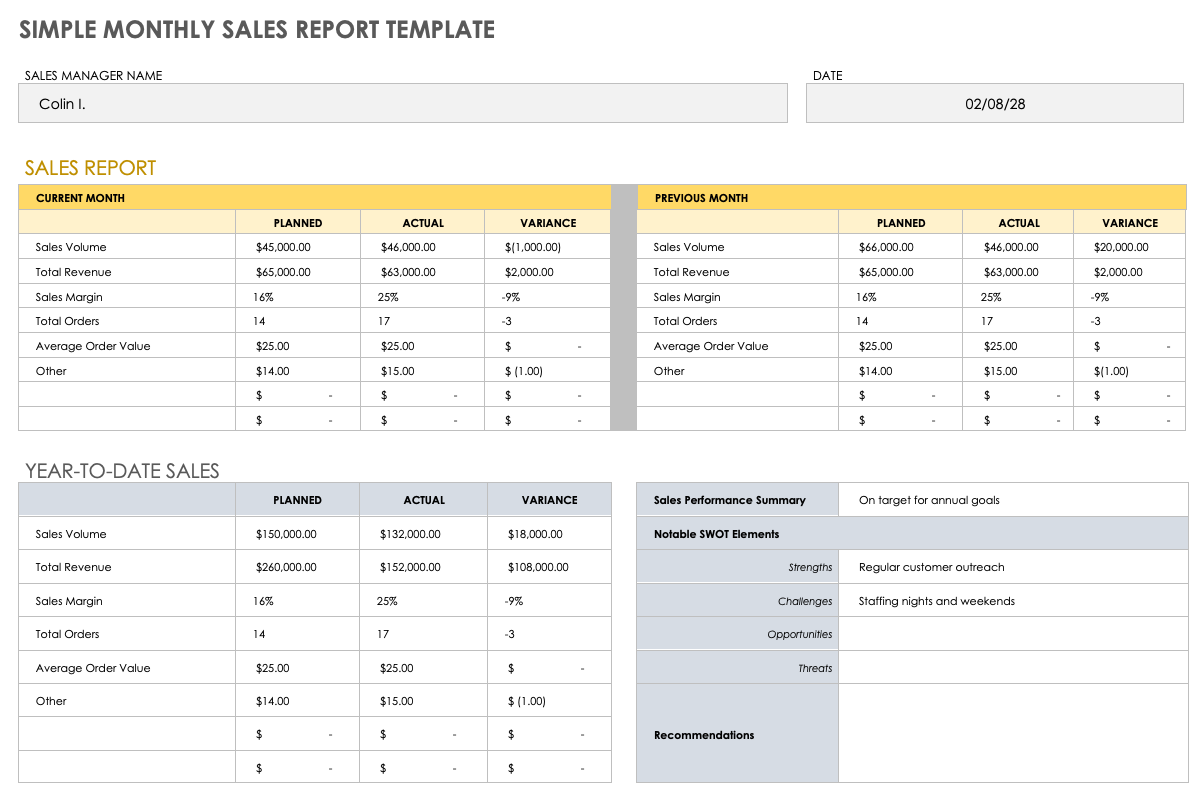
Some organizations treat their monthly financial reporting like a ritual—same time, same routine, like paying bills or pretending to understand tax tables. Others need something far more deliberate: a format that’s reliable, clean, accurate, and easy to scan when executives only have five minutes before a meeting. That’s where a Monthly Financial Report Template becomes a powerful internal tool. It keeps figures consistent across teams, departments, and months, offers transparency, and ensures everyone interprets the same numbers without ambiguity.

The true value of a structured approach isn’t just about tracking revenue and expenses. It’s about understanding why fluctuations happen. Why was revenue up last month? Why did operational costs spike? Which product line is performing unusually well, or unexpectedly poorly? Without a dependable format, these questions turn into wild guesses. With one, they turn into actionable conversations.

Let’s dive into how a structured monthly reporting framework strengthens decision-making and how different specialized templates can support more targeted financial needs.

Monthly Financial Report Template – Unexplored Advantages for Smarter Budget Management

A Monthly Financial Report Template offers a snapshot of financial health at a specific point in time. Think of it as reading vital signs during a medical checkup. Revenue is your pulse, expenses are your blood pressure, and net income is that deep breath you take when things are safely in the green. When formatted correctly, these templates simplify complex calculations and create a system that helps teams compare performance from month to month without diving back into raw numbers.

A dependable Monthly Financial Report Template usually starts with revenue categories—products, services, subscriptions, or operational income—followed by fixed and variable expenses. It ends with net profit, loss, or break-even outcomes. The goal is clarity. Numbers that speak for themselves. Figures that don’t trigger confusion or require frantic searching through spreadsheets.

Another benefit is repeatability. A consistent Monthly Financial Report Template means teams don’t improvise each cycle. They know what they’re filling out, what goes where, and how totals are calculated. This reduces mistakes while allowing managers to focus on interpreting the data, not hunting for it.

Templates also help identify financial leaks. A spike in administrative expenses? A pattern of rising software costs? An unexpected drop in revenue from a specific segment? These insights become far easier to notice when the data lives inside a predictable structure. With clear month-to-month comparisons, small issues are detected early—before they grow into large ones.

Businesses with multiple departments benefit even more. When each team reports using the same structure, consolidating data becomes effortless. Finance isn’t forced to decipher mismatched formats or retype numbers because someone decided to “get creative” with their reporting layout.

The best part? A good reporting structure encourages accountability. When numbers are transparent and easy to interpret, teams naturally become more aware of how their actions affect overall financial outcomes. It inspires thoughtful spending, deliberate planning, and realistic forecasting.

Supporting Tools and Specialized Uses for Monthly Reports

Some organizations need more than a general reporting template—they need supplementary formats tailored for specific financial roles. These formats dig into specialized data, offering deeper insights for more targeted workflows. This is where secondary Monthly Report Templates become valuable tools to support the broader monthly reporting system.

Below are three essential types of supporting templates, each offering different functions depending on the business model and reporting needs.

Get also: Monthly Status Report Template

Monthly Expense Report Template – Unbelievable Breakdown for Precise Cost Tracking

A specialized Monthly Team Expense Report Template can support internal departments by highlighting how teams use budgets month by month. Although businesses generally rely on a primary financial report, this secondary breakdown shows where each department invests resources—and how efficiently they operate within their allocated budget.

A Monthly Expense Report Template helps businesses categorize spending with extraordinary clarity. While the general financial report highlights totals, this template zooms in on individual expenses, documenting where money flows each month. It highlights patterns that might otherwise hide inside aggregated totals.

For example, if a company notices operational costs rising, the expense report can show whether the cause is travel, utilities, software, outsourced services, or unplanned purchases. Teams can also attach notes explaining why certain expenses occurred—useful when managers review unexpected costs.

This format is especially valuable for organizations where multiple employees or departments make monthly purchases. Instead of relying on memory or last-minute guesses, the expense template becomes a structured log that minimizes errors and suspicious “accidental” overspending. It creates complete visibility across categories and helps forecast future expenses with surprising accuracy.

This Monthly Financial Report Template also prevents miscommunication. When financial questions arise, teams aren’t left scrambling to justify numbers—they can rely on a documented, structured breakdown that reinforces responsibility and clarity.

Another advantage is reimbursement management. Employees often struggle to recall minor purchases, such as office supplies, fuel, training materials, or small subscriptions. Logging these in a Monthly Expense Report Template prevents receipts from getting lost and gives finance departments the documentation they need to process reimbursements without delays.

Get also: Free Monthly Marketing Report Template

Monthly Treasurer Report Template – Classified Insights for Transparent Financial Stewardship

A Monthly Treasurer Report Template is commonly used in nonprofits, clubs, associations, and community-based groups. It offers a deeper look at inflows, outflows, balances, and designated funds. The treasurer doesn’t just track money—they oversee the stewardship of collective resources. This template helps maintain transparency in ways that general corporate reports rarely provide.

Many organizations rely on donations, fees, or fundraising. These income sources need precise tracking. How much came in from dues? How much was spent on events, supplies, or maintenance? How much remains allocated for upcoming programs? The treasurer’s report organizes all of this without ambiguity.

This structure builds trust. Members, volunteers, and stakeholders want reassurance that funds are used responsibly. When finances are presented clearly and consistently, everyone feels confident about the organization’s management. With this level of clarity, issues like unauthorized spending, overlooked income, or accidental double-charging become far less likely.
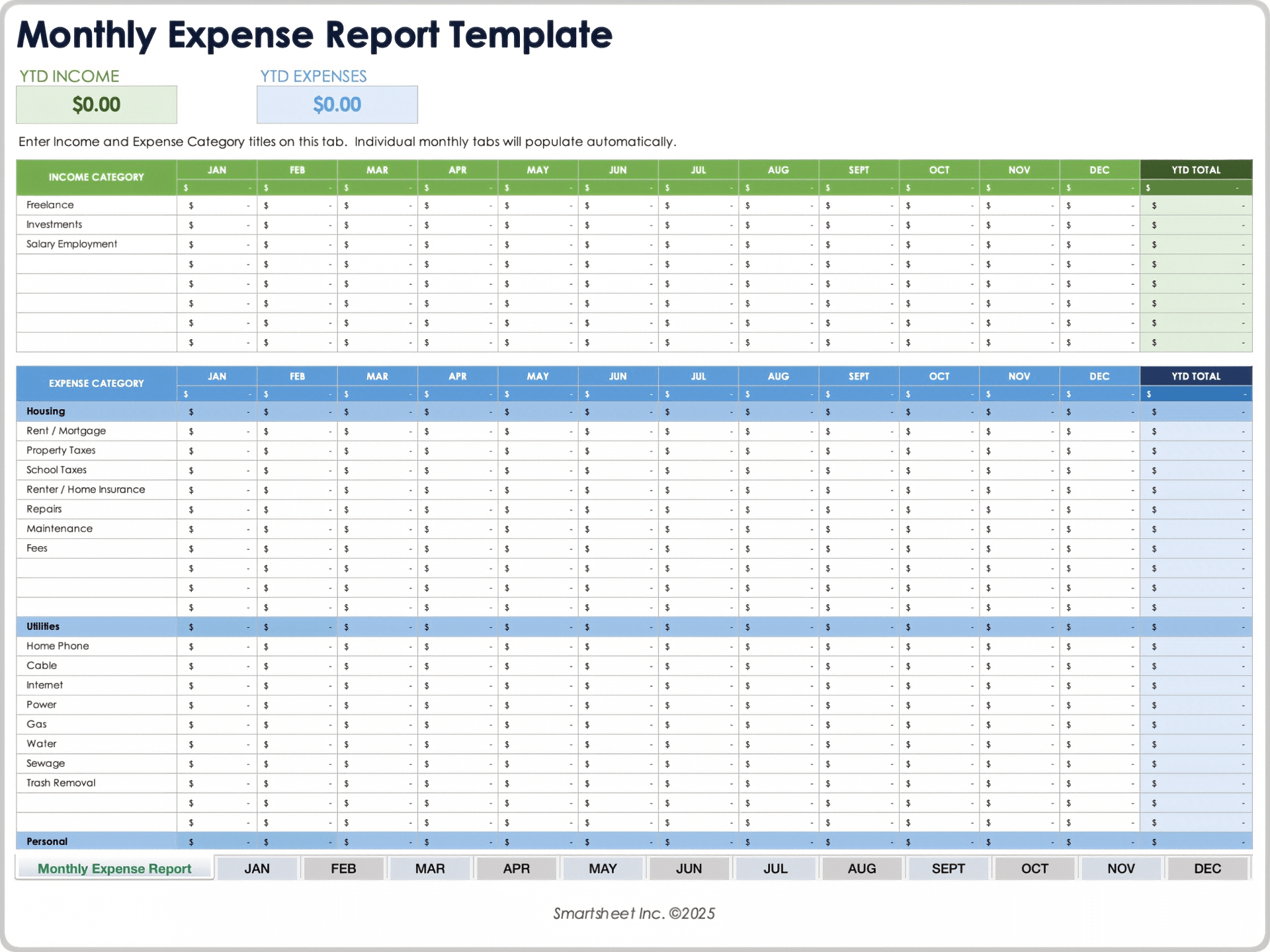
Another strength of this format is the ability to track restricted versus unrestricted funds. Some contributions come with rules—they can be used only for specific programs or purposes. A Monthly Treasurer Report Template keeps these distinctions separated so compliance becomes automatic.

Final Thoughts on Using Monthly Financial Report Templates Effectively

A strong monthly reporting structure does more than organize numbers. It introduces a rhythm—a predictable pattern that keeps teams aligned. Businesses that adopt a reliable Monthly Financial Report Template notice improvements not only in clarity but also in decision-making, accountability, and forward planning.

The secret is consistency. When data lives inside an organized format, trends become easier to interpret. Budget strategies become smarter. Teams collaborate with more confidence. And financial conversations shift from debates to solutions.

With specialized templates supporting the main monthly report—expense logs, treasurer insights, team-based spending breakdowns—organizations gain a complete financial ecosystem that works together seamlessly.

If you’re building a reliable foundation for financial clarity, adopting these structures isn’t just useful—it’s transformative. Let the numbers tell their story each month, and the decisions that follow will naturally grow sharper, stronger, and more aligned with long-term goals.

Monthly Report Template for 2026 Smarter Business Tracking

Monthly Report Template – Hidden High-Impact Insights for Smarter Business Tracking | A Monthly Report Template can easily become one of the most underrated tools inside any organization, sitting quietly in a folder while everyone rushes around looking for updates, numbers, summaries, and explanations.

Yet this simple document is often the backbone of decisions, budget approvals, performance evaluations, and long-term planning. It keeps communication structured, information reliable, and team efforts aligned. And when crafted thoughtfully, it can transform a jumble of monthly activities into a streamlined, meaningful narrative that leaders can actually use.

A good template doesn’t overwhelm readers with a wall of text, nor does it drown them in colourful charts with no context. Instead, it organizes data into digestible categories so stakeholders can quickly assess trends, identify gaps, and respond to issues before they escalate. Think of it as the monthly equivalent of tidying up your house—you don’t move the furniture every day, but once a month, everything gets refreshed and realigned.

Businesses, big and small, rely on a uniform reporting system to stay consistent. A structured Monthly report template gives teams the confidence to communicate clearly while reducing the chance of missing details. It also cuts preparation time, because no one enjoys starting a report from scratch each month—unless they’re powered exclusively by caffeine and misplaced optimism. With a reusable, polished layout, teams can focus on the content instead of the formatting.

In the sections below, you’ll find what makes this template invaluable, how organizations apply it across different functions, and why it works as a foundation for financial updates, marketing activities, and sales performance. Most importantly, it can adapt to a variety of work styles, fields, and business structures without becoming messy or complicated.

Monthly Report Template – Limited Breakdown of Structure and Function

A powerful Monthly report template typically begins with a clear overview summarising the entire month. This high-level section is like the trailer of a movie—short, engaging, and packed with the most relevant highlights. It immediately gives stakeholders the big picture, including milestones achieved, setbacks faced, and priorities for the upcoming month.

After the overview, the Monthly Report Template often moves into key categories such as project updates, team progress, financial insights, workflow performance, challenges encountered, and forward-looking plans. Using consistent sections each month makes analyzing trends easier, especially when teams compare past cycles to track improvements. It’s similar to monitoring your fitness progress; one monthly snapshot doesn’t mean much, but several months of organized results reveal valuable patterns.

A well-designed Monthly Report provides a predictable structure. People know where to find financial details. They know where project updates are. They know where risks are flagged. This reduces confusion and keeps reports laser-focused. And while some managers prefer reports so short they could fit on a sticky note, others love detailed breakdowns that rival full documentaries—this Monthly Report Template supports both by offering adjustable sections without sacrificing clarity.

Designed thoughtfully, this report template ensures every part of the business stays accountable without making reporting feel like a punishment. Tasks become traceable, performance becomes measurable, and communication becomes consistent. In short, the template becomes a monthly ritual that clarifies the organization’s direction rather than complicating it.

Strategic Applications and Adaptability Across Business Functions

A single Monthly report template can stretch across multiple departments because each team can adapt the structure to highlight their specific contributions. Finance professionals might focus on revenue trends and expenditure patterns. Marketing teams may emphasize campaign performance, engagement metrics, and content output. Sales groups zero in on pipeline growth, conversions, and customer behaviours.

Despite their differences, every department benefits from the template’s consistent reporting flow. It helps unify communication styles so executives can quickly move from one section to another without requiring a translator. The ability to integrate numbers, narratives, and action steps in a cohesive format makes the template universally valuable.

Below are three powerful extensions of the Monthly report template, each represented by a structured sub-template that focuses on a different business area.

Get also: Annual Marketing Report Template Free Download

Monthly Financial Report Template – Extraordinary Framework for Smarter Budget Tracking

A monthly financial report template allows decision-makers to understand exactly how money moves across the organization. It organizes financial data into sections such as revenue streams, cost analysis, recurring expenses, operational budgets, liquidity updates, and profitability evaluations. Without a clean template, financial updates can quickly turn into an avalanche of spreadsheets that nobody wants to sift through unless they’re being bribed with snacks.

This type of financial report template often includes visuals such as bar charts, line graphs, and performance indicators that change month to month. However, the true value lies in the narrative context that accompanies these numbers. Data without explanation is like a puzzle without edges—it’s harder to see the bigger picture. The financial template resolves this by encouraging brief commentary under each section to clarify trends and highlight anomalies.

By using the same template consistently, businesses can detect patterns like seasonal fluctuations, cost escalations, or unexpected dips before they become major issues. For example, if expenditures rise steadily for three consecutive months, leaders can act proactively rather than reactively. Conversely, strong revenue performance can guide investment decisions or early expansion plans.

This Monthly Report Template also works well for cross-functional collaboration. Finance teams aren’t the only ones interested in the numbers; operations teams use the insights to plan resources, marketing teams adjust budgets for upcoming campaigns, and leadership teams use the overview to shape strategic directions. Everything becomes easier to interpret when numbers are presented in a coherent, structured manner.

Monthly Marketing Report Template – Stunning High-Impact Lens for Campaign Evaluation

A monthly marketing report template dives into performance indicators that reveal how well ongoing campaigns, content strategies, and audience outreach efforts are working. It captures social engagement, lead generation, traffic patterns, content output, advertising impact, and audience behaviour—all in a layout that is both informative and easy to skim.

Without a structured monthly marketing template, updates can become chaotic. Numbers get scattered across different tools, anecdotes get mixed with performance data, and trying to understand which campaign actually worked feels like decoding an ancient text. A consistent monthly template prevents this confusion by keeping marketing evaluations organized and actionable.

One major strength of this Monthly Report Template is its focus on long-term patterns rather than short-lived spikes. Monthly intervals give marketing teams enough data to identify meaningful behaviours—such as which platforms consistently bring in leads, which campaigns generate the most conversions, or which content formats are gaining traction.

This Monthly Marketing Report Template also helps teams align their storytelling across channels. Marketing isn’t just numbers; it’s the art of understanding what resonates with audiences. Monthly snapshots reveal the relationship between strategies and outcomes, helping teams refine their approach. Whether it’s assessing creative output, evaluating partnerships, or planning the next quarter’s activities, the template ensures no detail gets lost.

Ultimately, it helps marketing teams communicate their value clearly, which is especially important when the rest of the organization still thinks “posting memes online” is their main job.

Get also: Weekly Report Template Free Printable

Monthly Sales Report Template – Uncharted Insight for Stronger Revenue Momentum

A monthly sales report template highlights how effectively the sales pipeline moves over the course of a month. It structures updates on lead acquisition, conversion rates, product performance, customer engagement, territory management, and revenue forecasts. Without a clear template, sales reports risk looking like a collection of numbers pulled from random places—probably because they are pulled from random places.

This Monthly Report Template eliminates inconsistencies by offering a unified reporting style. Every metric sits in its designated section, making it easy for managers to compare performance among individuals, teams, or territories. And because sales cycles often shift quickly, a monthly breakdown helps leaders catch early signs of momentum or slowdown.

The narrative portion of this template also encourages teams to highlight opportunities and challenges. For example, if the sales cycle lengthens unexpectedly, teams can dig deeper to identify trends in buyer hesitation. If a specific product suddenly gains traction, managers can focus on expanding availability or launching targeted campaigns.

What makes this template especially impactful is its forward-looking section. After showcasing the results of the current month, it naturally transitions into next-step planning—such as strategies for reaching upcoming targets, opportunities that emerged recently, or areas requiring improvement. This helps sales teams maintain a consistent direction even during volatile cycles.

Across industries, this template remains one of the most versatile. Whether used in real estate, retail, B2B services, SaaS companies, or distribution networks, the structure helps transform raw performance data into meaningful insights that support confident decision-making.

Final Thoughts on Using the Monthly Report Template Effectively

The Monthly report template functions as a communication bridge connecting every team in the organization—finance, marketing, sales, operations, and beyond. With structured sections, clear breakdowns, and predictable formatting, it ensures everyone stays aligned while reducing the time needed for preparation and review.

When used consistently, it becomes a powerful tool for trend analysis, risk identification, performance evaluation, and strategic planning. It keeps all departments accountable, organized, and moving in the same direction, even when priorities shift or new projects emerge unexpectedly.

A strong reporting system doesn’t just document what happened; it clarifies what must happen next. And that’s the true value of a Monthly report template: it turns scattered updates into a coherent narrative that supports smarter decisions month after month.

Weekly Sales Activity Report Template – 10+ BEST Fillable Forms

Weekly Sales Activity Report Template – Proven High-Impact Framework for Better Sales Momentum | A Weekly sales activity report template can completely shift how sales teams understand their progress, spot obstacles early, and keep opportunities moving instead of gathering digital dust in a CRM no one opens. Whether the goal is to track volume, measure quality, or keep leaders updated without endless meetings, a well-built structure turns scattered activity into a clear narrative. With the right template, sales teams can move from “I think things are going well” to “Here’s exactly what’s happening, what’s improving, and what needs attention.”

The power of a consistent reporting routine isn’t only in its neat columns and segments—it’s in how it sharpens decision-making. It reduces the guesswork that typically creeps into weekly planning, and it keeps teams aligned on deals that matter. Even the busiest reps benefit from a layout that captures the essentials without slowing them down.

Below is a full breakdown of how a Weekly sales activity report template supports clarity, accountability, and faster workflows—all while keeping things practical, realistic, and easy to apply to real sales operations.

Weekly Sales Activity Report Template

A Weekly sales activity report template creates a central structure for summarizing what actually happened throughout the week: calls made, emails sent, meetings held, deals advanced, obstacles encountered, and pipelines updated. It’s not meant to be a novel; it’s meant to capture impactful activity in a clean, structured way that decision-makers can absorb quickly.

A Streamlined View of Weekly Momentum

Busy sales teams don’t need extra work—they need better visibility. A well-formatted weekly sales activity outline highlights the right patterns: how many leads were contacted, how prospects responded, what moved forward, and what stalled. When the information is consistent each week, patterns become easier to interpret. You don’t just see activity—you see momentum.

Clarity that Minimizes Repeated Questions

A clear template reduces repetitive check-ins between managers and reps. Instead of “How’s the Johnson account going again?” every detail is summarized in a clean, predictable structure. It eliminates ambiguity and keeps everyone synced.

Better Prioritization for The Following Week

Not all prospects need equal attention. Some are slow burners, some are red-hot opportunities, and some need a polite follow-up so they don’t ghost into the abyss. A structured Weekly Sales Report helps salespeople prioritize based on progress, interest levels, and upcoming deadlines. It makes next week’s planning significantly easier and sharper.

General Supporting Section

Sales isn’t just about hitting numbers; it’s about hitting them with control. And control comes from understanding patterns. A weekly update provides tight visibility over closing rates, lead quality, activity depth, and engagement levels. That means no more surprises late in the quarter, no more scrambling at the end of the month, and far fewer “How did we miss this?” moments.

Alongside activity summaries, a good Weekly Sales Activity Report Template tracks trends—like whether conversations are improving, whether follow-ups are consistent, and whether customer behavior is signaling readiness or hesitation. It also enables quick comparison with previous weeks, making wins easier to understand and issues easier to diagnose.

Below are the three essential variations of weekly sales reporting structures, each serving a unique purpose while sharing a consistent backbone of clarity, visibility, and actionable detail.

Weekly Sales Call Report Template – Essential Format for Stronger Client Engagement

A Weekly sales call report template focuses specifically on call activity—a core part of many sales operations. It pinpoints the conversations that drive revenue and clarifies which interactions had real traction. Calls aren’t just numbers; they’re opportunities to understand the client’s problems and move deals forward.

A strong call-focused Weekly Sales Call Report Template logs details like:

  • Number of outbound calls
  • Number of inbound calls
  • Length and quality of discussions
  • Key objections raised
  • Follow-up actions scheduled
  • New opportunities identified
  • Deals influenced by call activity

This structure is invaluable for teams that rely heavily on voice-based communication, such as B2B enterprise sales, retail partnerships, technology solutions, and service-based providers.

Insight into Conversation Quality

Not all calls are equal. Some end with a prospect genuinely excited; some end with you wondering if they muted you for 20 minutes. This format highlights the meaningful parts of conversations—did the prospect express intent? Did they share a timeline? Did they reveal pain points that can shape your pitch?

These insights are the foundation of stronger follow-ups. When call notes are consistent, you don’t have to rely on memory or sift through messy CRM logs. Everything is laid out simply.

Predictable Follow-up Processes

A good weekly call report template naturally guides reps toward better follow-up discipline. If calls are documented with expected next steps, the week ahead becomes clearer. Deals move faster because conversations don’t “cool down” due to unclear planning.

Weekly Sales Performance Report Template – Powerful Structure for Tracking Measurable Wins

A Weekly sales performance report template focuses on results: conversions, revenue progression, pipeline movement, and the measurable impact of sales activities. It summarizes the week’s achievements in a way that leaders can evaluate instantly.

A performance-focused Weekly Sales Performance Report Template typically includes:

  • Deals closed
  • Revenue booked
  • Pipeline progression
  • Opportunities created
  • Conversion rate snapshots
  • Lost deals and reasons
  • Win/loss ratio trends
  • Individual/team highlights

This structure is ideal for leadership reviews and deeper evaluations of what’s driving growth.

Turning Data into a Direction

Seeing performance indicators weekly helps sales teams stay proactive rather than reactive. For instance, if conversion rates dip for two consecutive weeks, it signals a deeper issue—lead quality, value positioning, competitor influence, or negotiation challenges.

When these metrics are consistently tracked, teams can adjust strategies quickly instead of waiting until the end of the month or quarter.

Transparency that Empowers Teams

Instead of feeling micromanaged, reps get clarity. They see exactly how their efforts translate into measurable outcomes. When performance insights are clear, coaching becomes more supportive rather than corrective. It turns leadership into collaboration.

Weekly Sales Status Report Template – High-Impact Layout for Clear Pipeline Visibility

A Weekly sales status report template focuses on the health and progress of the sales pipeline. It answers the big question: Where do all active deals stand right now, and what must happen next?

A good status-focused Weekly Status Report Template includes:

  • Active opportunities
  • Stage of each deal
  • Estimated close date
  • Value of each opportunity
  • Stakeholders involved
  • Action items
  • Roadblocks or delays
  • Probability of closing

This layout grounds the team in reality, showing exactly what’s moving and what needs a push.

Predictable Forecasting

A well-tracked status report strengthens forecasting accuracy. Instead of relying on gut feeling, teams have clear indicators of deal velocity and likelihood. This clarity can shape resource allocation, goal setting, and sales planning.

Faster Identification of Bottlenecks

Deals get stuck for many reasons—delayed replies, procurement holdups, internal approvals, unclear pricing, or simply a prospect getting distracted by a cat video. This structure identifies roadblocks early, so salespeople can intervene instead of waiting for a deal to stall completely.

Bringing It All Together with a Weekly Sales Activity Report Template

A Weekly sales activity report template isn’t just documentation—it’s a structured rhythm that supports accountability, clarity, and alignment across the sales team. When reporting becomes predictable and consistent, patterns emerge. Busy weeks, slow weeks, high-quality interactions, stalled opportunities—they become visible, measurable, and actionable.

The three variations—call-focused, performance-focused, and status-focused—integrate naturally into a comprehensive weekly routine. Each version highlights different parts of the sales cycle, but together they create a complete picture. Leaders get visibility, reps get direction, and the entire team gets a shared understanding of progress.

More importantly, it fosters smarter planning. When salespeople know exactly what happened the previous week, they can prioritize better for the upcoming one. Instead of reacting to problems, they anticipate them. Instead of guessing which deals matter, they see it clearly. Instead of hoping their activity aligns with targets, they track it with confidence.

Whether used in small teams or large organizations, this kind of Weekly Sales Activity Report Template supports clarity, alignment, and continued momentum—core ingredients for consistent success in any sales environment.

Exit mobile version