Marketing Report Template (9+ BEST Strategic Formats)

Marketing Report Template usage is essential for translating marketing activity into clear, actionable insight. As marketing efforts become more complex and data-driven, structured reporting helps teams understand what is working, what needs adjustment, and where resources should be focused next.

Without a consistent reporting format, marketing data often becomes fragmented, difficult to interpret, and disconnected from objectives. A well-designed template provides structure, consistency, and clarity—turning raw data into meaningful performance narratives.

What Is a Marketing Report Template?

A Marketing Report Template is a structured document used to summarize marketing activities, results, and insights over a defined period. It presents key information in a clear, organized format that supports evaluation, communication, and decision-making.

Marketing reports typically aim to:

  • Track campaign performance
  • Measure progress against objectives
  • Identify trends and insights
  • Communicate results to stakeholders
  • Support planning and optimization

By standardizing how information is presented, reporting becomes more efficient and easier to compare over time.

Why Structured Marketing Reporting Matters

Marketing generates large volumes of data, but data alone does not create value. Structure is what turns numbers into understanding.

Using a Marketing Report Template helps teams:

  • Focus on relevant metrics
  • Maintain consistency across reporting periods
  • Reduce misinterpretation of results
  • Improve accountability and transparency
  • Support informed decision-making

Clear reporting aligns marketing activity with broader business goals and expectations.

Core Components of an Effective Marketing Report

While formats vary by purpose and audience, effective marketing reports share several key elements.

Reporting Period and Objectives

This section defines the timeframe covered and outlines the goals the marketing activity aimed to achieve.

Campaign or Channel Overview

Summarizes the main initiatives, channels, or campaigns included in the report.

Performance Metrics

Key indicators are presented clearly to show progress and outcomes.

Insights and Observations

This section explains what the results mean and highlights notable patterns or trends.

Challenges and Learnings

Document issues encountered and lessons gained during execution.

Next Steps and Recommendations

Every Marketing Report should guide future action, not just describe past performance.

Types of Marketing Report Templates by Reporting Frequency

Different reporting cycles serve different purposes. Below are the most commonly used formats based on timeframes.

Monthly Marketing Report Template for Consistent Performance Review

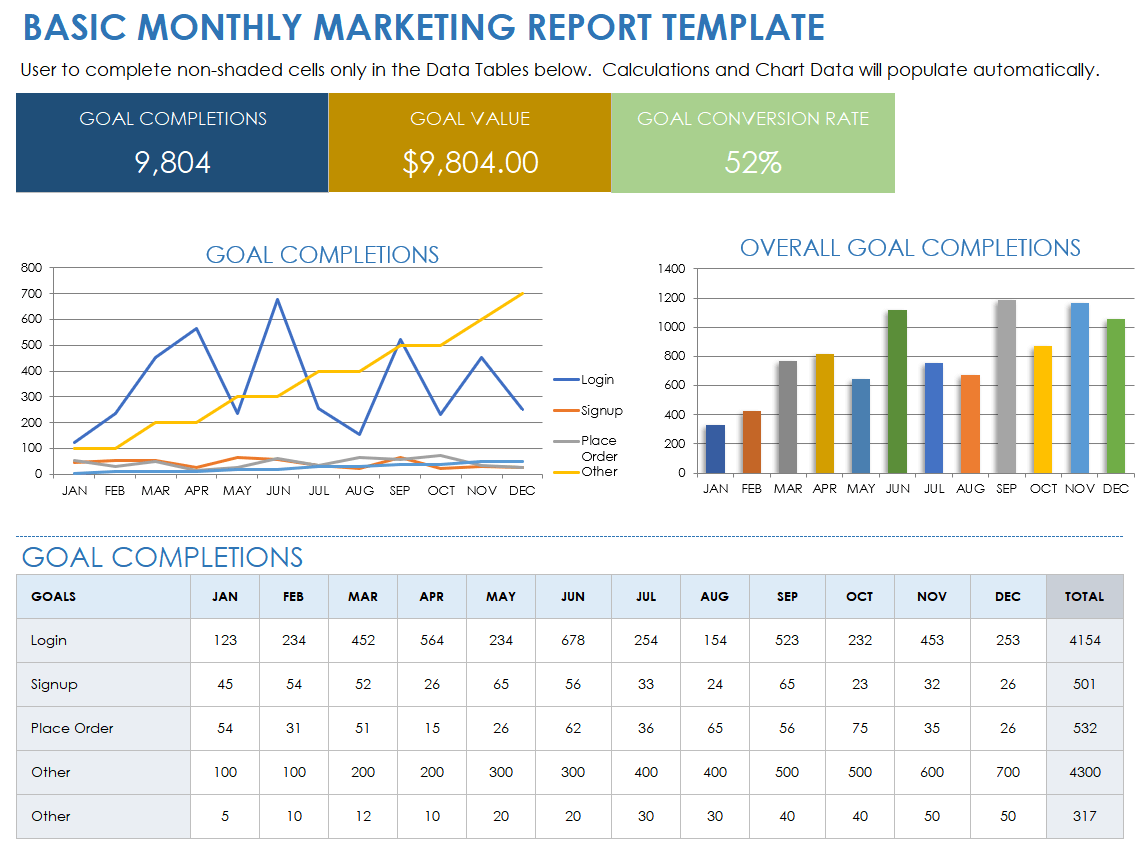
A Monthly Marketing Report Template for Structured Performance Evaluation provides a balanced view of short-term results and emerging trends.

This format is commonly used to:

  • Compare performance month over month
  • Track progress toward quarterly goals
  • Identify channels or campaigns needing adjustment

Monthly reports offer enough data for meaningful analysis without overwhelming detail.

Weekly Marketing Report Template for Tactical Execution Tracking

A Weekly Marketing Report Template for Agile Execution Oversight focuses on immediate activity and short-term outcomes.

This format typically includes:

  • Weekly campaign updates
  • Key performance snapshots
  • Issues or blockers
  • Priorities for the next week

Weekly reporting supports fast-paced environments where quick adjustments are critical.

Get also: Consulting Report Template

Specialized Marketing Report for Different Needs

Beyond frequency-based reports, marketing teams often use specialized formats tailored to specific objectives.

Digital Marketing Report Template for Multi-Channel Performance Clarity

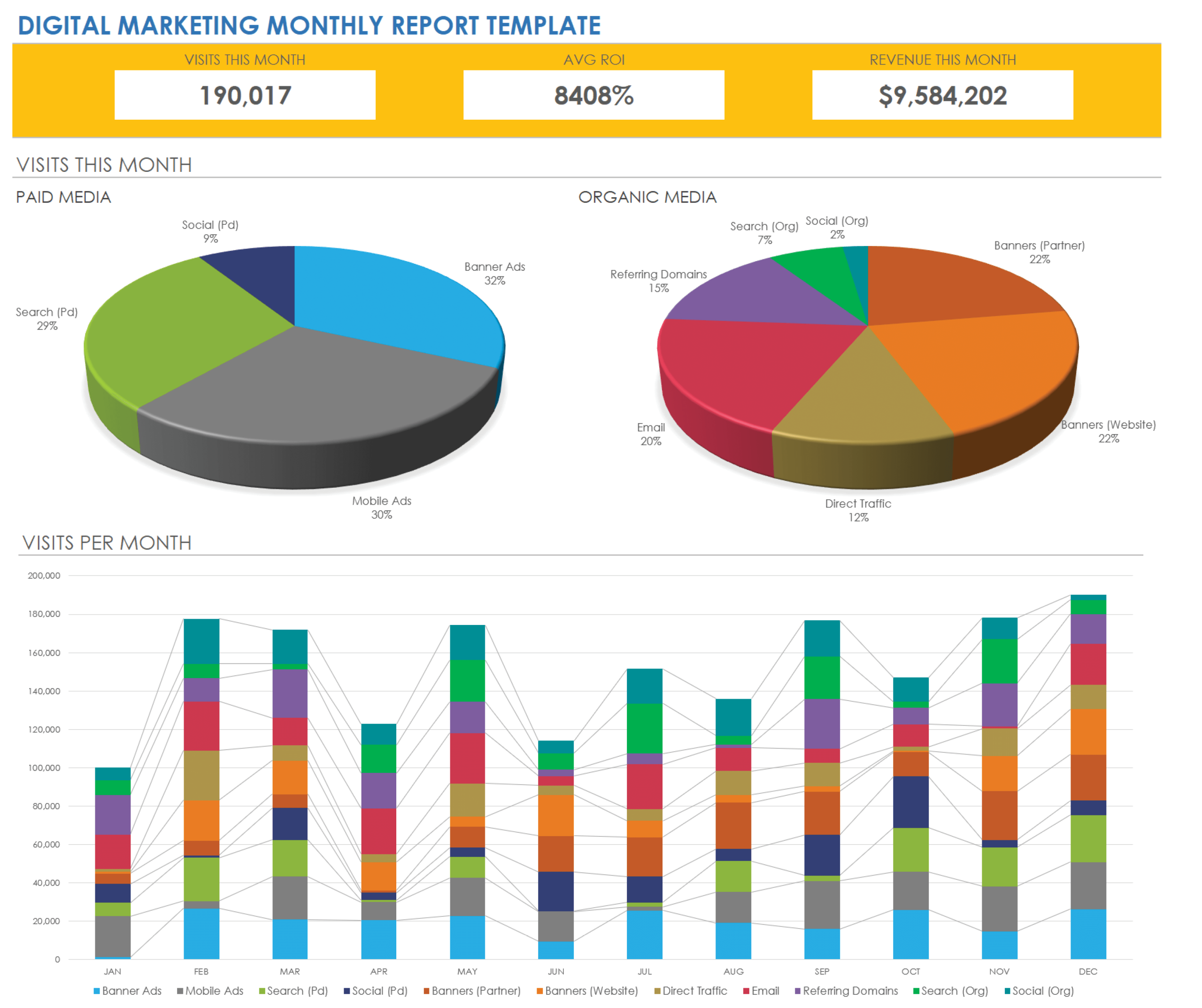
A Digital Marketing Report Template focuses on online campaigns and digital touchpoints.

It commonly covers:

  • Channel-level performance
  • Campaign outcomes
  • Engagement and conversion trends
  • Budget allocation and efficiency

This format helps teams understand how digital initiatives perform collectively and individually.

Choosing the Right Marketing Report Template

Selecting the right template depends on several factors:

  • Reporting audience
  • Decision-making needs
  • Level of detail required
  • Reporting frequency

A Marketing Report Template should be detailed enough to inform decisions, yet concise enough to be reviewed efficiently.

Reports that are too complex risk being ignored, while overly simple reports may lack actionable insight.

Adapting Marketing Reports for Different Stakeholders

Marketing reports are most effective when tailored to their audience.

Executive-Level Reporting

Executives value summaries, insights, and implications rather than granular detail.

Management and Team Reporting

Managers and teams benefit from operational detail, performance drivers, and next steps.

Client or External Reporting

External audiences require clarity, transparency, and alignment with agreed objectives.

A flexible Marketing Report allows for content adjustment without losing structural consistency.

Common Mistakes in Marketing Reporting

Even experienced teams can reduce report effectiveness through common errors, such as:

  • Reporting metrics without context
  • Overloading reports with unnecessary data
  • Ignoring insights and recommendations
  • Changing the report structure frequently

Strong reporting emphasizes clarity, relevance, and interpretation.

Best Practices for Creating High-Quality Marketing Reports

To maximize reporting value:

  • Align metrics with objectives
  • Focus on insights, not just numbers
  • Use consistent formatting
  • Highlight trends and implications
  • End with clear next steps

A well-crafted Marketing Report turns reporting into a strategic asset rather than an administrative task.

Using Marketing Reports to Improve Strategy and Execution

Marketing reports should inform action. When reviewed consistently, they help teams:

  • Identify high-performing initiatives
  • Address underperforming areas
  • Allocate resources more effectively
  • Improve planning accuracy

Over time, historical reports create a performance baseline that supports smarter strategy development.

Integrating Marketing Reports into Planning Cycles

Marketing reports are most valuable when integrated into regular planning and review processes.

They often feed into:

  • Campaign planning sessions
  • Budget reviews
  • Quarterly strategy discussions
  • Performance evaluations

A consistent Marketing Report Template ensures continuity across these cycles.

Long-Term Benefits of Standardized Marketing Reporting

Organizations that adopt structured marketing reporting gain:

  • Improved visibility into performance
  • Stronger alignment across teams
  • Faster decision-making
  • Greater accountability
  • Clearer performance documentation

Over time, reporting becomes a foundation for continuous improvement.

Marketing, Reporting, and Organizational Alignment

Clear reporting creates shared understanding. When everyone reviews performance using the same structure, alignment improves naturally.

A strong Marketing Report ensures that discussions focus on insights and actions rather than debating data interpretation.

Evolving Marketing Reports as Teams Mature

As marketing capabilities grow, reporting should evolve accordingly.

Early-stage teams may focus on activity tracking, while mature teams emphasize:

  • Comparative analysis
  • Trend identification
  • Strategic implications

Templates should adapt without losing consistency.

Conclusion

A Marketing Report Template is a critical tool for organizing marketing data, communicating performance, and supporting informed decision-making. By providing structure and clarity, it transforms marketing activity into actionable insight.

Whether using a Digital Marketing Report Template for Multi-Channel Performance Clarity, a Monthly Marketing Report Template for Consistent Performance Review, or a Weekly Marketing Report Template for Tactical Execution Tracking, the right format ensures that marketing results are visible, understandable, and meaningful.

When applied consistently, marketing reporting strengthens execution, improves alignment, and drives smarter, more confident marketing decisions.
Monthly Marketing Report Template – 7+ Best References

Monthly Marketing Report Template – Stunning Insider Breakdown for Clearer Results | A Monthly Marketing Report Template can feel like the difference between navigating with a GPS or relying on the stars—sure, both can eventually get you somewhere, but one of them doesn’t require guessing constellations or pretending you’re an ancient sailor. A well-designed template gives teams clarity, alignment, and visibility into what’s working, what’s wasting budget, and what needs immediate fixing before it turns into the office version of a sinking ship.

Modern marketing moves quickly. Campaigns shift, audiences respond (or don’t), and trends evolve almost overnight. A structured monthly reporting tool ensures every team—growth, content, sales, social, paid media, analytics—can understand the story behind the numbers. And more importantly, act on it. That’s where a Monthly Marketing Report Template becomes an essential piece of operational gear, offering consistency, accuracy, and a reliable format that keeps everyone from interns to executives on the same page.

Below is a deeper, structured dive into what makes a strong reporting framework, how it actually functions in practical scenarios, and why a dependable template turns monthly chaos into an organized narrative that teams can use to improve performance every cycle.

Monthly Marketing Report Template – Hidden Advantages That Transform Your Workflow

A Monthly Marketing Report Template does more than simply store metrics. It frames them. It guides interpretation. It prevents scattershot reporting that mixes vanity metrics with irrelevant details. And unlike ad-hoc presentations that feel like last-minute patchwork, a repeatable template forms a predictable rhythm that leadership trusts.

The value begins with consistency. When every month uses the same format, performance trends become easier to spot. Instead of flipping between mismatched spreadsheets and random PowerPoint slides, the template connects content performance, channel progression, traffic sources, revenue contribution, and customer behavior in one narrative. The end result is clarity. Not the vague “we think things are going okay” clarity, but concrete, structured visibility.

A marketing report template also improves accountability. People are less likely to hide weak performance beneath walls of unrelated data when the structure forces measurable transparency. It becomes clear which campaigns are thriving, which experiments are stagnating, and which channels are quietly draining budget in the background like a subscription forgotten on a credit card.

The hidden magic? Time saved. Nobody wants to spend the first week of the new month wrestling with scattered analytics tabs. With a solid template, much of the process becomes rinse-and-repeat—update data, compare results, summarize insights, recommend next steps.

Practical Use Cases That Prove Its Importance

There’s no single marketing team that doesn’t benefit from organized monthly reporting, but a few environments stand out:

Growing companies
They need predictable communication between departments. Reporting templates prevent misalignment as teams scale.

Agencies
Clients love clarity. They love understanding where their money goes even more. Templates help agencies deliver polished updates that inspire confidence.

In-house performance teams
Paid search, paid social, and growth channels move fast. Monthly reports help spot patterns too subtle to catch day-to-day.

Content and social teams
Monthly Marketing Report Templates give them visibility into how their campaigns actually contribute to conversions and revenue, not just likes and impressions.

Sales-led organizations
A monthly marketing structure helps bridge the communication gap between marketing efforts and pipeline outcomes.

No matter the team structure, the Monthly Marketing Report Template acts like a compass—quiet, consistent, and always pointing in the right direction.

What Strong Monthly Marketing Reports Usually Contain

A strong Monthly Marketing Report Template typically uses a narrative flow. It doesn’t just dump charts onto a page. It walks readers through performance step by step.

1. Summary Overview
A concise snapshot summarizing the biggest wins, challenges, and notable changes across the marketing landscape for that month.

2. Goals vs. Outcomes
Metrics only have meaning when placed in context. This section aligns planned objectives with actual results.

3. Channel Performance Breakdown
Traffic sources, paid media results, content engagement, email performance, social outcomes, and more.

4. Budget Allocation & Efficiency
Shows where money went, what it returned, and which campaigns delivered the best ROI.

5. Audience Behavior Trends
Shifts in user engagement, demographics, and customer patterns.

6. Campaign Highlights & Learnings
List high-impact actions and the reasoning behind future course corrections.

7. Recommendations for the Next Month
Data-backed direction that helps leadership make smarter decisions.

Every element works together to tell a cohesive story. Not a random collage.

Why Teams Rely on This Template Month After Month

Marketing reports can be dull. It’s true. But when a Monthly Report Template is designed well, it becomes far more than a routine deliverable. Teams rely on it because:

  • It brings order to the wide world of campaign data.
  • It creates a communication bridge between creatives, analysts, strategists, and executives.
  • It breaks down silos and makes individual contributions visible.
  • It builds historical context, which is essential for forecasting.
  • It motivates action, especially when teams clearly see which areas are bottlenecks.
  • It reinforces discipline, preventing random reporting styles that confuse more than they clarify.

People don’t love marketing reports. But they definitely love good ones—especially those that actually drive decisions and fix problems.

Monthly Marketing Report Template – Uncharted Strengths for Improving Consistency

A Monthly Marketing Report Template becomes more powerful over time. The longer a team uses it, the more patterns emerge, causing insights to sharpen and strategies to mature.

One of the template’s biggest strengths is how it centralizes diverse performance indicators into a unified picture. Modern marketing spans countless touchpoints—organic content, paid ads, PR, partnerships, email, influencer collaborations, video campaigns, and more. Without a structured reporting system, it becomes incredibly easy to miss something important.

This unified format keeps every stakeholder aligned. Creatives understand what messaging works best. Media buyers see which audiences deliver the strongest ROI. Content strategists recognize which topics consistently draw conversions. Executives finally see the full picture rather than disjointed updates.

The result is long-term clarity. And consistency drives better decisions, better planning, and better growth cycles.

Supporting Insights and Deep-Dive Evaluation

Monthly Digital Marketing Report Template – Confidential Metrics Framework for Smarter Planning

A Monthly Digital Marketing Report Template helps teams make sense of everything happening across digital channels—search, email, social, paid media, video platforms, and landing pages. What makes it especially useful is the compartmentalized view of digital behavior: impressions, clicks, conversions, drop-off patterns, device usage, and content interactions.

Digital landscapes move quickly. One month’s hero campaign can become next month’s underperformer. That’s why a structured format helps teams detect subtle shifts—like rising acquisition costs, new audience clusters gaining traction, or sudden declines in retargeting efficiency.

This kind of Monthly Marketing Report Template also helps teams evaluate their omnichannel strategy. Instead of treating every platform like an isolated island, the report connects them. Maybe email drives more high-quality leads than expected. Maybe video content indirectly lifts organic traffic. A structured digital report uncovers connections people usually overlook.

With its compartmentalized yet integrated structure, this Monthly Digital Marketing Report Template helps guide budget allocation and campaign adjustments with precision—not guesses.

Get also: Free Monthly Financial Report Template

Monthly Sales and Marketing Report Template – Shocking Alignment Blueprint for Revenue-Focused Performance

A Monthly Sales and Marketing Report Template is the bridge between two teams that often speak similar concepts with vastly different accents. Marketing talks about impressions, leads, and engagement. Sales talks about qualified opportunities, close rates, and revenue. This monthly sales report template unifies both sides into one narrative.

It highlights which marketing initiatives influence the upper funnel—and how those contributions flow into conversion activities. Sales teams get clarity on which campaigns produce the best-quality leads. Marketing teams get direct visibility into what results from their efforts downstream.

One underrated benefit is pattern discovery. For instance:

  • A specific content series might repeatedly correlate with high-quality lead generation.
  • Certain audiences might convert better across both organic and paid channels.
  • Some campaigns might overproduce volume but underdeliver quality.

This unified structure prevents miscommunication and finger-pointing. Instead, it fosters collaboration built on shared data. When both teams use the same blueprint, performance analysis becomes smoother, faster, and more objective.

Get also: Monthly Expense Report Template

Monthly Marketing Report PowerPoint Template – Secret Visual Storyboard for High-Impact Presentations

A Monthly Marketing Report PowerPoint Template transforms raw data into visually digestible information. Not every stakeholder wants to sift through spreadsheets. Executives and cross-functional leaders appreciate structured visuals—charts, funnels, indicator tiles, comparison bars, and performance snapshots.

This Monthly Marketing Report PowerPoint Template acts like a storytelling engine. It frames the narrative clearly, turning a month’s worth of marketing activity into a sequence that audiences can follow effortlessly.

A powerful layout may include:

  • A headline insights slide
  • Channel-by-channel comparison tables
  • Customer journey visualization
  • Budget allocation and return
  • Key wins and losses
  • Strategic recommendations

The beauty of a strong PowerPoint template is that it’s reusable. Instead of reformatting slides every cycle, teams simply plug in updated numbers while maintaining a consistent visual identity. This dramatically reduces production time and prevents the monthly scramble of designing slides from scratch.

In fast-moving companies, that time saved is worth as much as the insights themselves.

Pulling It All Together into an Action-Driven Framework

A Monthly Marketing Report Template is more than a worksheet or a slide deck—it’s a dependable operational rhythm. It tightens team communication, clarifies decision-making, and gives performance trends a clear home. When used consistently, it becomes the backbone of monthly planning, helping every campaign cycle become more predictable and ultimately more successful.

A strong reporting template doesn’t simply show numbers. It tells a story—one that teams can act on, executives can trust, and organizations can use to grow with purpose.

Exit mobile version