

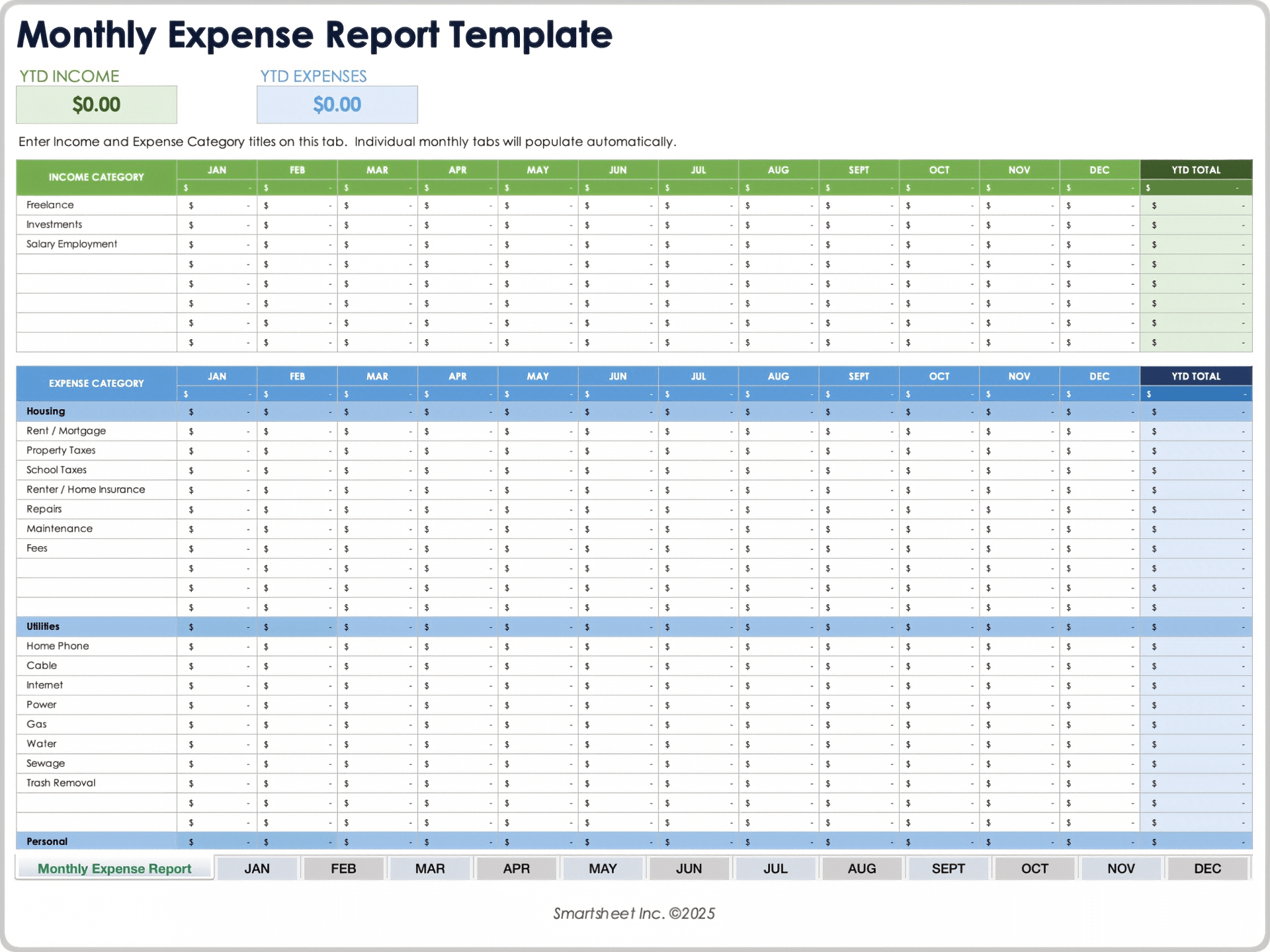
Monthly Expense Report Template | Managing monthly expenses isn’t exactly the most glamorous part of running a business, but it sits right at the core of sustainable growth. A well-structured Monthly Expense Report Template makes the entire process easier, clearer, and far more reliable. Instead of chasing random spreadsheets, emails, and handwritten notes that somehow always disappear at the worst moment, a solid template gives you a consistent and dependable way to capture financial activity every month.
An organized monthly expense system doesn’t just record numbers—it shapes better decision-making. When every detail is presented cleanly, teams can understand spending patterns, identify budget leaks, and map out future allocations without the usual guesswork. That level of clarity becomes even more important as companies grow and pockets of spending begin to multiply across teams, departments, and projects.
Visualizing financial movements in one place also minimizes the friction of reporting. People take action faster when the format is familiar and predictable. Instead of inventing a new structure every month, the template becomes the standard language for reporting, ensuring that everyone—from employees to managers to stakeholders—knows how to read and interpret the information instantly.
Monthly Expense Report Template – Hidden Benefits
A thoughtfully designed Monthly Expense Report Template does much more than tally numbers. It delivers structure, reduces ambiguity, and elevates the way financial information moves through a team. When reporting becomes easier, consistency naturally follows. And consistency is what makes trends obvious, risks visible, and decisions more informed.
Using a centralized format also prevents the “creative accounting” chaos that arises when every department submits reports using its own preferred layouts. Instead of 10 different spreadsheets with 10 different styles, the organization works with a cohesive framework. The result is a streamlined approval flow and fewer clarification emails that begin with, “What does this column mean?”

Templates also make onboarding simpler. New employees don’t need to learn the history of past reports—they simply follow a structure that already works. Over time, that uniformity becomes the backbone of predictable budgeting and smoother audits.
A structured monthly reporting rhythm also encourages financial discipline. When teams know exactly what will be examined at the end of each cycle, they become more mindful of how money moves. It’s not about restricting spending—it’s about improving visibility so decisions feel responsible rather than reactive.
A Clearer Approach to Breakdown and Reporting
A polished monthly report template works because it removes unnecessary decisions: What columns should be included? Where should totals go? Which categories matter most? When those questions are already answered, people can focus on documenting information accurately instead of worrying about formatting.
At its core, the Monthly Expense Report Template typically highlights:
- Spending categories
- Amounts allocated and amounts used
- Notes or justifications
- Dates, receipts, and supporting information
- Comparisons with previous months
These sections turn raw expenses into readable patterns. Over time, they reveal the operation style of the business—where money consistently goes, which months spike, and which areas become unexpectedly resource-heavy.
Some businesses use the Monthly Expense Report Template purely for internal review, while others rely on it for cross-functional communication. When several teams collaborate on shared goals, having one unified financial reporting system makes planning much easier. Misunderstandings shrink, and the team can focus on outcomes instead of sorting through mismatched financial data.
Supporting Insights for Effective Monthly Documentation
Financial reporting sounds dry, yet a well-structured Monthly Expense Report Template adds a surprising level of clarity that teams genuinely appreciate. The standardized approach builds confidence because people know they’re tracking information the right way and can trust the accuracy of what they see.
A strong monthly system also enables:
- Clearer spending accountability
- Faster budget adjustments
- Better alignment between team leads
- A more realistic view of operational costs
- Less confusion when preparing quarterly or annual summaries
Even small businesses benefit from this discipline. When monthly data is precise, larger financial reports—whether annual or departmental—become much more manageable.
A Monthly Expense Report Template isn’t just a tool for recording; it’s a tool for improving decision-making. It keeps teams aware of their habits, helps prevent waste, and encourages more responsible use of resources.
Detailed Insights and Template Extensions
A refined Monthly Expense Report Template can expand into more specific formats based on operational needs. Some teams need deeper tracking for reimbursements. Others need clearer visuals for financial presentations. Many need an easy-to-share file that plugs seamlessly into systems like Excel or cloud-based reporting software.
These extensions often include:
- Automated totals
- Built-in comparison charts
- Category breakdowns
- Receipt attachment fields
- Notes for explanation and justification
The more intuitive the layout, the easier it is to use consistently—and consistency is what generates reliable financial patterns.
Now, let’s break down how each specialized version of the Monthly Expense Report Template functions and where it builds the most value.
Get also: Weekly Expense Report Template
Specialized Template Variations for Different Reporting Needs
Monthly Business Expense Report Template – Essential Enhancements


A Monthly Business Expense Report Template Essential Enhancements offers structure tailored specifically for company-wide spending. This variation helps businesses keep a clean log of operational costs, departmental expenses, and activity-based spending that occurs throughout the month.
It typically includes:
- Fields for each department
- Line items for recurring vs. one-time costs
- Optional notes for vendor details or unusual expenses
- Summary sections for management review
This version works particularly well for organizations with multiple teams contributing to shared budgets. The consistency helps finance departments reconcile records without unnecessary back-and-forth. Managers also gain clearer visibility into spending behavior, allowing them to adjust budgets in real time when needed.
It’s also common for this Monthly Business Expense Report Template to be used during presentations or oversight meetings, since the structured layout simplifies discussions around cost optimization and upcoming operational needs.
Monthly Income Expense Report Template – Hidden Structure


A Monthly Income Expense Report Template Hidden Structure blends income tracking with expense documentation, giving a complete view of financial inflow and outflow in one convenient layout. This dual-format approach is ideal for teams that need to evaluate profitability or monitor financial health across short cycles.
Its structure often includes:
- Gross and net income fields
- Separate expense categories
- Automatic balance calculations
- Comparative sections for previous months
This Monthly Income Expense Report Template is particularly useful for small businesses, freelancers, or departments managing their own budgets. By combining income and expenses, it highlights patterns that might be easy to overlook when they’re tracked separately.
Teams can quickly spot months with unusually high spending, irregular earnings, or mismatched balance patterns. Over time, this consistent visibility helps guide decisions for upcoming projects, resource needs, or investment adjustments.
Monthly Expenses Report Excel Template: Unexpected Advantages


A Monthly Expenses Report Excel Template brings flexibility to the reporting process, especially for teams familiar with spreadsheet-based systems. Excel allows formulas, conditional formatting, automated graphs, and built-in checks—all of which increase accuracy and reduce manual work.
Key advantages include:
- Automatic calculations
- Color-coded categories
- Dynamic charts for visual summaries
- Option to lock formulas to prevent edits
- Flexible exporting options for PDF or shared folders
This type of Monthly Financial Report Template works flawlessly for organizations that rely heavily on data-driven evaluations. It’s also ideal for teams preparing financial summaries for leadership, since visual structures can communicate information much faster than raw numbers alone.
Even non-technical users benefit from the intuitive layout—fields are already set, totals compute automatically, and categories remain consistent month after month.
Final Thoughts on Practical Monthly Reporting Frameworks
A reliable Monthly Expense Report Template isn’t just a form—it’s a strategic tool that influences how businesses plan, allocate, and evaluate their spending. With the right layout, teams gain clarity, structure, and confidence in their financial decisions. Supplementary versions like business-focused templates, income-expense hybrids, and Excel-based formats expand these benefits even further.
When financial documentation becomes predictable and easy to follow, companies operate with more stability. Small details—like consistent categories and automated calculations—stack up into habits that shape better financial discipline across the entire organization.
If the goal is smoother operations, clearer insights, and a stronger understanding of monthly financial patterns, adopting a refined monthly expense reporting system becomes an invaluable step.