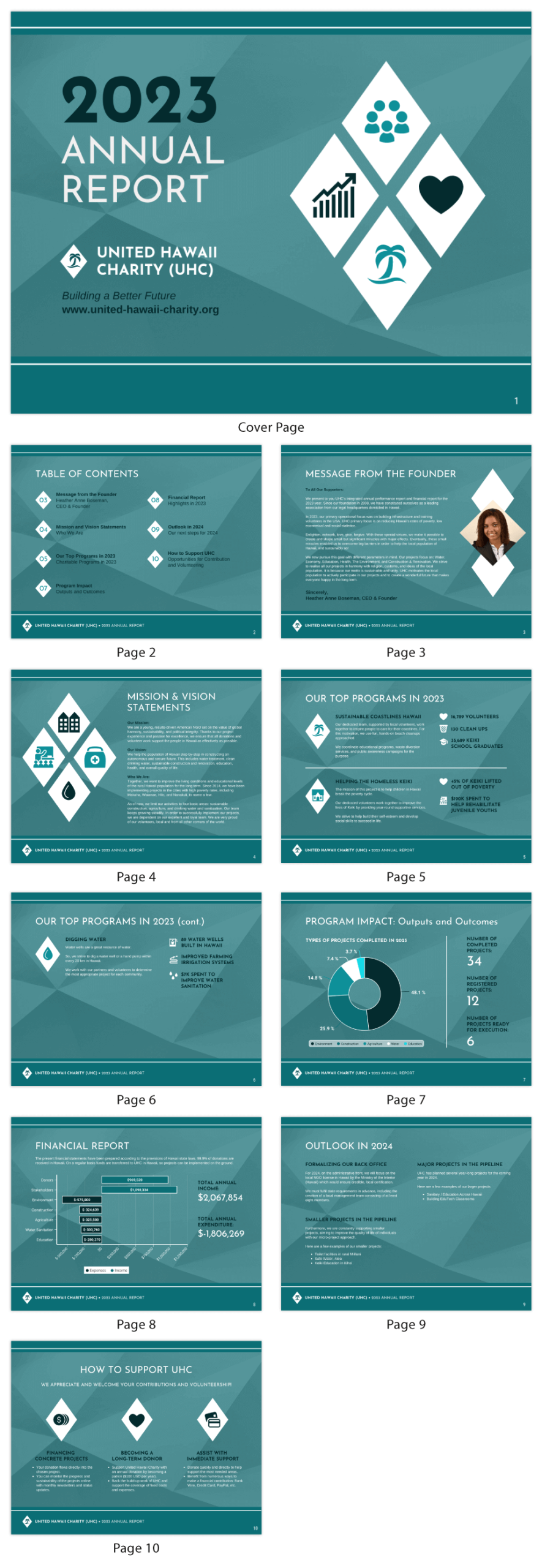
Expense Report Template – Strengthen 2026 Financial Transparency

Expense Report Template systems are essential for documenting costs, monitoring spending patterns, and maintaining financial accountability across organizations of all sizes. Without a standardized reporting format, expense tracking often becomes inconsistent, error-prone, and difficult to analyze. A structured template turns scattered receipts and transactions into clear financial insight.

Whether used by individuals, teams, or entire organizations, expense reporting supports better budgeting, clearer reimbursement processes, and stronger financial oversight. This article explores the purpose of expense reporting, the key components of an effective template, and the most practical formats used in different financial reporting scenarios.

What Is an Expense Report Template and Why Does It Matter

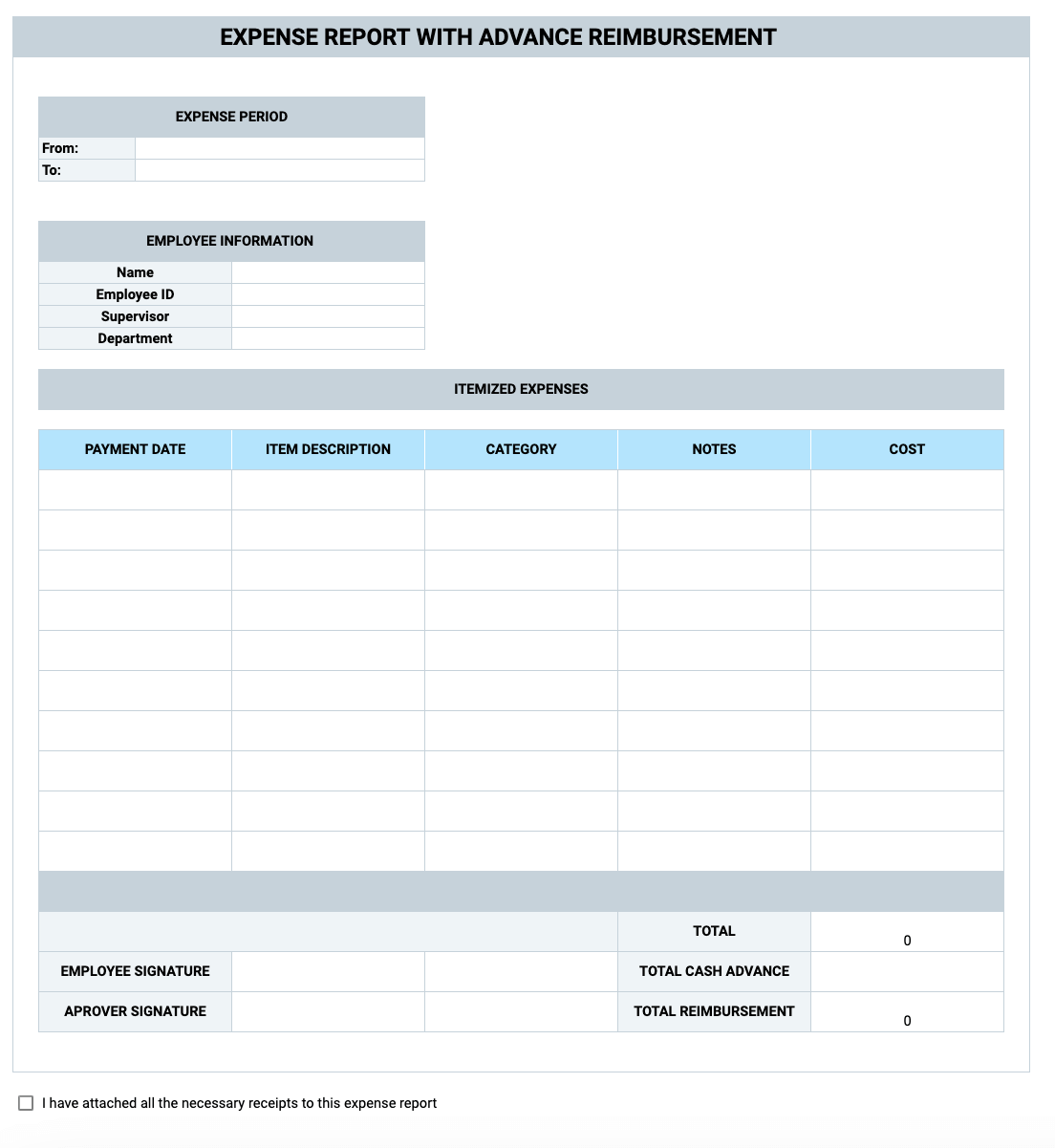
An Expense Report is a structured document designed to record, categorize, and summarize expenses over a specific period. Its primary purpose is to provide transparency into how money is spent and to ensure that financial records are accurate and complete.

Organizations and individuals rely on standardized expense reporting to:

  • Track spending consistently
  • Support reimbursement and approval workflows
  • Identify cost patterns and anomalies
  • Improve budget control and forecasting
  • Maintain clear financial documentation

By using the same reporting framework repeatedly, expense data becomes easier to review, compare, and validate.

The Role of Expense Reporting in Financial Management

Expense reporting plays a critical role in maintaining financial discipline. When expenses are recorded consistently, decision-makers gain visibility into where funds are allocated and how spending aligns with planned budgets.

A well-designed Expense Report helps prevent:

  • Missing or duplicated expense entries
  • Unclear spending justifications
  • Delayed reimbursements
  • Inaccurate financial summaries

Clear documentation also builds trust between employees, finance teams, and management by ensuring that all expenses are transparent and verifiable.

Essential Components of an Effective Expense Report

Although formats may vary, effective expense reports share a common structure that balances detail with usability.

Reporting Period and Basic Information

This section defines the timeframe covered by the report and includes basic details such as name, department, or project reference.

Expense Categories

Expenses are grouped into clear categories, such as travel, meals, supplies, or operational costs, to improve clarity and analysis.

Itemized Expense Details

Each expense entry typically includes the date, description, amount, and payment method.

Supporting Documentation

Receipts or references are listed to support verification and approval.

Total Expense Summary

A consolidated summary shows total spending for the reporting period.

Approval and Review Section

Every Expense Report Template should include space for review, approval, or acknowledgment, ensuring accountability.

Common Types of Expense Report Templates

Different financial needs require different reporting formats. Below are the most widely used expense report variations.

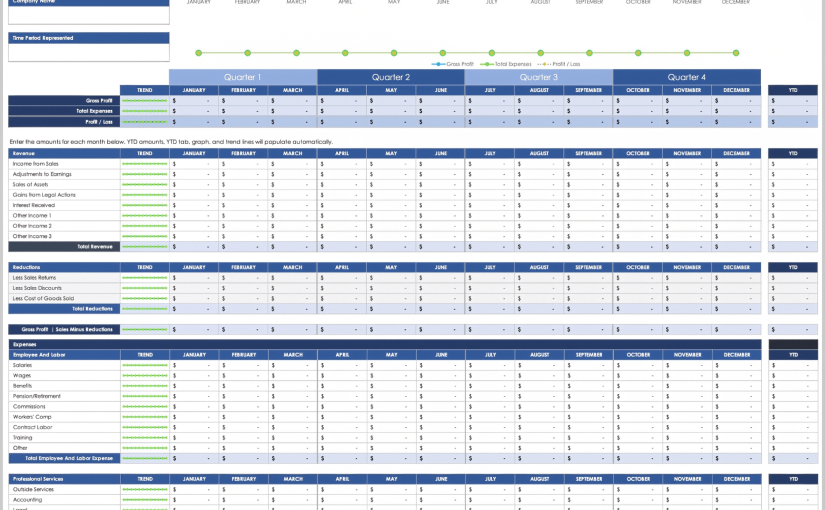
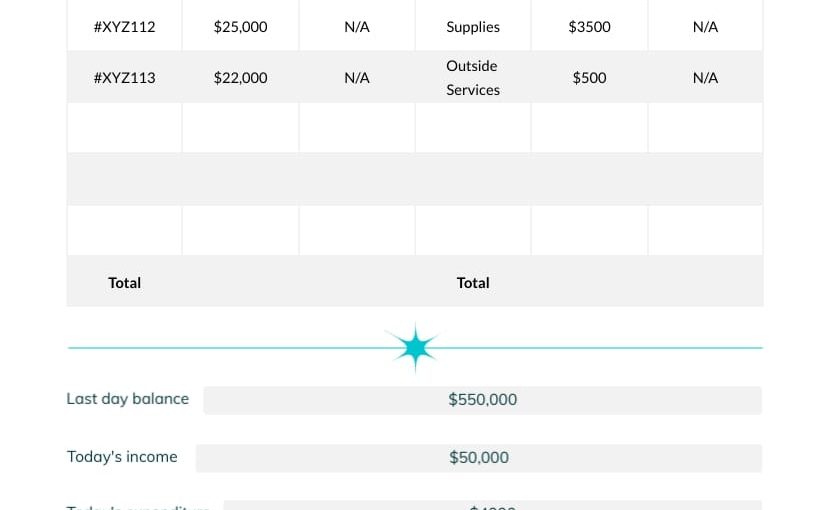
Expense and Income Report Template for Balanced Financial Tracking

An Expense and Income Report Template for Balanced Financial Tracking combines cost tracking with income documentation. This format provides a clearer picture of overall financial performance.

It is commonly used for:

  • Small businesses
  • Freelancers and consultants
  • Personal finance tracking

By capturing both inflows and outflows, this template supports better cash flow awareness and financial planning.

Get also: Annual Income and Expense Report Template

Monthly Expense Report Template for Consistent Budget Oversight

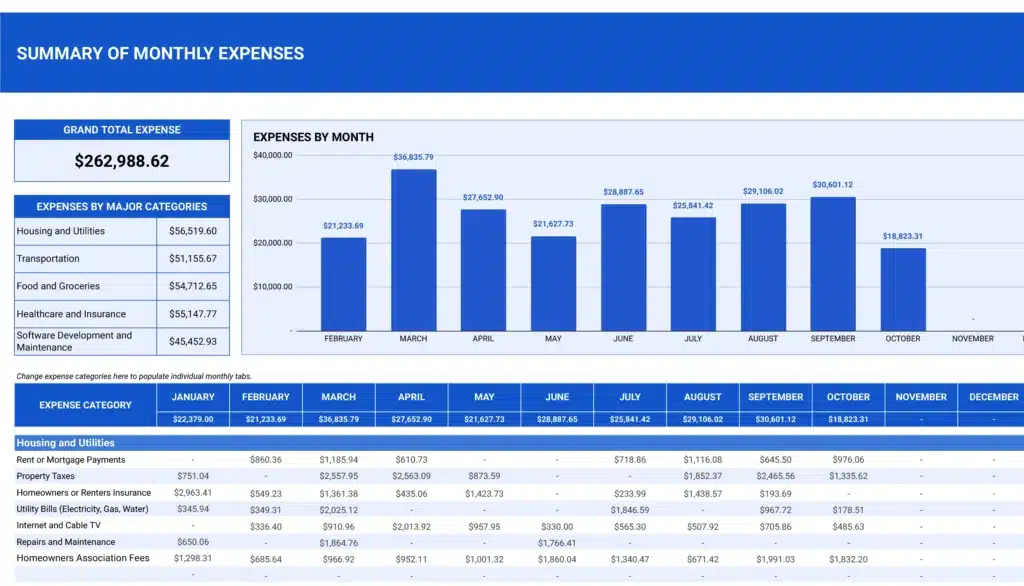
A Monthly Expense Report Template summarizes expenses over a fixed monthly period. Monthly reporting allows for reliable comparison and trend analysis.

This format typically includes:

  • Monthly spending totals
  • Category-based summaries
  • Comparison with planned budgets
  • Notable variances

Monthly expense reports are widely used by finance teams, managers, and individuals who require structured oversight without daily detail.

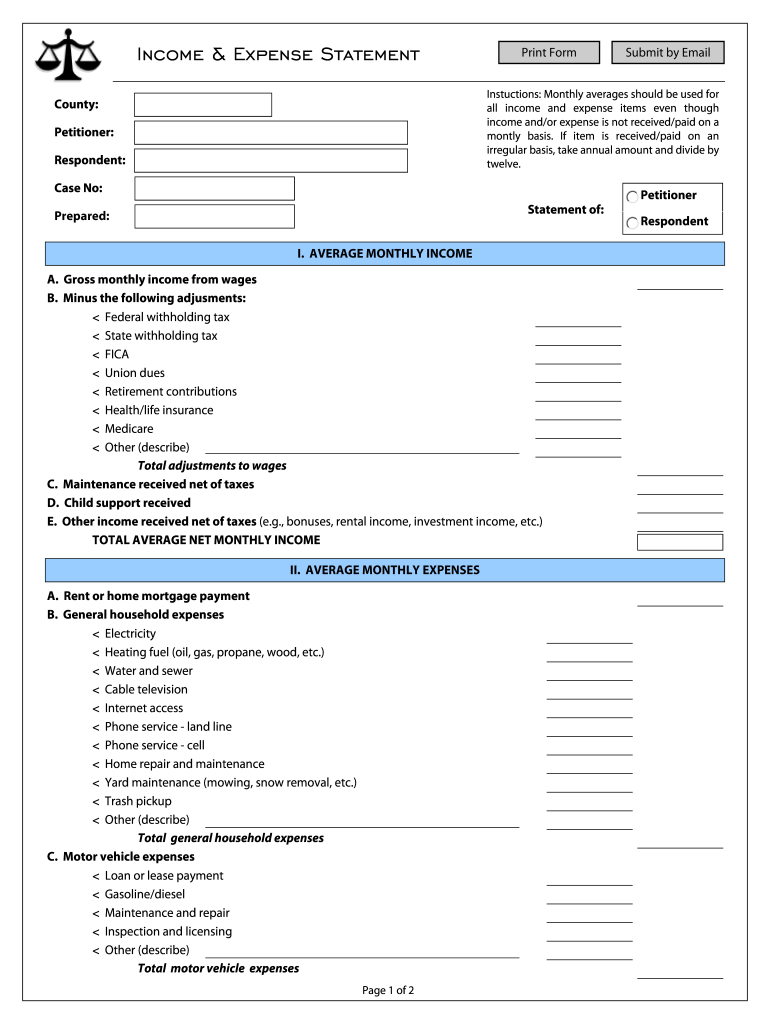
Free Printable Expense Report Form for Simple Documentation

A Free Printable Expense Report Form for Simple Documentation provides a straightforward, paper-based solution for recording expenses.
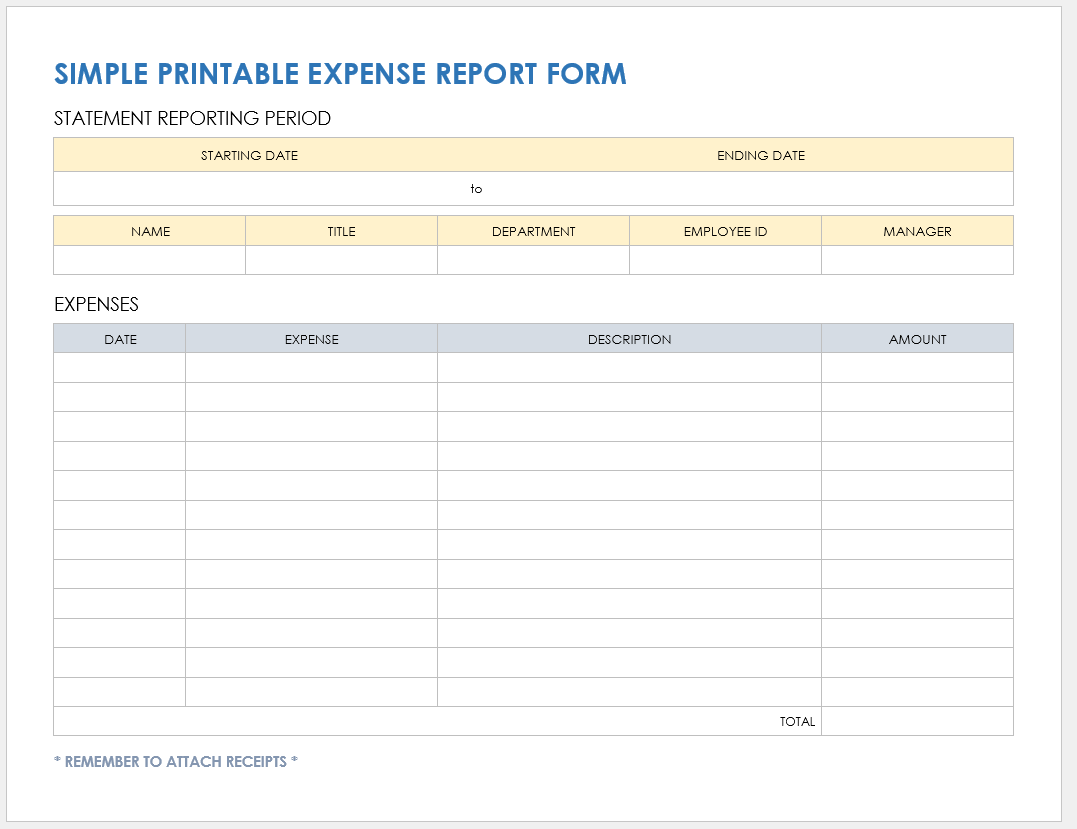
This format is especially useful for:

  • Small teams
  • Field workers
  • Temporary or offline reporting needs

While simple, printable forms still support consistency and clarity when designed with clear fields and categories.

Get also: Travel Expense Report Template

Choosing the Right Expense Report Template

Selecting the appropriate template depends on several factors:

  • Reporting frequency
  • Level of detail required
  • Approval processes
  • User familiarity

A good Expense Report should be easy to complete consistently while capturing all necessary financial details.

Overly complex templates discourage regular use, while overly simple formats may lack sufficient information for proper review.

Adapting Expense Reports for Different Use Cases

Expense reporting requirements vary across roles and contexts.

Employee Expense Reporting

Employees benefit from clear templates that simplify submission and reimbursement.

Team or Project Reporting

Project-based expense reports help track costs against specific initiatives or budgets.

Personal Expense Tracking

Individuals use simplified templates to monitor spending habits and manage budgets.

Tailoring the format ensures that expense reporting remains efficient and accurate.

Common Mistakes in Expense Reporting

Even well-designed templates can lose effectiveness if common mistakes occur, such as:

  • Incomplete or missing expense details
  • Poor categorization
  • Delayed reporting
  • Inconsistent reporting periods

A strong Expense Report Template emphasizes completeness, accuracy, and consistency.

Best Practices for Maintaining Accurate Expense Reports

To maximize the value of expense reporting:

  • Record expenses promptly
  • Use clear and consistent categories
  • Attach supporting documentation
  • Review reports before submission
  • Maintain a consistent reporting schedule

These practices reduce errors and improve financial reliability.

Using Expense Reports to Improve Financial Decisions

Expense reports are not only for recordkeeping. When reviewed regularly, an Expense Report Template supports better decision-making by revealing spending patterns and cost drivers.

Consistent reporting helps organizations and individuals:

  • Identify unnecessary expenses
  • Adjust budgets proactively
  • Improve cost control
  • Strengthen financial planning

Over time, historical expense data becomes a valuable resource for forecasting and optimization.

Long-Term Benefits of Standardized Expense Reporting

Organizations that adopt structured expense reporting gain:

  • Improved financial transparency
  • Faster approval and reimbursement cycles
  • Reduced risk of errors or disputes
  • Stronger budget discipline
  • Clearer audit trails

A reliable Expense Report Template becomes a foundational element of sound financial management.

Conclusion

An Expense Report is a vital tool for tracking spending, maintaining transparency, and supporting informed financial decisions. By standardizing how expenses are documented and reviewed, individuals and organizations gain clarity, consistency, and control.

Whether using an Expense and Income Report Template for Balanced Financial Tracking, a Monthly Expense Report Template for Consistent Budget Oversight, or a Free Printable Expense Report Form for Simple Documentation, the right format ensures that financial data is accurate, accessible, and actionable.

When applied consistently, expense reporting transforms everyday transactions into meaningful financial insight and stronger fiscal discipline.

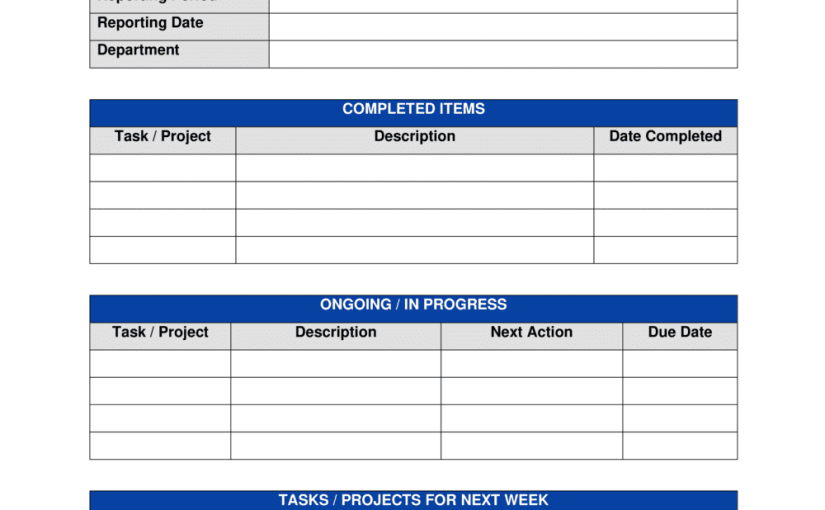
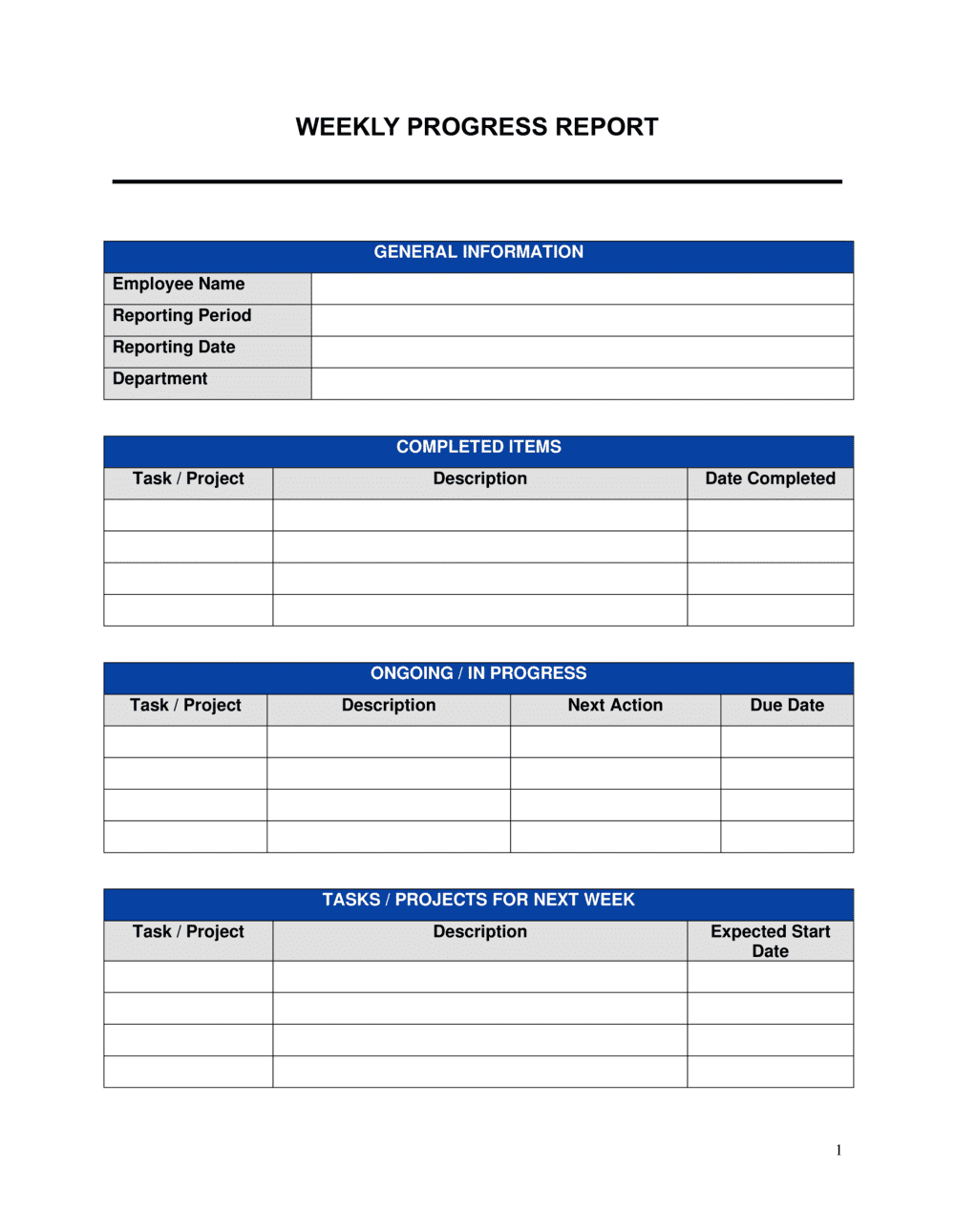
Weekly Progress Report Template – 10+ Formats to Improve Accountability

Weekly Progress Report Template structures are essential for teams and organizations that operate in fast-moving environments where visibility, alignment, and timely action matter. Weekly reporting provides a short feedback loop that helps identify issues early, maintain execution momentum, and ensure that priorities stay on track.

Without a standardized weekly format, progress updates often become fragmented, inconsistent, or overly informal. A clear reporting structure transforms weekly activity into meaningful insight that supports coordination, accountability, and continuous improvement.

What Is a Weekly Progress Report?

A Weekly Progress Report is a structured document used to summarize progress, activities, challenges, and next steps within a one-week reporting period. Its primary goal is to provide a clear and consistent snapshot of work status that supports timely decision-making.

Weekly reports focus on execution rather than long-term strategy. They answer critical questions such as:

  • What was planned for the week?
  • What was completed?
  • What is still in progress?
  • What issues or risks emerged?
  • What are the priorities for next week?

By answering these questions consistently, weekly reporting keeps teams aligned and accountable.

Why Weekly Progress Reporting Is So Effective

Weekly reporting strikes an ideal balance between detail and efficiency. It is frequent enough to catch issues early, yet structured enough to prevent information overload.

A Weekly Progress Report helps teams:

  • Detect delays before they escalate
  • Maintain focus on short-term priorities
  • Track execution against plans
  • Improve communication across roles
  • Reinforce accountability at the task level

Because the reporting cycle is short, corrective actions can be taken quickly and with minimal disruption.

Core Components of an Effective Weekly Progress Report

Although formats vary by context, high-quality weekly reports share common structural elements.

Reporting Period and Scope

This section clearly defines the week covered and the scope of work included in the report.

Planned vs. Completed Tasks

Comparing planned activities with completed work helps assess execution accuracy and reliability.

Work in Progress

This section documents ongoing tasks, their current status, and expected completion timelines.

Issues, Risks, and Blockers

Early identification of challenges allows teams to resolve problems before they affect delivery.

Key Outcomes or Learnings

Notable achievements or lessons learned during the week are highlighted here.

Next Week’s Priorities

Every Weekly Progress Report Template should end with a clear outline of upcoming priorities and responsibilities.

How Weekly Reporting Improves Execution Discipline

Weekly reporting reinforces discipline by creating a predictable rhythm of planning, execution, and review. When teams know progress will be reviewed weekly, priorities become clearer, and follow-through improves.

A Weekly Progress Report Template also encourages ownership. Individuals and teams become more conscious of commitments, timelines, and outcomes when progress is documented regularly.

Specialized Types of Weekly Progress Report Templates

Different contexts require tailored weekly reporting formats. Below are high-impact variations commonly used across industries and environments.

Weekly Project Status Report Template for Structured Delivery Control

A Weekly Project Status Report Template for Structured Delivery Control focuses on project-level execution, milestones, and dependencies.

This format typically includes:

  • Task completion status
  • Milestone progress
  • Schedule alignment
  • Resource or dependency issues

It is widely used in project management environments where coordination across roles and timelines is critical.

Weekly Student Progress Report Template for Academic Performance Tracking

A Weekly Student Progress Report Template for Academic Performance Tracking is designed to monitor learning progress, engagement, and development.

This report format often covers:

  • Academic tasks completed
  • Participation and engagement levels
  • Areas of improvement
  • Learning objectives for the next week

Educators and institutions use weekly student reports to provide timely feedback and support consistent progress.

Get also: Free Weekly Status Report Template Excel

Weekly Training Progress Report Template for Skill Development Monitoring

A Weekly Training Progress Report Template for Skill Development Monitoring tracks progress in structured learning or training programs.

Common elements include:

  • Training modules completed
  • Skill acquisition progress
  • Practice outcomes
  • Challenges or gaps

This format is especially useful in onboarding, professional development, and certification programs.

Choosing the Right Weekly Progress Report Template

Selecting the right template depends on several factors:

  • Nature of the work
  • Reporting audience
  • Level of detail required
  • Decision-making needs

A Weekly Progress Report Template should be simple enough to complete consistently, yet detailed enough to provide real value.

Overly complex templates discourage regular use, while overly simple formats risk missing critical insights.

Adapting Weekly Reports for Different Stakeholders

Although the core structure remains consistent, the presentation should vary depending on who will read the report.

Leadership and Management

Leaders benefit from summaries that highlight outcomes, risks, and alignment with short-term goals.

Team-Level Reporting

Teams need operational detail, task-level status, and clearly defined next steps.

External or Client-Facing Reporting

External audiences value clarity, transparency, and progress tied directly to agreed deliverables.

Tailoring reports ensures relevance without compromising consistency.

Common Mistakes in Weekly Progress Reporting

Weekly reports can lose effectiveness if common mistakes occur, such as:

  • Reporting activities without outcomes
  • Being too vague or overly detailed
  • Ignoring unresolved blockers
  • Changing the report structure frequently

A strong Weekly Progress Report Template emphasizes clarity, honesty, and actionability.

Best Practices for Writing Clear Weekly Progress Reports

To maximize the value of weekly reporting:

  • Use concise and specific language
  • Focus on results and implications
  • Be transparent about challenges
  • Keep formatting consistent
  • Align updates with weekly objectives

Well-written weekly reports support trust, alignment, and continuous improvement.

Using Weekly Progress Reports to Drive Better Decisions

The real value of a Weekly Progress Report lies in how it informs action. When reviewed consistently, weekly reports help teams:

  • Adjust priorities quickly
  • Resolve issues before they escalate
  • Improve execution accuracy
  • Strengthen short-term planning

Over time, weekly reporting creates a detailed execution history that supports better forecasting and performance evaluation.

Long-Term Benefits of Consistent Weekly Reporting

Organizations that adopt structured weekly reporting gain:

  • Stronger execution discipline
  • Improved communication
  • Reduced delivery risk
  • Clearer accountability
  • Better alignment across teams

A Weekly Progress Report Template becomes a foundational tool for maintaining momentum and operational clarity.

Conclusion

A Weekly Progress Report Template is a critical tool for tracking execution, maintaining alignment, and supporting timely decision-making. By standardizing how weekly updates are documented, organizations gain clarity, consistency, and accountability.

Whether using a Weekly Project Status Report Template for Structured Delivery Control, a Weekly Student Progress Report Template for Academic Performance Tracking, or a Weekly Training Progress Report Template for Skill Development Monitoring, the right reporting format ensures that progress is visible and actionable.

When applied consistently, weekly progress reporting transforms short-term activity into sustained performance and measurable results.

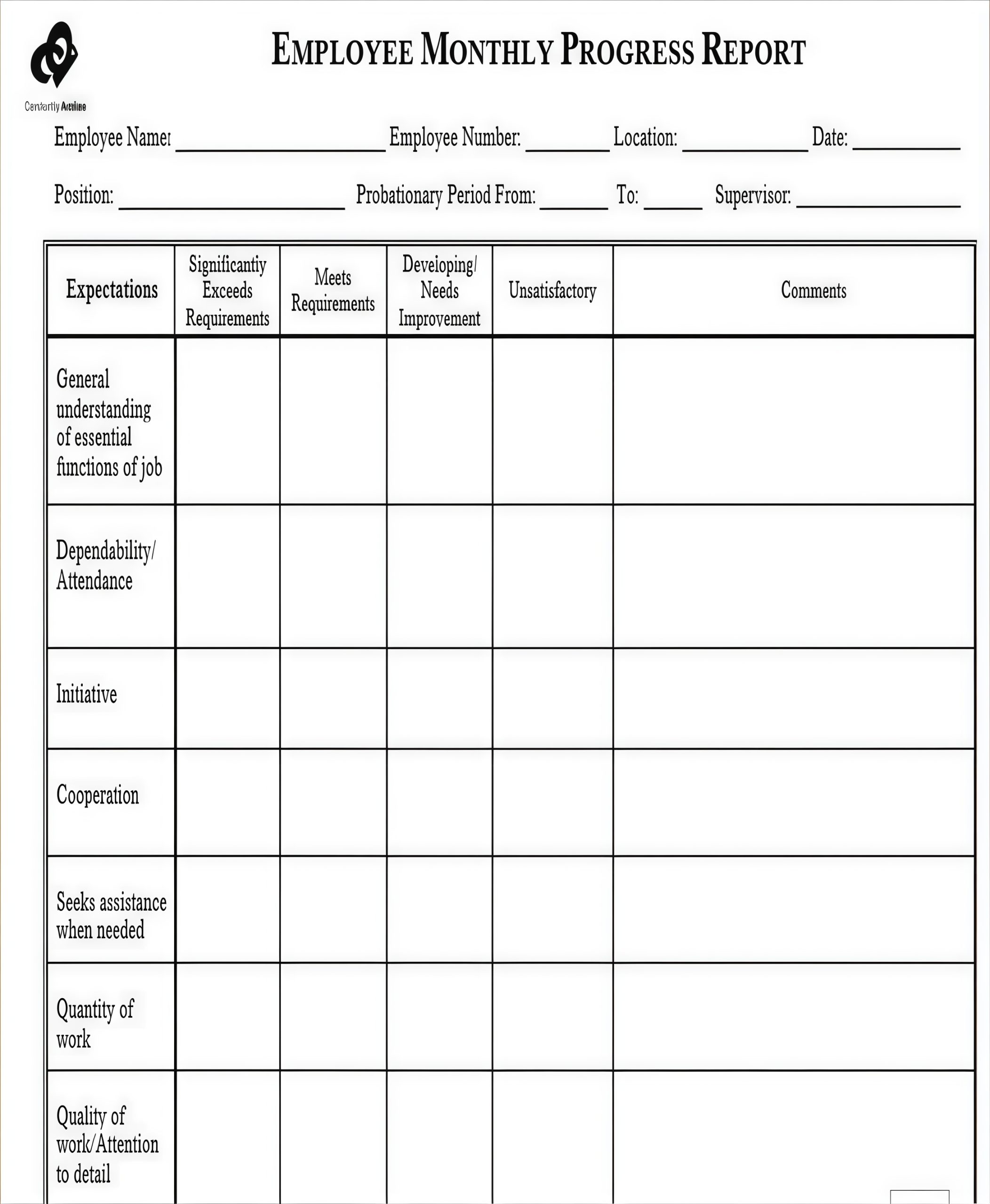
Monthly Progress Report Template – 2026 Strengthen Accountability

Monthly Progress Report Template frameworks are essential for organizations that need clear, structured visibility into ongoing work and performance outcomes. Monthly reporting sits at a critical intersection—frequent enough to detect issues early, yet comprehensive enough to show meaningful trends. Without a standardized format, monthly updates often become inconsistent, subjective, or difficult to compare.

A well-structured monthly report transforms scattered updates into reliable insights. It helps teams evaluate progress, communicate status clearly, and maintain accountability across projects, departments, and stakeholders.

What Is a Monthly Progress Report Template?

A Monthly Progress Report Template is a structured document used to summarize activities, achievements, challenges, and next steps within a single month. Its primary purpose is to provide a consistent snapshot of progress that supports informed decision-making.

Unlike informal updates, this template ensures that every report covers the same core elements, making comparisons between months clear and reliable. When used consistently, it becomes a powerful management and communication tool.

Organizations rely on monthly reporting to:

  • Track execution against planned objectives
  • Identify delays or performance gaps
  • Communicate progress transparently
  • Support accountability and ownership
  • Maintain alignment between planning and execution

Why Monthly Progress Reporting Is So Effective

Monthly reporting offers a balanced reporting cadence. It avoids the noise of daily or weekly updates while still providing timely insights before issues escalate.

A Monthly Progress Report allows teams to:

  • Review outcomes over a meaningful timeframe
  • Identify recurring patterns and trends
  • Assess whether corrective actions are working
  • Adjust priorities based on real progress

Because the timeframe is consistent, monthly reports provide a reliable foundation for comparison and performance evaluation.

Core Elements of a Strong Monthly Progress Report

An effective monthly report combines clarity, structure, and relevance. While formats may vary, the following elements are commonly included.

Reporting Period Summary

This section defines the month covered and provides a brief context for the report.

Objectives and Planned Activities

Clear objectives establish what the team aims to accomplish during the month.

Completed Work and Achievements

This section highlights milestones reached, tasks completed, and outcomes delivered, focusing on results rather than effort.

Ongoing Activities

Work still in progress is documented here, along with its current status and expected completion.

Challenges, Risks, and Constraints

Identifying issues early allows teams to take corrective action before delays or failures occur.

Next Month’s Action Plan

Every Monthly Progress Report should conclude with clear priorities and planned actions for the upcoming month.

How a Progress Report Template Supports Long-Term Consistency

A Progress Report Template provides the foundation for structured reporting beyond a single month. When the same framework is reused, teams can easily track performance trends over time.

Consistent reporting helps organizations:

  • Compare progress month over month
  • Maintain standardized documentation
  • Reduce ambiguity in performance reviews
  • Improve clarity in stakeholder communication

Monthly reports become more valuable with repetition, as historical data strengthens analysis and planning.

High-Impact Variations of Monthly Progress Reports

Different industries and functions require tailored reporting formats. Below are specialized monthly report variations commonly used in practice.

Monthly Performance Report Template for Measurable Results Tracking

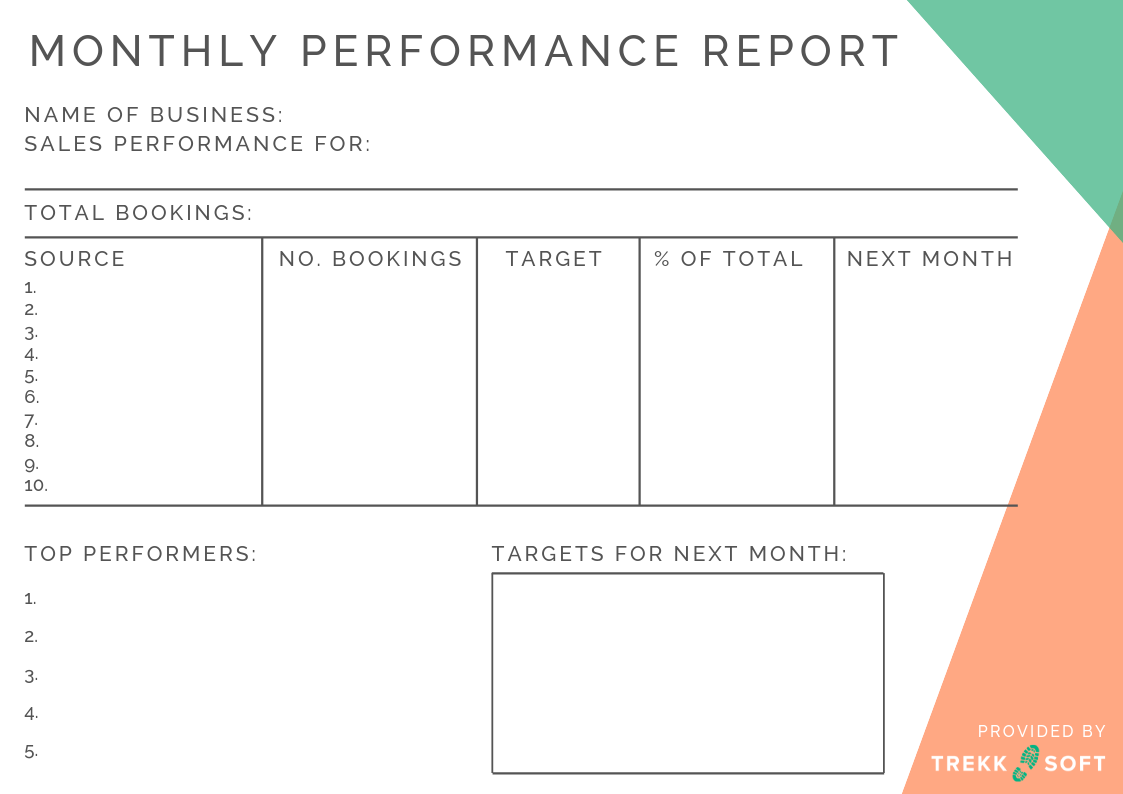
A Monthly Performance Report Template for Measurable Results Tracking emphasizes outcomes, metrics, and performance indicators rather than task-level detail.

This format typically focuses on:

  • Key performance indicators
  • Target versus actual results
  • Variance analysis
  • Performance trends

It is especially useful for management reporting, operational oversight, and performance reviews where measurable outcomes matter most.

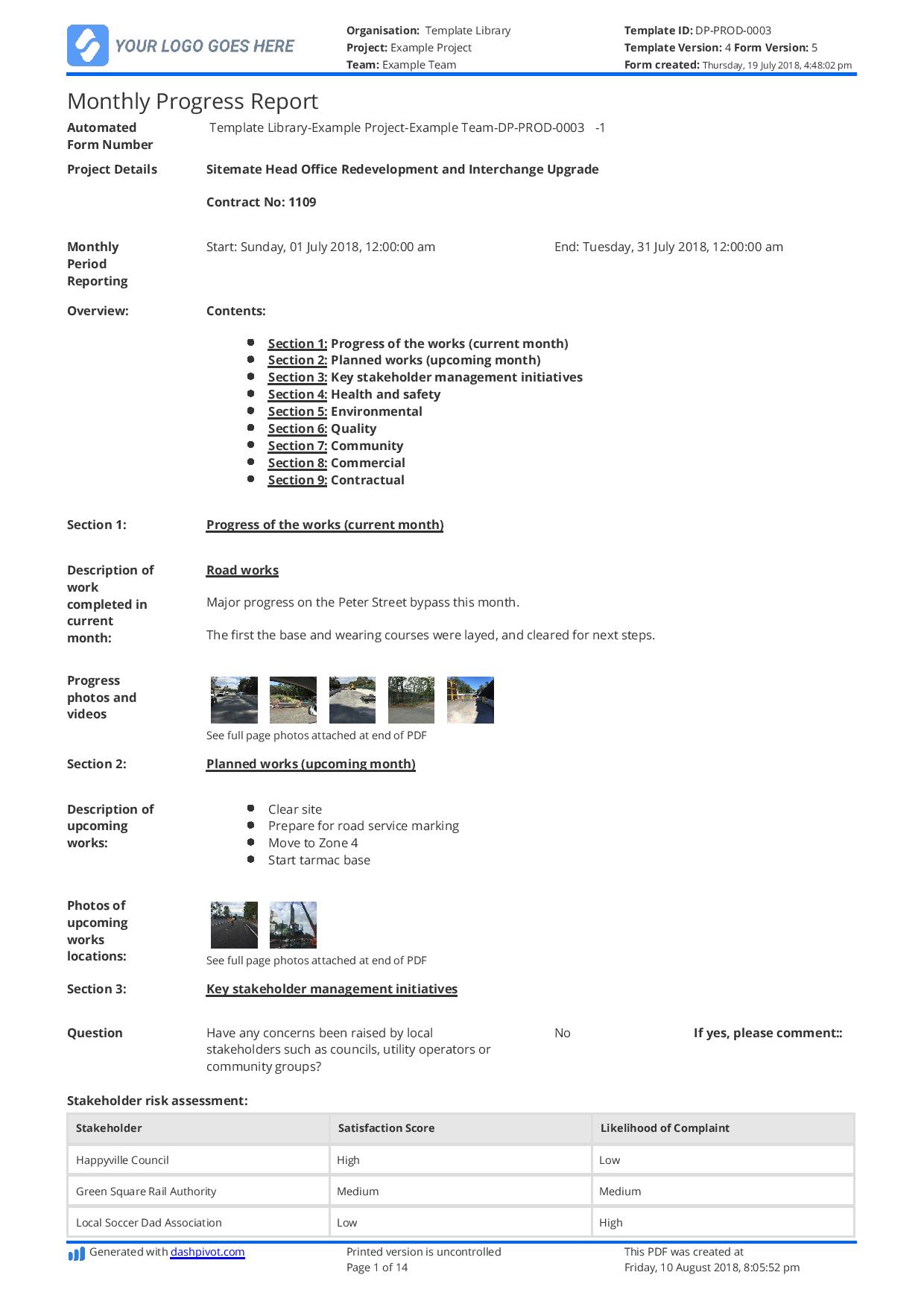
Monthly Construction Progress Report Template for On-Site Execution Control

A Monthly Construction Progress Report Template for On-Site Execution Control is designed for environments where timelines, resources, and physical progress must be monitored closely.

This report format often includes:

  • Work completed versus schedule
  • Site activities and milestones
  • Resource usage and constraints
  • Safety or compliance observations

Because construction projects involve multiple dependencies, monthly reporting provides critical visibility into execution status and risk exposure.

Get also: Construction Monthly Report Template

Integrated Monthly Progress Report Template for Cross-Functional Teams

Some organizations combine operational updates with performance tracking into a single document. This integrated approach supports collaboration across departments.

An integrated Monthly Progress Report typically includes:

  • Strategic objectives
  • Operational progress
  • Performance outcomes
  • Risks and mitigation actions

This format is ideal for complex projects involving multiple teams or stakeholders.

Choosing the Right Monthly Progress Report Template

Selecting the right template depends on:

  • The nature of the work
  • The level of detail required
  • The intended audience
  • Reporting objectives

For leadership audiences, summary-focused formats are often more effective. For operational teams, detailed task and risk tracking may be necessary.

A well-chosen Monthly Progress Report Template aligns reporting detail with decision-making needs.

Adapting Monthly Reports for Different Audiences

Although the structure remains consistent, the presentation should vary based on who will read the report.

Executive and Leadership Reports

Executives benefit from concise summaries, key outcomes, and high-level risks.

Team and Department Reports

Operational teams require detailed updates, blockers, and clearly defined next steps.

Client or External Reports

External stakeholders typically value transparency, clarity, and progress tied directly to agreed deliverables.

Tailoring reports improves clarity without sacrificing consistency.

Common Mistakes in Monthly Progress Reporting

Even well-designed templates can lose effectiveness if common mistakes occur, such as:

  • Reporting activities instead of outcomes
  • Being overly vague or excessively detailed
  • Hiding or minimizing challenges
  • Changing the report structure frequently

A strong Monthly Progress Report prioritizes honesty, clarity, and relevance.

Best Practices for Writing Effective Monthly Progress Reports

To maximize the impact of monthly reporting:

  • Use clear and professional language
  • Focus on results and implications
  • Highlight risks early
  • Maintain consistent formatting
  • Align updates with stated objectives

Good reporting builds trust and improves collaboration across teams.

Using Monthly Progress Reports to Drive Better Decisions

The true value of a Monthly Progress Report Template lies in how it supports action. Reports should inform decisions, not simply document activity.

When reviewed consistently, monthly reports help organizations:

  • Identify performance gaps
  • Adjust timelines and priorities
  • Allocate resources more effectively
  • Improve forecasting and planning

Over time, monthly reporting creates a reliable performance history that supports continuous improvement.

Long-Term Benefits of Standardized Monthly Reporting

Organizations that adopt structured monthly reporting gain:

  • Stronger accountability
  • Better communication
  • Reduced project risk
  • Improved visibility into execution
  • Clearer alignment between goals and outcomes

A Monthly Progress Report becomes a strategic asset when used consistently.

Conclusion

A Monthly Progress Report Template is a vital tool for tracking progress, evaluating performance, and maintaining accountability across projects and teams. By standardizing how updates are documented, organizations gain clarity, consistency, and actionable insight.

Whether using a Progress Report Template as a foundational framework, a Monthly Performance Report Template for Measurable Results Tracking, or a Monthly Construction Progress Report Template for On-Site Execution Control, the right reporting format ensures that progress is visible and decisions are informed.

When applied consistently, monthly progress reporting turns ongoing work into measurable, manageable results.

Progress Report Template: Drive Accountability in 2025

Progress Report Template structures are essential tools for documenting work status, measuring achievements, and communicating progress clearly across teams and stakeholders. Without a standardized reporting format, updates often become inconsistent, vague, or overly subjective. A well-designed template transforms ongoing activities into structured insights that support clarity, accountability, and informed decision-making.

Whether used in business operations, project management, education, or organizational planning, progress reporting provides a factual snapshot of where work stands and what actions are required next. This article explores the role of progress reporting, the essential elements of an effective template, and the most impactful formats used in different reporting cycles.

What Is a Progress Report Template and Why Does It Matter

A Progress Report Template is a structured document designed to capture updates on tasks, goals, milestones, and outcomes over a defined period. Its primary purpose is to provide visibility into ongoing work and ensure that progress is measured consistently.

Rather than relying on informal updates or scattered notes, organizations use standardized templates to:

  • Track completion status objectively
  • Identify delays, risks, or bottlenecks
  • Communicate progress clearly to stakeholders
  • Maintain alignment between goals and execution
  • Support accountability at individual and team levels

By using the same reporting framework repeatedly, progress becomes easier to evaluate and compare over time.

The Strategic Value of Structured Progress Reporting

Progress reporting is not merely administrative documentation. When structured correctly, it becomes a strategic tool that supports better coordination and performance control.

A Progress Report ensures that updates are:

  • Clear rather than ambiguous
  • Data-driven instead of opinion-based
  • Consistent across reporting periods
  • Action-oriented rather than descriptive

Structured reporting also reduces miscommunication. Everyone involved understands what is expected, what has been completed, and what remains outstanding.

Core Components of an Effective Progress Report

A high-quality template balances simplicity with sufficient detail. While the exact format may vary depending on context, most effective reports include the following elements.

1. Reporting Period Overview

This section defines the timeframe covered by the report, ensuring clarity on what progress is being evaluated.

2. Objectives or Deliverables

Clear objectives provide context for progress updates. This section outlines what the work aimed to accomplish during the reporting period.

3. Completed Activities

A summary of tasks or milestones that have been completed, focusing on outcomes rather than effort alone.

4. Ongoing Work

This section highlights activities that are currently in progress, including their current status and expected completion.

5. Challenges and Risks

Identifying obstacles early allows teams to address issues before they escalate. This section focuses on factors affecting progress.

6. Next Steps and Action Items

Every Progress Report Template should clearly outline what will happen next, who is responsible, and expected timelines.

Different Types of Progress Report Templates and When to Use Them

Progress reporting needs vary depending on how frequently updates are required. Below are the most commonly used reporting formats and their practical applications.

Weekly Progress Report Template for Fast-Paced Execution Control

A Weekly Progress Report Template for Fast-Paced Execution Control is designed for environments where work moves quickly, and frequent updates are necessary.

This format focuses on:

  • Short-term task completion
  • Immediate blockers or risks
  • Priorities for the upcoming week

Weekly reports are commonly used in:

  • Project management teams
  • Agile or sprint-based workflows
  • Operational roles with tight timelines

Their strength I focus on is clarity and immediacy, helping teams stay aligned without excessive detail.

Get also: Consulting Report Template

Monthly Progress Report Template for Strategic Performance Visibility

A Monthly Progress Report Template for Strategic Performance Visibility provides a broader view of progress over a longer period. It balances operational detail with high-level analysis.

This format typically includes:

  • Summary of key achievements
  • Comparison against planned objectives
  • Identification of trends or recurring issues
  • Adjustments to timelines or resources

Monthly reporting is ideal for managers, department heads, and stakeholders who require structured updates without daily or weekly granularity.

Get also: Daily Progress Report Template

Annual Progress Report Template for Comprehensive Outcome Review

An Annual Progress Report Template for Comprehensive Outcome Review delivers a long-term perspective on progress, outcomes, and overall effectiveness.

This format emphasizes:

  • Achievement of annual goals
  • Major milestones and deliverables
  • Lessons learned and performance patterns
  • Strategic priorities for the following period

Annual reports are often used for organizational reviews, institutional reporting, and long-term planning initiatives.

Choosing the Right Report Template for Your Needs

Selecting the appropriate reporting format depends on several factors:

  • Reporting frequency
  • Audience expectations
  • Project complexity
  • Level of detail required

A Progress Report Template should match the decision-making needs of its readers. Short reporting cycles benefit from concise formats, while longer cycles require more analytical depth.

Adapting Progress Reports for Different Stakeholders

Although the core structure remains consistent, progress reports should be tailored to the intended audience.

Executive-Level Reports

Executives benefit from summaries that focus on outcomes, risks, and alignment with broader objectives.

Team-Level Reports

Teams require operational detail, task-level updates, and clear next steps.

Client or External Reports

External audiences typically value transparency, clear explanations, and progress linked directly to agreed deliverables.

Customization ensures relevance without sacrificing consistency.

Common Mistakes That Reduce the Effectiveness of Progress Reports

Even well-designed templates can fail if misused. Common issues include:

  • Reporting activities instead of outcomes
  • Being overly vague or overly detailed
  • Ignoring unresolved challenges
  • Using inconsistent reporting periods

An effective Progress Report emphasizes clarity, relevance, and actionability over volume.

Best Practices for Writing Clear and Useful Progress Reports

To maximize the value of progress reporting:

  • Use clear and concise language
  • Focus on measurable outcomes
  • Be honest about challenges
  • Maintain consistency across reports
  • Align updates with defined objectives

Well-written reports support trust, transparency, and better collaboration.

Using Progress Reports to Improve Decision-Making

Progress reports should actively inform decisions, not simply document activity. When reviewed consistently, a Progress Report helps leaders and teams:

  • Identify performance gaps early
  • Reallocate resources effectively
  • Adjust timelines based on evidence
  • Improve planning accuracy

Over time, consistent reporting builds a reliable record of performance that supports continuous improvement.

The Long-Term Benefits of Standardized Progress Reporting

Organizations that adopt standardized reporting frameworks experience:

  • Improved accountability
  • Better communication
  • Reduced project risk
  • Clearer performance tracking
  • Stronger alignment between planning and execution

A Progress Report Template becomes more valuable with repeated use, as historical data strengthens analysis and forecasting.

Conclusion

A Progress Report is a foundational tool for tracking work, communicating updates, and supporting informed decisions. By standardizing how progress is reported, organizations gain clarity, consistency, and accountability across all levels.

Whether using a Weekly Progress Report Template for Fast-Paced Execution Control, a Monthly Progress Report Template for Strategic Performance Visibility, or an Annual Progress Report Template for Comprehensive Outcome Review, the right format ensures that progress is documented accurately and acted upon effectively.

When applied consistently, progress reporting transforms updates into insights and effort into measurable results.

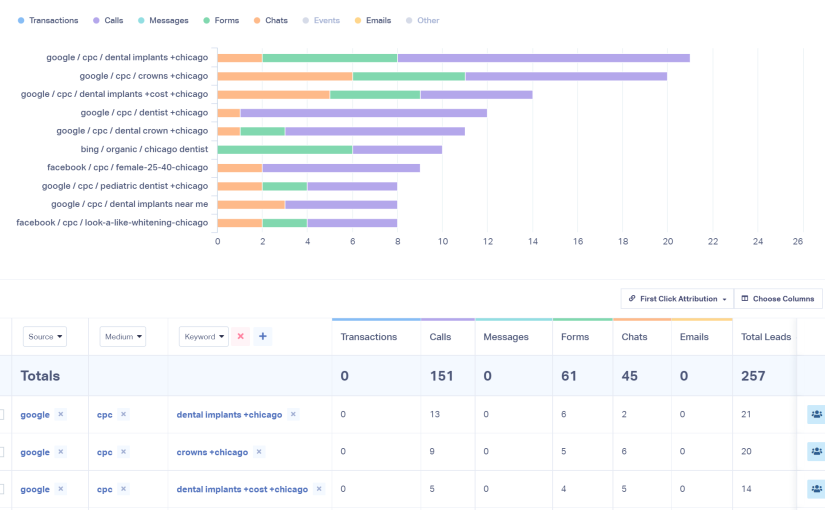
Digital Marketing Report Template – 7+ Free High-Impact Frameworks

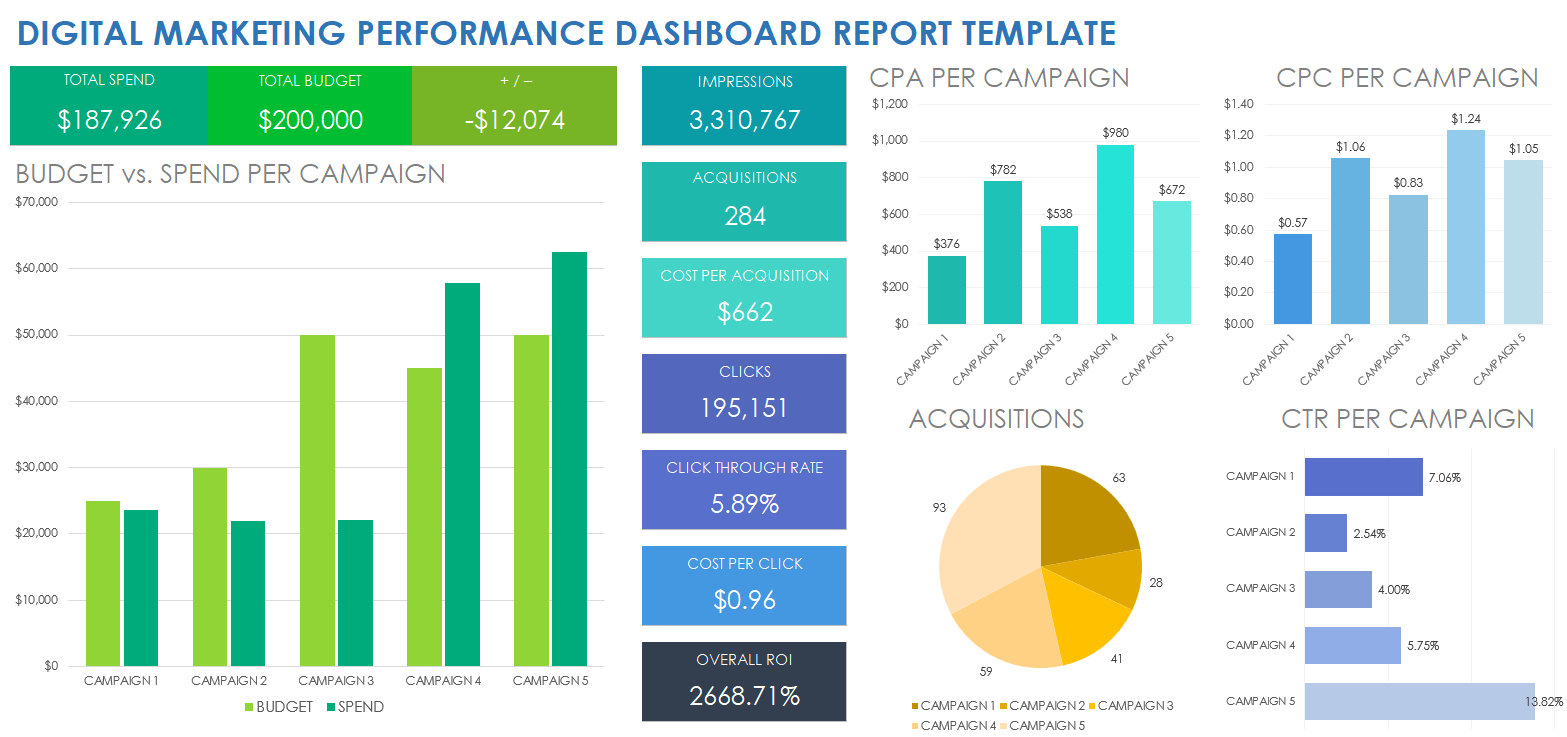
Digital Marketing Report Template frameworks play a central role in how modern organizations evaluate performance, interpret outcomes, and plan future initiatives. Without a clear reporting structure, digital marketing data becomes scattered, difficult to compare, and easy to misinterpret. A structured approach to reporting ensures that results are not only visible but also meaningful.

By using a standardized reporting format, teams can translate complex data into clear insights that support better decisions. This article explores the structure, purpose, and practical use of reporting frameworks, along with the most impactful variations used across different digital marketing scenarios.

What Makes a Digital Marketing Report Template Essential

A Digital Marketing Report Template is designed to organize marketing performance data into a consistent and repeatable format. Rather than reviewing isolated metrics from multiple sources, teams rely on a single document that presents outcomes in a logical and easy-to-read structure.

The core objectives of a Digital Marketing Report Template include:

  • Providing clarity across multiple marketing channels
  • Ensuring consistent measurement over time
  • Supporting performance comparison between initiatives
  • Improving communication with stakeholders
  • Guiding future planning and optimization

When reporting follows a clear framework, patterns become easier to identify, and insights become more actionable.

Why Consistency Is Critical in Digital Marketing Reporting

Digital marketing activities often run simultaneously across platforms, audiences, and timelines. Without a unified reporting structure, evaluating overall performance becomes inefficient and unreliable.

A Digital Marketing Report Template ensures that all initiatives are measured using the same criteria. This consistency allows teams to:

  • Track progress accurately
  • Identify long-term performance trends
  • Understand the relationship between effort and outcome
  • Maintain alignment across departments

Consistent reporting also reduces subjective interpretation, keeping discussions focused on data-driven outcomes rather than assumptions.

Core Components of a High-Quality Digital Marketing Report

An effective report balances high-level summaries with detailed analysis. While formats may vary, most successful reports include the following elements.

Performance Snapshot

This opening section summarizes key outcomes, highlighting notable changes and overall direction. It allows readers to understand results quickly before diving into details.

Objectives and Measurement Framework

Clear objectives give context to performance data. This section outlines what the marketing activities aimed to achieve and which indicators were used to measure success.

Channel-Level Results

Breaking performance down by channel helps identify where results originate and how different platforms contribute to overall outcomes.

Audience Engagement Analysis

This section focuses on how users interact with digital assets, providing insight into behavior, interest, and interaction depth.

Conversion and Business Impact

Conversions represent measurable outcomes. This part of the report tracks completed actions that reflect real business value.

Insights and Interpretation

Beyond presenting numbers, this section explains what the data suggests and why certain trends may have occurred.

Strategic Recommendations

A Marketing Report Template should always conclude with clear, actionable recommendations based on observed performance.

High-Impact Types of Digital Marketing Reporting Templates

Different reporting goals require different frameworks. Below are the most commonly used formats, each serving a distinct purpose.

Digital Marketing Performance Report Template for Strategic Growth Tracking

A Digital Marketing Performance Report Template for Strategic Growth Tracking provides a comprehensive overview of ongoing marketing activities. It emphasizes long-term trends, overall effectiveness, and cross-channel performance.

This format is especially valuable for:

  • Monthly or quarterly performance reviews
  • Executive-level reporting
  • Internal strategy evaluation

By focusing on the bigger picture, this report helps organizations understand how individual efforts contribute to broader objectives.

Get also: Digital Marketing Monthly Report Template

Digital Marketing Campaign Report Template for Conversion-Driven Analysis

A Digital Marketing Campaign Report Template for Conversion-Driven Analysis is designed to evaluate a specific initiative within a defined timeframe. It isolates campaign-related data to measure effectiveness and efficiency.

This framework is commonly used for:

  • Promotional campaigns
  • Product or service launches
  • Paid media initiatives

Focusing on a single campaign allows teams to refine tactics, identify strengths, and address weaknesses with precision.

Digital Marketing Audit Report Template for Deep Strategic Assessment

A Digital Marketing Audit Report Template for Deep Strategic Assessment takes a diagnostic approach to reporting. Instead of emphasizing short-term results, it evaluates the overall condition of digital marketing activities.

Audit reports typically examine:

  • Channel alignment and consistency
  • Content effectiveness
  • Funnel structure and flow
  • Process efficiency

This format is ideal for identifying gaps and improvement opportunities before implementing new strategies.

Adapting a Digital Marketing Report Template for Different Audiences

While the structure of a Digital Marketing Report Template remains consistent, the presentation should be adapted to the intended audience.

Executive Reporting

Executives benefit from concise summaries, trend-focused insights, and outcome-driven conclusions.

Operational Team Reporting

Marketing teams often require deeper analysis, including detailed metrics and tactical observations.

Client-Facing Reporting

Clients typically value clarity, transparency, and clearly explained recommendations that connect performance to value.

Adapting reports ensures relevance without compromising consistency.

Key Advantages of Using a Standardized Reporting Framework

Organizations that rely on structured reporting frameworks gain measurable benefits:

  • Clear and consistent performance evaluation
  • Faster insight generation
  • Improved communication across teams
  • Stronger accountability
  • Better alignment between goals and outcomes

A Digital Marketing Report also simplifies historical comparison, making long-term analysis more reliable.

Common Reporting Challenges and How to Avoid Them

Even well-designed reports can lose effectiveness if common mistakes occur. These include:

  • Overloading reports with raw data
  • Focusing on activity rather than outcomes
  • Ignoring context when interpreting results
  • Inconsistent reporting periods

Avoiding these issues ensures that reports remain useful and actionable.

Using Reports as a Foundation for Better Decisions

The true value of a Digital Marketing Report lies in how it supports decision-making. Reports should not exist solely for documentation, but as tools that guide future actions.

When reviewed consistently, reports help teams:

  • Identify performance patterns
  • Optimize underperforming initiatives
  • Allocate resources more effectively
  • Improve planning accuracy

Over time, structured reporting builds a reliable performance history that supports smarter and more confident decisions.

Conclusion

A Digital Marketing Report Template is a critical asset for organizations managing complex digital initiatives. By providing a clear and consistent structure, it enables teams to evaluate outcomes, compare performance, and refine strategies with confidence.

Whether using a Digital Marketing Performance Report Template for Strategic Growth Tracking, a Digital Marketing Campaign Report Template for Conversion-Driven Analysis, or a Digital Marketing Audit Report Template for Deep Strategic Assessment, structured reporting transforms data into actionable insight.

When applied consistently, these frameworks support stronger alignment, clearer communication, and more effective digital marketing outcomes.

Weekly Expense Report Template – 2026 Powerful Financial Control

Weekly Expense Report Template – Eye-Opening Structure for Clear Financial Discipline | A Weekly Expense Report Template is a practical tool designed to keep spending visible, controlled, and accountable on a short-term horizon. Unlike monthly or annual reports that summarize after the fact, weekly expense reporting operates in real time. It captures financial behavior as it happens, making corrections possible before small leaks turn into serious budget problems.

Organizations that rely on weekly reporting often discover a simple truth: money behaves differently when it is watched closely. A Weekly Expense Report Template creates that visibility. It records routine costs, tracks operational spending, and highlights unusual activity while the details are still fresh.

This type of template is widely used across departments, project teams, sales operations, and field-based roles. Its value lies in immediacy. Managers do not need to wait for end-of-month reconciliations to understand spending patterns. Decisions can be made faster, supported by current data rather than outdated summaries.

Weekly Expense Report Template

A well-designed Weekly Expense Report Template organizes expenses into a consistent structure that can be completed quickly without sacrificing accuracy. The goal is simplicity paired with clarity.

Most weekly expense reports include:

  • Reporting period and employee or department details
  • Expense categories such as travel, meals, supplies, and services
  • Individual expense entries with dates and descriptions
  • Payment methods used (cash, card, reimbursement)
  • Subtotals by category
  • Weekly total expenses
  • Approval or verification section

This structure allows the report to function as both a tracking tool and a control mechanism. Employees can log expenses daily, while supervisors can review totals at the end of the week without needing additional clarification.

Consistency is critical. When the same template is used every week, comparisons become effortless. Trends emerge naturally, and irregular spending becomes easy to identify.

Why Weekly Expense Tracking Matters

Weekly reporting serves a different purpose than longer reporting cycles.

Immediate Visibility

Spending issues are identified while they can still be corrected.

Improved Budget Control

Frequent summaries prevent overspending from going unnoticed.

Faster Approvals

Shorter reporting periods reduce review time and bottlenecks.

Stronger Accountability

Clear ownership of weekly expenses encourages discipline.

Reduced Administrative Stress

Less pressure at month-end or year-end.

A Weekly Expense Report Template supports all of these benefits by standardizing how information is captured and reviewed.

General Supporting Section

Different operational needs call for slightly different reporting formats. The following variations expand on the core weekly expense structure while maintaining compatibility with a standardized approach.

Weekly Financial Report Template – Unbelievable Clarity Beyond Expenses

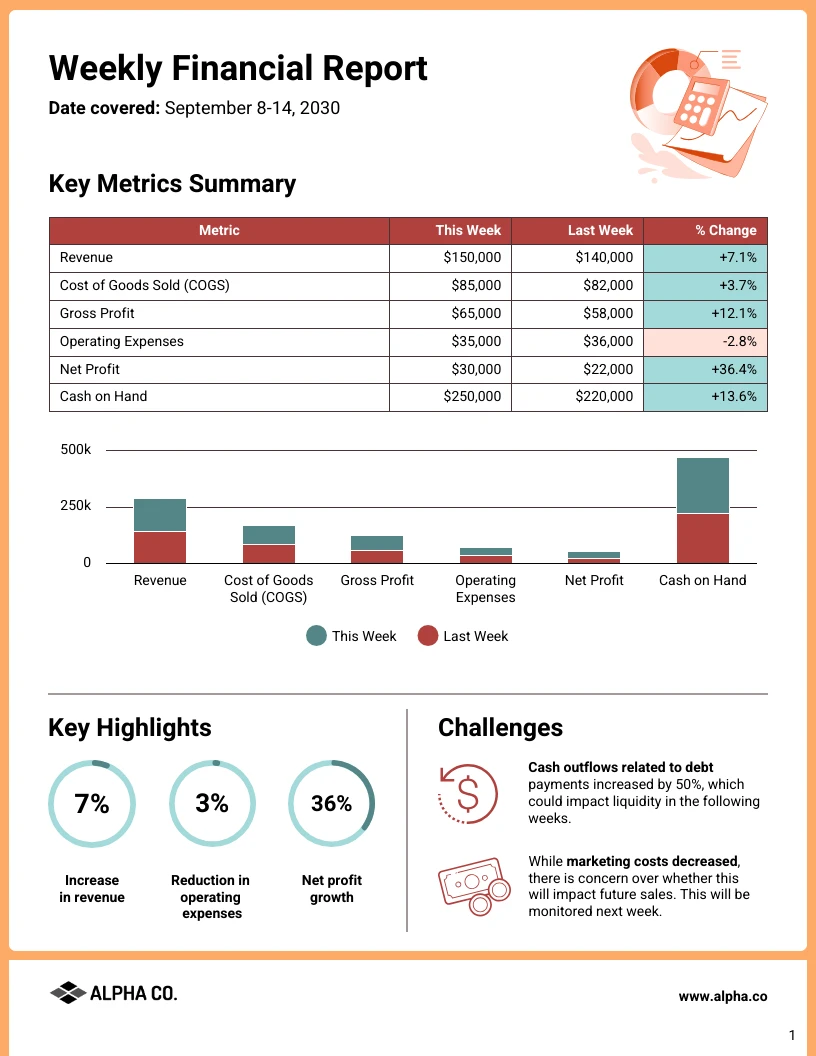
A Weekly Financial Report Template extends beyond expense tracking to provide a broader snapshot of short-term financial performance. While expenses remain a key component, this format also incorporates income, balances, and cash movement.

Typical elements include:

  • Weekly income or revenue summaries
  • Operating expenses and overhead costs
  • Net cash movement
  • Outstanding payables or receivables
  • Brief financial notes or observations

This weekly report template is particularly useful for small businesses, project-based teams, and departments that need to monitor cash flow closely. By pairing expense data with income information, decision-makers gain a clearer understanding of financial health on a week-by-week basis.

Used consistently, a Weekly Financial Report Template supports proactive planning. Instead of reacting to financial surprises, teams can anticipate short-term needs and adjust spending behavior accordingly.

Get also: Weekly Sales Report Template

Weekly Expense Sheet Excel Template – Stunning Simplicity for Fast Data Entry

A Weekly Expense Sheet Excel Template prioritizes speed and ease of use. It is often presented in a tabular format that allows quick entry of expenses with minimal friction.

Common features include:

  • Predefined expense categories
  • Simple rows for daily entries
  • Automatic weekly totals
  • Clear separation between reimbursable and non-reimbursable costs

This format is ideal for field staff, sales teams, and employees who incur frequent small expenses. The simplicity encourages consistent usage, which improves data accuracy over time.

Because the sheet format is easy to review, managers can scan totals quickly and focus attention where it matters most. Small irregularities stand out without requiring complex analysis.

Get also: Daily Expense Report Template

Weekly Expense Report Form – Eye-Opening Standardization for Approvals

An Expense Report Form emphasizes structure and approval workflows. It is often used in organizations that require formal validation before expenses are reimbursed or recorded.

This format typically includes:

  • Employee identification and role
  • Expense descriptions with supporting references
  • Declaration or confirmation statements
  • Supervisor review and approval fields
  • Submission and approval dates

The strength of this template lies in accountability. Every expense is clearly attributed, documented, and approved within a defined timeframe. This reduces disputes, prevents duplication, and supports internal controls.

For organizations with compliance requirements, a standardized Weekly Expense Report Form ensures that documentation remains consistent and review-ready.

Key Elements That Strengthen Weekly Expense Reporting

Clear Categories

Defined categories reduce misclassification and confusion.

Short Reporting Cycles

Weekly intervals keep data relevant and actionable.

Consistent Layout

Familiar structure speeds up completion and review.

Accurate Descriptions

Brief notes add context without unnecessary detail.

Approval Visibility

Clear sign-offs reinforce responsibility.

These elements turn routine expense tracking into a reliable management process.

Common Use Cases for Weekly Expense Reports

A Weekly Expense Report Template is effective in many real-world scenarios:

  • Sales teams tracking travel and client-related costs
  • Construction and field operations monitoring on-site expenses
  • Project teams controlling short-term budgets
  • Departments managing discretionary spending
  • Small businesses overseeing cash flow

In each case, the weekly format offers a balance between detail and efficiency.

Practical Benefits of Using a Standard Template

Organizations that adopt a consistent Weekly Expense Report Template experience measurable advantages:

  • Faster reporting cycles: Less time spent compiling data
  • Improved accuracy: Regular entries reduce forgotten expenses
  • Better oversight: Spending patterns become visible quickly
  • Simplified reviews: Managers know exactly where to look
  • Scalable process: Works for small teams and larger operations

Over time, these benefits contribute to stronger financial discipline and more confident decision-making.

Challenges Without Weekly Structure

Without a weekly reporting framework, organizations often face:

  • Delayed expense visibility
  • Incomplete or rushed month-end reports
  • Higher reimbursement disputes
  • Reduced spending accountability
  • Increased administrative workload

A structured weekly template resolves these issues by spreading reporting effort evenly across the reporting period.

Design and Presentation Considerations

While functionality is the priority, presentation still matters:

  • Use clean tables for readability
  • Highlight totals clearly
  • Separate daily entries visually
  • Keep formatting professional and consistent

A clear design improves adoption and reduces errors.

Final Thoughts

A Weekly Expense Report Template provides immediate insight into spending behavior, supports accountability, and simplifies financial oversight. When complemented by a Weekly Financial Report Template, streamlined through a Weekly Expense Sheet Template, and formalized using a Weekly Expense Report Form, it becomes a complete system for short-term financial control.

Consistent weekly reporting strengthens discipline. Clear documentation builds trust. And structured templates transform expense tracking from a routine task into a strategic advantage.

Annual Expense Report Template – 2026 Yearly Financial Clarity

Annual Expense Report Template – A Powerful Framework for Accurate Year-End Tracking | An Annual Expense Report Template is more than a financial summary—it is a control system for understanding where money truly goes over an entire year. Whether used by small businesses, organizations, nonprofits, or internal departments, this type of report brings order to what would otherwise be scattered receipts, inconsistent records, and vague assumptions.
Expenses have a habit of growing quietly. A coffee here, a subscription there, operational costs that seem harmless month to month suddenly look very different when viewed annually. An Annual Expense Report Template transforms those fragmented transactions into a clear, structured financial picture.

With a reliable template, decision-makers gain visibility. Patterns become obvious. Inefficiencies surface naturally. Budget discussions stop being emotional debates and start becoming evidence-based conversations. Most importantly, financial accountability becomes a habit rather than a once-a-year scramble.

Annual Expense Report Template

A well-structured Annual Expense Report Template organizes financial data into logical categories that make sense at a yearly scale. Instead of focusing on isolated transactions, it emphasizes trends, totals, and comparisons.

Typical sections within an annual expense report include:

  • Administrative and operational expenses
  • Payroll and contractor costs
  • Utilities and facility-related spending
  • Marketing and promotional expenses
  • Travel and logistics costs
  • Technology, software, and subscriptions
  • Miscellaneous and one-time expenses
  • Annual totals and variance summaries

Each category serves a purpose. Grouping expenses this way helps organizations quickly identify which areas consume the largest portion of resources and which costs fluctuate unpredictably.

A strong template also supports consistency. When the same structure is used year after year, financial comparisons become effortless. Leaders can assess growth, cost control, and sustainability without rebuilding reports from scratch.

Why Annual Expense Reporting Matters

Annual reporting offers a perspective that monthly or quarterly views cannot fully capture.

Long-Term Financial Awareness

Yearly expense summaries reveal trends that short-term reports often hide.

Budget Optimization

Understanding annual totals allows for more realistic budgeting for the future.

Accountability and Transparency

Clear expense documentation builds trust with stakeholders.

Audit Readiness

Structured records simplify internal reviews and external checks.

Strategic Decision Support

Reliable data improves planning and resource allocation.

An Annual Expense Report Template ensures these benefits are achieved without unnecessary complexity.

General Supporting Section

Different organizations and regulatory environments require tailored approaches to annual expense reporting. The following report formats address specific needs while remaining compatible with a standardized structure.

Yearly Expense Report Template – Unbelievable Simplicity for Long-Term Tracking

A Yearly Expense Report Template focuses on clarity and continuity. It is ideal for businesses and teams that want a straightforward, repeatable format to track expenses across a full calendar year.

This template typically emphasizes:

  • Monthly expense breakdowns aggregated into annual totals
  • Clear category definitions
  • Side-by-side comparisons between months
  • Visual summaries such as tables or charts

The strength of this format lies in its simplicity. Finance teams can trace how expenses evolve throughout the year without losing sight of the big picture. Sudden spikes or gradual increases become easy to spot.

For managers, a Yearly Expense Report Template reduces guesswork. Decisions about cost controls, vendor negotiations, or budget reallocations are grounded in documented patterns rather than assumptions.

Get also: Annual Financial Report Template

CT Annual Income and Expense Report – Eye-Opening Compliance and Accuracy

A CT Annual Income and Expense Report is designed to meet specific regulatory or organizational reporting standards, particularly where income and expenses must be presented together in a clearly reconciled format.

This type of report often includes:

  • Total annual income by source
  • Categorized annual expenses
  • Net surplus or deficit calculations
  • Supporting notes or explanations
  • Structured layouts aligned with reporting requirements

The value of this format lies in precision. Income and expense figures must align accurately, leaving little room for ambiguity. A structured template ensures that all required fields are addressed consistently.

Organizations using a CT Annual Income and Expense Report benefit from reduced compliance risk and improved confidence in their financial records. Leadership can review results knowing that data has been captured methodically.

Get also: Annual Marketing Report Template

Annual Income and Expense Report Template – Stunning Balance Between Costs and Revenue

An Annual Income and Expense Report Template presents a complete financial snapshot by pairing spending with earnings. Rather than viewing expenses in isolation, this format highlights financial sustainability.

Common components include:

  • Revenue streams and funding sources
  • Operating and non-operating expenses
  • Net financial position
  • Comparative figures from previous years
  • Summary insights and notes

This expense report template is particularly useful for nonprofits, project-based organizations, and internal departments. It allows stakeholders to understand how expenses relate directly to income and whether financial performance supports long-term goals.

By using a consistent Annual Income and Expense Report Template, organizations gain clarity. Financial discussions shift from fragmented cost analysis to holistic performance evaluation.

Key Elements That Strengthen Annual Expense Reports

Clear Categorization

Well-defined expense categories prevent misclassification and confusion.

Consistent Time Frames

Using the same reporting period ensures accurate comparisons.

Supporting Documentation

References to invoices or records strengthen credibility.

Readable Layout

Logical spacing and structure improve comprehension.

Summary Insights

High-level observations help readers interpret the data.

These elements turn raw numbers into meaningful financial intelligence.

Common Use Cases for Annual Expense Reporting

An Annual Expense Report Template supports a wide range of real-world scenarios:

  • Year-end financial reviews
  • Budget planning and forecasting
  • Board or leadership presentations
  • Regulatory and compliance reporting
  • Internal audits and evaluations

In each case, consistency and clarity make the report more effective and easier to trust.

Practical Benefits of Using a Template

Organizations that rely on a standardized Annual Expense Report Template gain lasting advantages:

  • Efficiency: Faster preparation and review
  • Accuracy: Reduced risk of missing or duplicated data
  • Transparency: Clear visibility into spending
  • Comparability: Easy year-over-year analysis
  • Scalability: Adaptable as operations grow

Over time, these benefits translate into stronger financial discipline and better strategic outcomes.

Challenges Without a Structured Template

Without a consistent reporting framework, organizations often face:

  • Incomplete expense records
  • Inconsistent categorization
  • Difficulty reconciling totals
  • Time-consuming manual reviews
  • Limited financial insight

A structured template resolves these issues by imposing order and repeatability.

Design and Presentation Considerations

While accuracy is essential, presentation also influences how reports are received:

  • Use tables for clarity
  • Group related expenses logically
  • Highlight totals and key figures
  • Keep formatting clean and professional

A well-presented report invites understanding rather than confusion.

Final Thoughts

An Annual Expense Report is a foundational tool for financial clarity and accountability. When combined with a Yearly Expense Report Template, aligned with regulatory needs such as a CT Annual Income and Expense Report, and integrated into a broader Annual Income and Expense Report Template, it provides a complete and reliable financial picture.

Clear reporting strengthens decision-making. Structured documentation builds trust. And consistent templates turn financial review from a burden into a strategic advantage.

Church Annual Report Template – Free 2026 Faith-Driven Accountability

Church Annual Report Template – A Powerful Record of Ministry, Stewardship, and Growth | A Church Annual Report Template is not merely an administrative document. It is a spiritual and organizational reflection of an entire year of ministry, service, and stewardship. Churches operate on trust—trust from congregations, volunteers, donors, and the wider community. An annual report captures how that trust has been honored.

Unlike business reports that focus on profit margins and market expansion, a church report balances faith-based storytelling with responsible reporting. It shows how resources were used, how ministries impacted lives, and how leadership guided the congregation through challenges and blessings alike.

Using a structured Church Annual Report Template ensures consistency and clarity. It helps leadership teams present information in a way that is easy to understand, spiritually grounded, and transparent. Over time, this consistency builds confidence, strengthens unity, and preserves the church’s institutional memory.

Church Annual Report Template

A well-built Church Annual Report Template organizes diverse information into a clear and meaningful narrative. Readers should be able to understand the church’s mission, activities, and outcomes without needing to decode complex data or theological jargon.

Most church annual reports include several essential sections:

  • Vision and mission statement
  • Message from the pastor or senior leadership
  • Overview of worship services and attendance
  • Ministry highlights and outreach programs
  • Volunteer engagement and staffing overview
  • Financial summary and stewardship overview
  • Facility updates and maintenance activities
  • Goals and ministry focus for the coming year

Each section serves a distinct role. Leadership messages provide spiritual direction. Ministry summaries demonstrate action. Financial sections confirm accountability. The closing vision invites the congregation to continue the journey together.

A reliable template ensures balance. No single section overwhelms the others, and the report reads as a cohesive story rather than a collection of disconnected updates.

General Supporting Section

Below are specific reporting perspectives that churches commonly integrate into their annual documentation to meet both spiritual and administrative expectations.

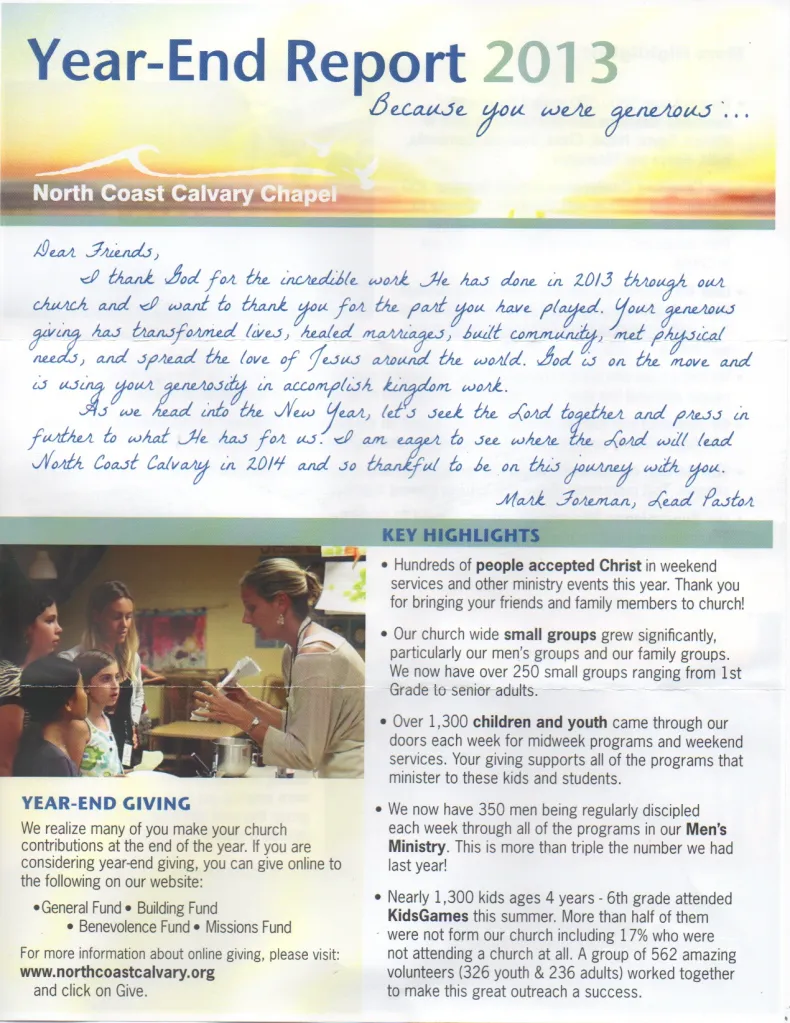
End of Year Church Report Sample – Eye-Opening Insight into Ministry Impact

An End of Year Church Report Sample focuses on reflection. It looks back over the year and answers a simple but powerful question: What did the church accomplish together?

This type of report often highlights:

  • Key worship milestones and attendance trends
  • Major events, programs, and celebrations
  • Outreach efforts and community service initiatives
  • Testimonies or stories of transformed lives
  • Ministry challenges and lessons learned

The value of an end-of-year report lies in its ability to connect numbers with meaning. Attendance figures are paired with context. Budget summaries are supported by explanations of ministry outcomes. Stories bring warmth to structured data.

For congregations, this report reinforces a sense of shared purpose. Members see how their time, prayers, and contributions translate into real impact. For leadership, it provides a clear snapshot to guide future planning.

When integrated into a Church Annual Report Template, the end-of-year section adds depth and emotional resonance without sacrificing clarity.

Get also: Charity Annual Report Template

Baptist Church Annual Report – Unbelievable Balance of Tradition and Transparency

A Baptist Church Annual Report often reflects a strong emphasis on congregational involvement, governance clarity, and doctrinal consistency. Baptist churches traditionally value transparency and member participation, making annual reporting especially significant.

This type of report typically includes:

  • Congregational meeting summaries
  • Committee and ministry reports
  • Baptism and membership statistics
  • Mission support and outreach activities
  • Financial accountability statements

Clear organization is essential. Members should be able to locate ministry updates and financial summaries easily. The report should feel structured, respectful, and aligned with the church’s theological values.

Beyond formality, a Baptist church report serves as a unifying document. It shows how leadership decisions were made, how funds were stewarded, and how ministries aligned with the church’s calling.

Within a broader Church Annual Report Template, the Baptist reporting approach emphasizes clarity, shared responsibility, and faithful stewardship—principles that resonate across many denominations.

Get also: Nonprofit Annual Report Template

Why Annual Church Reporting Truly Matters

Churches are mission-driven organizations, but they are also responsible stewards of resources. Annual reporting supports both callings.

Strengthening Congregational Trust

Clear reporting reassures members that offerings and donations are managed responsibly.

Encouraging Participation

When members understand ministry impact, they are more likely to volunteer and engage.

Supporting Leadership Accountability

Documented reports encourage thoughtful decision-making and transparency.

Preserving Church History

Annual reports create a written record of growth, challenges, and milestones.

Guiding Future Ministry

Reflection helps leadership align future goals with past experiences.

Key Elements That Elevate a Church Annual Report

Clear Spiritual Narrative

Faith-based messaging should connect activities to mission, not just list events.

Accessible Financial Overview

Financial summaries should be understandable without accounting expertise.

Ministry-Focused Metrics

Attendance, participation, and outreach numbers gain meaning when paired with context.

Volunteer Recognition

Acknowledging service reinforces gratitude and unity.

Forward-Looking Vision

Sharing goals helps the congregation see where the church is headed.

Practical Use Cases for Church Annual Reports

A Church Annual Report Template supports multiple real-world needs:

  • Congregational meetings and annual assemblies
  • Leadership planning and evaluation
  • Transparency for donors and supporters
  • Orientation for new members
  • Historical documentation

In each case, consistency and clarity make the report more valuable and easier to use.

Benefits of Using a Structured Template

Churches that rely on a standardized annual report template gain several advantages:

  • Time savings: Less effort spent on formatting and organization
  • Accuracy: Consistent presentation of data year after year
  • Professionalism: Clear, polished communication
  • Continuity: Easy comparison across reporting periods
  • Scalability: Adaptable as ministries expand

Over time, these benefits reduce administrative burden and allow leadership to focus more on ministry.

Common Challenges and How Templates Help

Information Overload

Templates help prioritize what truly matters.

Inconsistent Reporting

Standard sections ensure continuity across years.

Limited Resources

Pre-defined structures simplify preparation for smaller teams.

Communication Gaps

Clear layouts improve understanding among diverse audiences.

Design and Presentation Considerations

While content is critical, presentation also plays a role in engagement:

  • Use headings and spacing for readability
  • Include charts or tables for financial summaries
  • Maintain a respectful, clean visual style
  • Ensure tone matches the church’s values

A well-presented report invites reading rather than feeling like an obligation.

Final Reflections

A Church Annual Report Template is a cornerstone of transparent, faith-centered communication. It honors the past year’s ministry, acknowledges the people who made it possible, and sets a clear direction for the future.

When complemented by an End of Year Church Report Sample and adapted to denominational needs such as a Baptist Church Annual Report, it becomes a complete and trustworthy record of service, stewardship, and spiritual growth.

Strong reporting strengthens unity. Clear documentation builds trust. And thoughtful reflection helps churches move forward with confidence and purpose.

Charity Annual Report Template – 2026 Extraordinary Transparency

Charity Annual Report Template – Unlocking Clear, Trust-Driven Reporting | A Charity Annual Report Template is more than a formal document—it is a strategic communication tool that demonstrates accountability, impact, and responsible stewardship. For charities, annual reporting is a moment of truth. It shows supporters how donations were managed, what outcomes were achieved, and how leadership decisions aligned with the mission.

Unlike corporate reports that focus on growth metrics and profitability, charity reports must balance emotional storytelling with structured accountability. A strong Charity Annual Report Template provides a clear framework to achieve both. It allows organizations to present achievements with pride while maintaining the transparency that donors, regulators, and partners expect.

Using a consistent template also reduces internal friction. Teams can focus on content rather than formatting, ensuring that program data, financial summaries, and narratives flow naturally. Over time, this consistency strengthens credibility and helps the organization build a recognizable reporting identity.

Charity Annual Report Template

At its foundation, a Charity Annual Report Template organizes complex information into a clear, readable structure. Readers should be able to understand the organization’s purpose, actions, and outcomes without needing prior knowledge or financial expertise.

Most charity reports include the following core sections:

  • Mission and organizational overview
  • Message from trustees or leadership
  • Program highlights and outcomes
  • Community or beneficiary impact
  • Financial overview and fund allocation
  • Governance and compliance information
  • Donor and partner acknowledgments
  • Strategic priorities for the coming year

Each section serves a purpose. The opening establishes trust and direction. Program highlights demonstrate action. Financial summaries confirm responsible management. The closing reinforces long-term commitment and forward momentum.

A well-designed template ensures that none of these sections overpower the others. The goal is balance—clear data supported by meaningful context, presented in a way that feels professional yet approachable.

General Supporting Section

Below is a closer look at how specialized reporting needs are addressed within charity-focused annual reports.

Charity Trustees Annual Report Template – Unbelievable Clarity for Governance and Compliance

A Charity Trustees Annual Report Template focuses on governance, decision-making, and oversight. Trustees are responsible for ensuring that the charity operates ethically, legally, and in alignment with its stated mission. Their report reflects that responsibility.

This template typically includes:

  • A statement of objectives and activities
  • An overview of the governance structure
  • Key decisions made during the reporting period
  • Risk management approaches
  • Compliance confirmations

Clear structure is essential. Regulators and stakeholders must be able to locate governance information quickly. A well-organized trustee’s report avoids vague language and focuses on factual clarity.

Beyond compliance, this template also reinforces confidence. When supporters see that trustees actively monitor strategy, finances, and risk, trust deepens. It signals that the organization is not only mission-driven but also responsibly managed.

Internally, the trustees’ report supports reflection. It provides leadership with a documented record of decisions, challenges, and lessons learned, helping guide future planning.

Nonprofit Annual Report Template – Stunning Consistency Across Mission and Finance

A Nonprofit Annual Report Template complements charity reporting by offering a broader framework that integrates mission storytelling with financial transparency. While charities often emphasize donor relationships, nonprofits must also address a wide range of stakeholders, including grantmakers, regulators, and community partners.

This template commonly balances:

  • Program performance summaries
  • Financial statements and expenditure breakdowns
  • Outcome measurements
  • Organizational growth or capacity updates
  • Long-term strategic direction

Consistency is the defining advantage. When reports follow a familiar structure year after year, stakeholders can easily compare progress, funding allocation, and program evolution. This continuity strengthens long-term credibility.

A nonprofit-focused template also supports internal alignment. Teams across departments—programs, finance, communications—work from a shared structure, reducing miscommunication and improving reporting efficiency.

When combined thoughtfully with a Charity Annual Report Template, nonprofits can tailor messaging while maintaining a unified organizational voice.

Why Annual Charity Reporting Matters

Annual reports are often viewed as administrative requirements, but their value extends far beyond compliance.

1. Building Donor Trust

Transparent reporting reassures supporters that their contributions are used responsibly.

2. Strengthening Organizational Reputation

Clear communication positions the charity as credible and accountable.

3. Supporting Strategic Reflection

Annual summaries encourage leadership to evaluate what worked and what needs improvement.

4. Preserving Institutional Memory

Reports document achievements, challenges, and milestones for future reference.

5. Enhancing Stakeholder Engagement

Well-crafted reports invite readers to stay connected and involved.

Key Components That Elevate Report Quality

Purpose-Driven Narrative

Stories should connect activities to outcomes, not just list events.

Accessible Financial Summaries

Numbers should be accurate, clear, and supported by explanations.

Visual Structure

Charts, tables, and headings improve readability and comprehension.

Balanced Tone

Professional, honest, and optimistic without exaggeration.

Forward-Looking Perspective

Highlight priorities and goals to maintain momentum.

Common Use Cases for Charity Annual Reports

  • Donor communications and fundraising campaigns
  • Grant reporting and renewals
  • Board reviews and governance oversight
  • Public transparency and outreach
  • Internal planning and evaluation

In each scenario, a reliable template ensures that information is presented clearly and consistently.

Practical Benefits of Using a Template

Using a structured Charity Annual Report Template delivers tangible advantages:

  • Time efficiency: Reduces repetitive formatting work
  • Accuracy: Encourages consistent data presentation
  • Clarity: Improves reader understanding
  • Professionalism: Enhances organizational image
  • Scalability: Adapts as the charity grows

Over time, these benefits compound, making reporting a strategic asset rather than an annual burden.

Final Thoughts

A Charity Annual Report Template is a powerful tool for demonstrating integrity, impact, and responsible leadership. When paired with a Charity Trustees Annual Report Template and aligned with a broader Nonprofit Annual Report Template, it creates a complete, trustworthy picture of organizational performance.

By presenting mission, governance, and financial stewardship in a clear and balanced way, charities strengthen relationships, inspire continued support, and reinforce their commitment to meaningful change.

Daily Financial Report Template – 2026 Smarter Daily Decisions

Daily Financial Report Template – Incredibly Effective for Tracking Daily Performance | A Daily Financial Report Template gives businesses a reliable way to understand their cash flow, spending behavior, and financial health on a day-to-day basis. Even companies with strong accounting systems often struggle with the “daily gap”—the difference between what happened today financially versus what becomes visible only at the end of the week or month. This Daily Financial Report Template fills that gap with a clean, structured workflow that turns daily activity into immediate insight.

When used consistently, a Daily Financial Report Template becomes a stabilizing force. It highlights opportunities, reveals inconsistencies, and provides a steady rhythm of visibility. Whether you’re monitoring revenue streams, tracking expenses, reviewing balances, or reconciling transactions, the template organizes everything into an easy-to-understand format that anyone on the finance team can use.

It’s especially valuable for businesses handling high-volume transactions, frequent cash movements, or expenses that appear unexpectedly. Retailers, service companies, hospitality venues, contractors, and field teams all benefit from having a daily financial snapshot that increases accuracy and removes guesswork.

Daily Financial Report Template Free Download

A standard Daily Financial Report Template includes several structured components designed to capture a full day’s financial picture:

  • Revenue summary
  • Cash inflows and outflows
  • Receipts and payment logs
  • Outstanding invoices or payables
  • Operational expenses
  • Account balances and adjustments
  • Notes on irregularities or anomalies
  • Plans or follow-up actions for the next day

Each section helps maintain transparency. Teams gain immediate visibility into spending patterns, revenue trends, and financial movements that would otherwise remain hidden until later reports are compiled.

By documenting the financial story of each day, businesses avoid miscalculations and ensure every dollar is accounted for. The template also reduces reliance on memory—something especially important when multiple departments or cash handlers are involved.

Daily reporting also simplifies long-term analysis. When patterns emerge over weeks or months, managers can adjust budgets, refine operations, or strengthen financial policies based on concrete evidence collected from daily logs.

General Supporting Section

Daily Cash Report Template Excel – Hidden Advantages for Cash Control and Accuracy

A Daily Cash Report Template Excel provides one of the most practical tools for businesses that depend heavily on cash transactions. Excel’s flexibility—combined with formulas, drop-down fields, and automated calculations—makes it ideal for daily financial documentation.

This kind of template typically includes:

  • Opening cash balance
  • Total cash received
  • Cash payments and withdrawals
  • Petty cash transactions
  • Closing cash balance
  • Variance tracking

The biggest advantage is accuracy. With formulas handling calculations automatically, human error is reduced significantly. Cashiers, bookkeepers, and finance officers can enter numbers quickly while Excel keeps everything aligned and reconciled.

Daily cash reporting also supports accountability. For businesses with multiple cash handlers, shifts, or branches, this template ensures that every cent is tracked with clarity. It helps identify discrepancies early, preventing issues from snowballing into significant financial losses.

It also supports better forecasting. Cash-heavy businesses often rely on these reports to understand purchasing patterns, replenishment needs, or staffing requirements. By reviewing daily movements, managers can plan more effectively and maintain steady operations.

Get also: Daily Sales Report Template

Daily Financial Statements – Little-Known Benefits for Operational Stability

Daily Financial Statements provide a condensed version of a company’s income, expenses, and financial standing for the day. Unlike traditional monthly or quarterly statements, daily statements offer real-time financial intelligence.

These statements tend to include:

  • Daily revenue breakdown
  • Cost of goods or services sold
  • Daily operational expenses
  • Taxes, fees, or other obligations
  • Running totals for the month
  • Short commentary for context

The benefit of daily statements is their ability to expose trends and inefficiencies early. If daily expenses spike without explanation, the issue becomes visible instantly. If revenue dips unexpectedly, managers can investigate within hours rather than waiting until month-end.

For organizations with complex operations or multiple revenue channels, daily statements bring everything together. They allow teams to monitor financial health with a level of frequency that encourages proactive management.

Additionally, they reinforce internal controls. By reviewing daily numbers, managers can verify accuracy, detect errors, or confirm that financial procedures are being followed consistently across the business.

Daily Income and Expense Report Template – Stunning Ways to Improve Budget Visibility

A Daily Income and Expense Report Template gives both individuals and businesses a straightforward way to understand their financial habits. For companies, this template often becomes the backbone of operational financial tracking.

It usually includes:

  • Total income collected for the day
  • Detailed expense breakdown
  • Category sorting (utilities, materials, payroll, marketing, etc.)
  • Notes on unusual items
  • Net total for the day
  • Running daily comparison charts

This format helps teams stay disciplined. It’s easy to underestimate daily spending, especially when purchases are small or frequent. By tracking each expense, organizations gain clarity over where their money is going and which areas may require cost adjustments.

For teams managing projects, service operations, or daily supply needs, this template supports smarter financial behavior. It helps highlight unnecessary expenses, duplicated purchases, or cost inefficiencies that would otherwise go unnoticed.

It also improves accountability. When employees know expenses are monitored daily, adherence to financial policies strengthens naturally. Managers gain visibility without the need for excessive oversight, creating a healthier financial culture.

Get also: Daily Marketing Report Template

How Companies Use a Daily Financial Report Template in Real Scenarios

1. Retail and Hospitality

Businesses with high transaction volume use daily reporting to track sales, reconcile cash, monitor shifts, and adjust staffing needs.

2. Construction and Contracting

Teams use templates to track daily expenses, material purchases, subcontractor payments, and project-specific financial activity.

3. Service-Based Companies

Daily tracking helps align revenue with hours worked, client billing, and operational expenses.

4. Corporate Finance Offices

Daily snapshots support cashflow forecasting, budget pacing, and internal audit readiness.

5. Startups and Small Businesses

Daily clarity helps new businesses avoid overspending and maintain steady control during rapid growth phases.

Internal Benefits of Using Daily Financial Reports

1. Stronger Budget Pacing

Daily visibility ensures budgets are followed consistently rather than over- or under-used.

2. Faster Problem Detection

Errors, fraud, or miscalculations can be discovered immediately.

3. Increased Transparency

Teams gain clarity about where financial resources are going.

4. Better Decision-Making

Daily trends inform smarter operational and financial choices.

5. More Accurate Month-End Reporting

Daily documentation makes the monthly closing smoother and more accurate.

Practical Tips for Getting the Most Out of Your Daily Financial Reports

1. Keep Data Entry Simple

Avoid overly complex fields. Make the template easy to update consistently.

2. Standardize Categories

Consistency ensures comparisons remain accurate and meaningful.

3. Review Numbers with Context

Small daily notes help explain anomalies in future audits.

4. Cross-Check Cash, Cards, and Transfers

Daily reconciliation prevents future confusion.

5. Align the Report With Business Model Needs

Adjust sections based on cashflow patterns, transaction types, or operational demands.

Final Thoughts

A Daily Financial Report Template provides an essential foundation for businesses that need control, accuracy, and real-time financial visibility. Whether used alongside a Daily Cash Report Template Excel, Daily Financial Statements, or a Daily Income and Expense Report Template, it strengthens financial discipline and keeps teams aligned with daily operational realities.

Exit mobile version