

Weekly Expense Report Template – Eye-Opening Structure for Clear Financial Discipline | A Weekly Expense Report Template is a practical tool designed to keep spending visible, controlled, and accountable on a short-term horizon. Unlike monthly or annual reports that summarize after the fact, weekly expense reporting operates in real time. It captures financial behavior as it happens, making corrections possible before small leaks turn into serious budget problems.
Organizations that rely on weekly reporting often discover a simple truth: money behaves differently when it is watched closely. A Weekly Expense Report Template creates that visibility. It records routine costs, tracks operational spending, and highlights unusual activity while the details are still fresh.
This type of template is widely used across departments, project teams, sales operations, and field-based roles. Its value lies in immediacy. Managers do not need to wait for end-of-month reconciliations to understand spending patterns. Decisions can be made faster, supported by current data rather than outdated summaries.
Weekly Expense Report Template


A well-designed Weekly Expense Report Template organizes expenses into a consistent structure that can be completed quickly without sacrificing accuracy. The goal is simplicity paired with clarity.
Most weekly expense reports include:
- Reporting period and employee or department details
- Expense categories such as travel, meals, supplies, and services
- Individual expense entries with dates and descriptions
- Payment methods used (cash, card, reimbursement)
- Subtotals by category
- Weekly total expenses
- Approval or verification section
This structure allows the report to function as both a tracking tool and a control mechanism. Employees can log expenses daily, while supervisors can review totals at the end of the week without needing additional clarification.
Consistency is critical. When the same template is used every week, comparisons become effortless. Trends emerge naturally, and irregular spending becomes easy to identify.
Why Weekly Expense Tracking Matters
Weekly reporting serves a different purpose than longer reporting cycles.
Immediate Visibility
Spending issues are identified while they can still be corrected.
Improved Budget Control
Frequent summaries prevent overspending from going unnoticed.
Faster Approvals
Shorter reporting periods reduce review time and bottlenecks.
Stronger Accountability
Clear ownership of weekly expenses encourages discipline.
Reduced Administrative Stress
Less pressure at month-end or year-end.
A Weekly Expense Report Template supports all of these benefits by standardizing how information is captured and reviewed.
General Supporting Section
Different operational needs call for slightly different reporting formats. The following variations expand on the core weekly expense structure while maintaining compatibility with a standardized approach.
Weekly Financial Report Template – Unbelievable Clarity Beyond Expenses

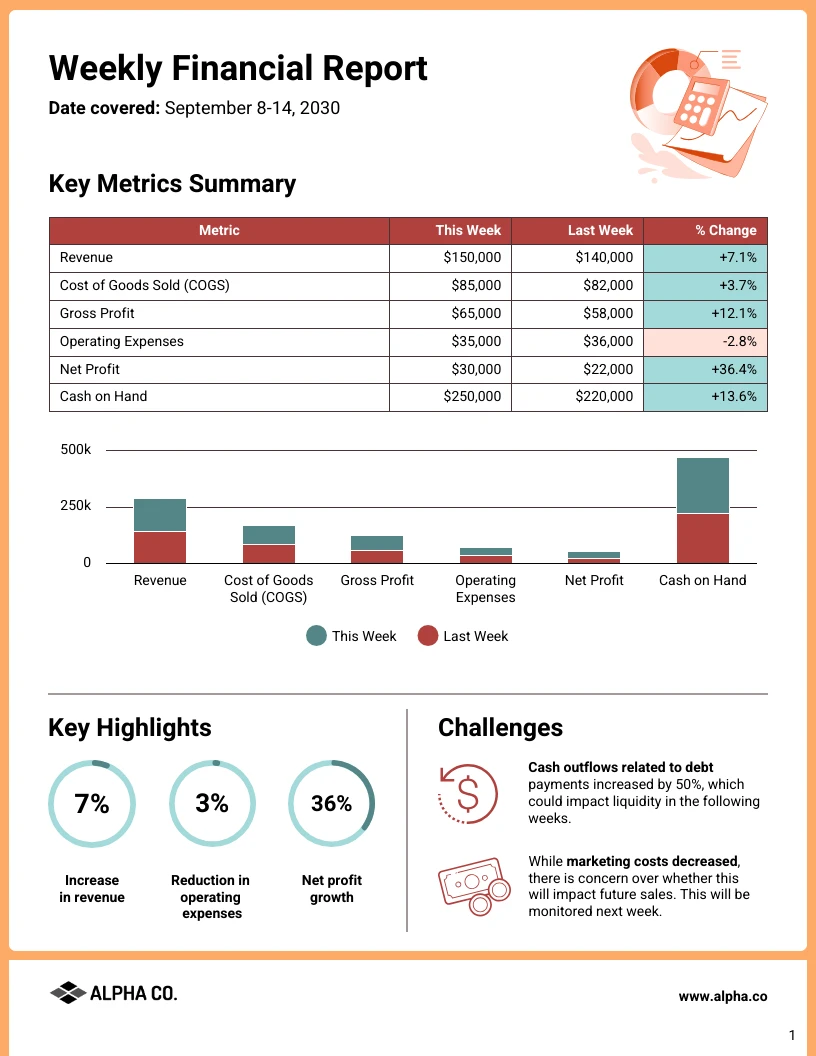
A Weekly Financial Report Template extends beyond expense tracking to provide a broader snapshot of short-term financial performance. While expenses remain a key component, this format also incorporates income, balances, and cash movement.
Typical elements include:
- Weekly income or revenue summaries
- Operating expenses and overhead costs
- Net cash movement
- Outstanding payables or receivables
- Brief financial notes or observations
This weekly report template is particularly useful for small businesses, project-based teams, and departments that need to monitor cash flow closely. By pairing expense data with income information, decision-makers gain a clearer understanding of financial health on a week-by-week basis.
Used consistently, a Weekly Financial Report Template supports proactive planning. Instead of reacting to financial surprises, teams can anticipate short-term needs and adjust spending behavior accordingly.
Get also: Weekly Sales Report Template
Weekly Expense Sheet Excel Template – Stunning Simplicity for Fast Data Entry


A Weekly Expense Sheet Excel Template prioritizes speed and ease of use. It is often presented in a tabular format that allows quick entry of expenses with minimal friction.
Common features include:
- Predefined expense categories
- Simple rows for daily entries
- Automatic weekly totals
- Clear separation between reimbursable and non-reimbursable costs
This format is ideal for field staff, sales teams, and employees who incur frequent small expenses. The simplicity encourages consistent usage, which improves data accuracy over time.
Because the sheet format is easy to review, managers can scan totals quickly and focus attention where it matters most. Small irregularities stand out without requiring complex analysis.
Get also: Daily Expense Report Template
Weekly Expense Report Form – Eye-Opening Standardization for Approvals


An Expense Report Form emphasizes structure and approval workflows. It is often used in organizations that require formal validation before expenses are reimbursed or recorded.
This format typically includes:
- Employee identification and role
- Expense descriptions with supporting references
- Declaration or confirmation statements
- Supervisor review and approval fields
- Submission and approval dates
The strength of this template lies in accountability. Every expense is clearly attributed, documented, and approved within a defined timeframe. This reduces disputes, prevents duplication, and supports internal controls.
For organizations with compliance requirements, a standardized Weekly Expense Report Form ensures that documentation remains consistent and review-ready.
Key Elements That Strengthen Weekly Expense Reporting
Clear Categories
Defined categories reduce misclassification and confusion.
Short Reporting Cycles
Weekly intervals keep data relevant and actionable.
Consistent Layout
Familiar structure speeds up completion and review.
Accurate Descriptions
Brief notes add context without unnecessary detail.
Approval Visibility
Clear sign-offs reinforce responsibility.
These elements turn routine expense tracking into a reliable management process.
Common Use Cases for Weekly Expense Reports
A Weekly Expense Report Template is effective in many real-world scenarios:
- Sales teams tracking travel and client-related costs
- Construction and field operations monitoring on-site expenses
- Project teams controlling short-term budgets
- Departments managing discretionary spending
- Small businesses overseeing cash flow
In each case, the weekly format offers a balance between detail and efficiency.
Practical Benefits of Using a Standard Template
Organizations that adopt a consistent Weekly Expense Report Template experience measurable advantages:
- Faster reporting cycles: Less time spent compiling data
- Improved accuracy: Regular entries reduce forgotten expenses
- Better oversight: Spending patterns become visible quickly
- Simplified reviews: Managers know exactly where to look
- Scalable process: Works for small teams and larger operations
Over time, these benefits contribute to stronger financial discipline and more confident decision-making.
Challenges Without Weekly Structure
Without a weekly reporting framework, organizations often face:
- Delayed expense visibility
- Incomplete or rushed month-end reports
- Higher reimbursement disputes
- Reduced spending accountability
- Increased administrative workload
A structured weekly template resolves these issues by spreading reporting effort evenly across the reporting period.
Design and Presentation Considerations
While functionality is the priority, presentation still matters:
- Use clean tables for readability
- Highlight totals clearly
- Separate daily entries visually
- Keep formatting professional and consistent
A clear design improves adoption and reduces errors.
Final Thoughts
A Weekly Expense Report Template provides immediate insight into spending behavior, supports accountability, and simplifies financial oversight. When complemented by a Weekly Financial Report Template, streamlined through a Weekly Expense Sheet Template, and formalized using a Weekly Expense Report Form, it becomes a complete system for short-term financial control.
Consistent weekly reporting strengthens discipline. Clear documentation builds trust. And structured templates transform expense tracking from a routine task into a strategic advantage.