

Incident Report Template usage plays a critical role in documenting unexpected events, workplace issues, and operational disruptions in a clear and structured way. Whether an incident involves employee safety, property damage, or procedural violations, accurate reporting ensures transparency, accountability, and proper follow-up actions.
Organizations across industries rely on incident documentation to maintain operational integrity, support investigations, and establish reliable records. A structured reporting format removes ambiguity and ensures that essential information is captured consistently every time an incident occurs.
What Is an Incident Report?
An Incident Report is a standardized document used to record details of an unexpected event, accident, or irregular occurrence. It provides a clear framework for capturing factual information, observations, and immediate responses related to an incident.
This type of report is commonly used in:
- Workplace environments
- Educational institutions
- Public facilities
- Construction sites
- Healthcare organizations
- Government and security operations
By using a consistent template, organizations reduce reporting errors and improve the quality of incident documentation.
Why Incident Reporting Is Operationally Critical


Incident reporting is not just administrative paperwork. It is a core operational function that supports safety, compliance, and decision-making.
A well-structured Incident Report helps organizations:
- Preserve accurate records of events
- Support internal reviews and investigations
- Identify recurring risks or patterns
- Improve safety procedures and policies
- Demonstrate due diligence and accountability
Incomplete or inconsistent reporting can lead to confusion, disputes, or missed opportunities for improvement.
Key Elements of an Effective Incident Report
While formats may vary depending on industry or severity, high-quality incident reports share common components.
Basic Incident Information
This includes the date, time, and location of the incident, along with the names of individuals involved or affected.
Incident Description
A clear, factual account of what happened, written objectively without assumptions or opinions.
Immediate Actions Taken
Details of any actions taken at the time, such as first aid, evacuation, or temporary controls.
Witness Statements
Optional but valuable accounts from individuals who observed the incident.
Impact and Damage Assessment
Documentation of injuries, property damage, or operational disruption.
Follow-Up and Preventive Measures
Recommendations or actions planned to prevent similar incidents in the future.
A strong Incident Report Template ensures none of these critical elements are overlooked.
Common Types of Incident Report Templates
Incident reporting is used across many scenarios. Below are some of the most widely applied formats.
Incident at Work Report Template for Workplace Safety Documentation

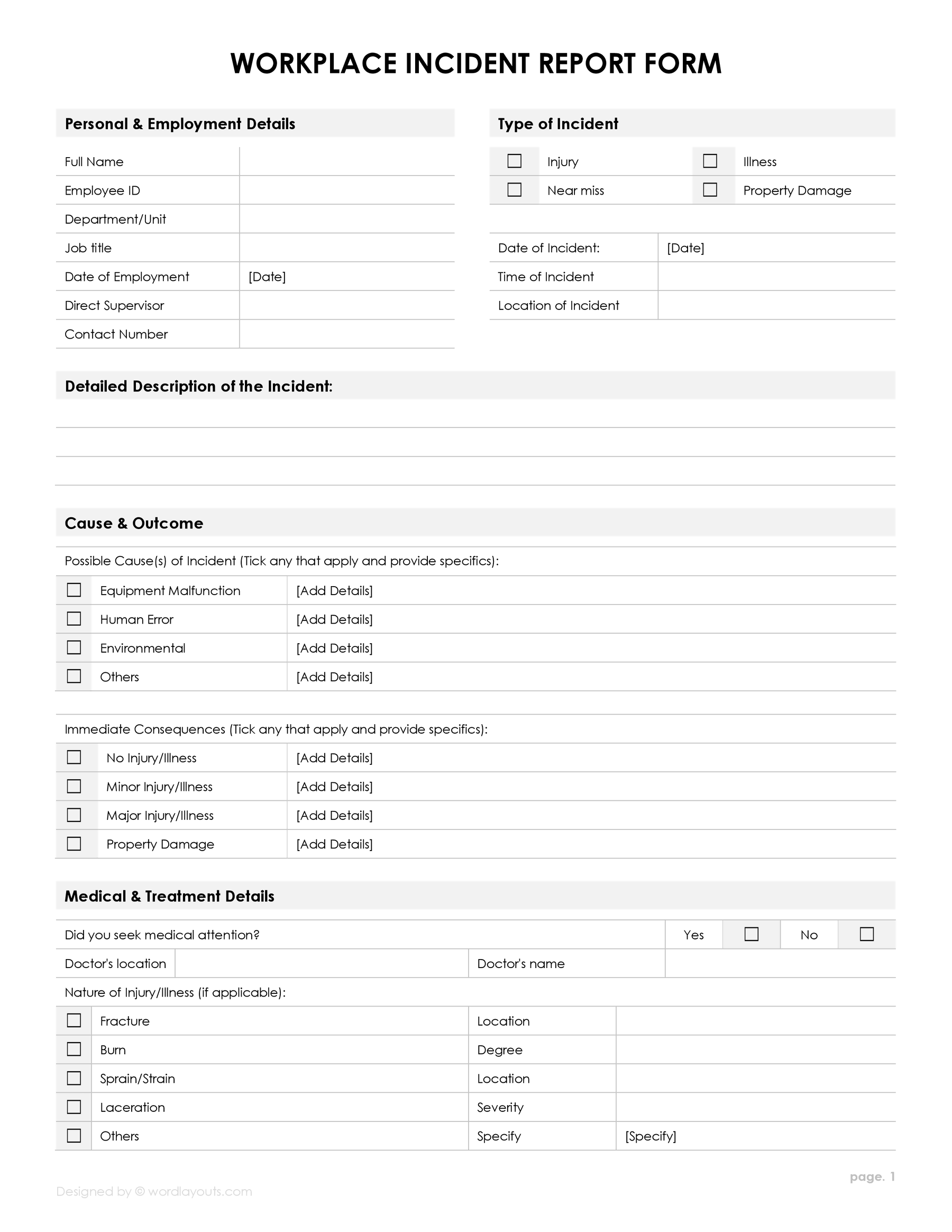
An Incident at Work Report Template for Accurate Workplace Records is designed to capture events that occur during work-related activities.
Typical use cases include:
- Employee injuries
- Equipment malfunctions
- Near-miss events
- Unsafe conditions
This format supports workplace safety programs and internal risk assessments by documenting incidents consistently and objectively.
Incident Accident Report Template for Injury and Damage Events


An Incident Accident Report Template for Clear Accident Documentation focuses on events involving physical injury or property damage.
It is commonly used when:
- An employee or visitor is injured
- Machinery or vehicles are involved
- Facilities or assets are damaged
This template emphasizes factual timelines, injury details, and immediate response actions.
Incident Report Form Template for Standardized Data Collection


An Incident Report Form Template for Structured Information Capture provides a form-based layout with predefined fields.
This format is ideal for:
- High-volume incident environments
- Frontline reporting by staff
- Digital or paper-based submissions
Form-style templates reduce reporting variability and improve data consistency across departments.
Get also: Safety Incident Report Template
Operational Benefits of Using a Standardized Incident Report
Organizations that adopt standardized incident reporting gain several long-term advantages.
Improved Accuracy and Consistency
Templates guide users to provide complete and relevant information without guesswork.
Faster Reporting and Review
Clear structure reduces the time required to complete and review reports.
Stronger Accountability
Documented records support responsibility tracking and follow-up actions.
Better Risk Identification
Consistent reports make it easier to identify trends and recurring issues.
A reliable Incident Report transforms incident documentation into a proactive operational tool.
Who Uses Incident Report Templates?
Incident reporting is not limited to a single industry or role. Common users include:
- Supervisors and managers
- Safety officers
- Human resources teams
- Facility managers
- Security personnel
- Compliance and legal teams
Each group relies on accurate incident documentation to perform its responsibilities effectively.
Adapting Incident Reports to Different Operational Contexts
While the core structure remains consistent, incident reports should be adapted to the context in which they are used.
Workplace and Corporate Environments
Focus on employee safety, equipment usage, and procedural compliance.
Educational Institutions
Document student or staff incidents, facility issues, and supervision details.
Construction and Industrial Sites
Emphasize hazard identification, equipment involvement, and safety controls.
Public and Government Operations
Prioritize clarity, neutrality, and legal documentation standards.
A flexible Incident Report Template allows customization without compromising consistency.
Common Mistakes in Incident Reporting
Even with templates, reporting quality can suffer if common mistakes are not addressed.
Typical issues include:
- Vague or subjective descriptions
- Missing timestamps or locations
- Incomplete witness information
- Delayed report submission
- Mixing assumptions with facts
Effective templates encourage factual, timely, and objective reporting.
Best Practices for Writing Clear Incident Reports
To ensure high-quality documentation:
- Write objectively and avoid opinions
- Use clear, simple language
- Stick to observable facts
- Complete reports as soon as possible
- Review reports for accuracy before submission
Following these practices enhances the value of every Incident Report Template used.
Incident Reporting and Compliance Requirements
In many organizations, incident documentation is tied to regulatory or internal compliance standards. Accurate reports support:
- Workplace safety obligations
- Insurance claims
- Internal audits
- Legal reviews
Consistent reporting demonstrates that incidents are taken seriously and handled responsibly.
Using Incident Reports for Continuous Improvement
Incident reports should not be archived and forgotten. When reviewed regularly, they provide insight into:
- Operational weaknesses
- Training gaps
- Environmental risks
- Process inefficiencies
Over time, historical incident data supports smarter preventive strategies and operational improvements.
Integrating Incident Reports into Operational Workflows
Organizations benefit most when incident reporting is integrated into daily workflows.
This includes:
- Clear reporting responsibilities
- Defined review processes
- Follow-up tracking
- Management oversight
A standardized Incident Report Template ensures smooth integration across teams and departments.
Digital vs. Paper-Based Incident Report Templates
Both formats have advantages depending on operational needs.
Digital Templates
- Faster submission
- Easier storage and retrieval
- Improved data analysis
Paper-Based Templates
- Useful in field environments
- Simple and accessible
- No technology dependency
Many organizations adopt a hybrid approach to maximize flexibility.
Choosing the Right Incident Report Template
The best template depends on:
- Industry requirements
- Incident severity
- Reporting volume
- Audience and review process
An effective Incident Report Template balances detail with usability, ensuring accurate reporting without unnecessary complexity.
Conclusion
An Incident Report Template is an essential operational tool for documenting unexpected events with clarity, consistency, and professionalism. Whether using an Incident at Work Report Template for Workplace Safety Documentation, an Incident Accident Report Template for Clear Accident Documentation, or an Incident Report Form Template for Structured Information Capture, standardized reporting strengthens accountability and risk management.
By capturing accurate information and supporting continuous improvement, incident reports help organizations maintain safer, more reliable, and more transparent operations.