

Contractor Daily Report Template – Unbelievable Ways It Transforms Job-Site Visibility | A Contractor Daily Report Template is more than a simple checklist. It’s the backbone of predictable construction performance—your day-by-day, boots-on-the-ground story of what’s happening on-site, why it matters, and how you control the moving parts. When used properly, it reduces ambiguity, strengthens communication, and eliminates those classic “Wait, I thought you meant that” debates that derail progress.
Teams rely on this template to track daily labor activities, equipment usage, weather impacts, progress notes, safety observations, delays, site conditions, subcontractor involvement, and field changes. Instead of scattered updates across chats, verbal discussions, and sticky notes that fall off the dashboard of a contractor’s truck, the Contractor Daily Report Template consolidates everything into a clean, repeatable reporting structure.
At its core, this template ensures three crucial things:
- What happened today is documented clearly.
- What should happen next is visible to everyone.
- What may cause delays is flagged early instead of exploding later.
Whether a project spans 30 days or 30 months, daily accuracy compounds. Project managers use these reports to adjust manpower, clients depend on them to verify progress, and foremen rely on them to keep field updates consistent. That’s the real muscle behind a Contractor Daily Report Template—it plugs leaks in communication before they ever become sinkholes.
Essential Foundation for Reliable Reporting
A solid reporting process keeps teams aligned from the field to the office. This section breaks down how the structure works, why consistency matters, and where secondary templates elevate the system even further.
Construction Daily Field Report Template – Extraordinary Impact on On-Site Coordination


A Construction Daily Field Report Template captures the minute-by-minute pulse of the job site. Think of it as the operational diary, documenting the actual manpower, tasks, weather disruptions, productivity notes, and subcontractor activities.
Essential elements include:
- Headcounts for labor and subcontractor teams
- Equipment hours and unexpected breakdowns
- Material deliveries with confirmation status
- Progress updates broken down by trade
- Field challenges requiring escalation
Its magic lies in transparency. When everyone sees exactly what resources are used, where, and by whom, it becomes nearly impossible for misinterpretations to slip through.
Here’s a common real-world example:
A site may plan for eight concrete finishers, but only five arrive due to another project running overtime. Without a field report, this shortage might only be recognized late in the afternoon when tasks fall behind. With the field report captured early in the day, the project manager can source a supplemental crew, adjust work sequences, or call the client with an updated timeline.
No drama. No confusion. Just clarity.
And when this field report feeds into a Contractor Daily Report Template, it completes the picture—productivity data aligns with inspection feedback, giving decision-makers a full view of current project health.
Daily Construction Inspection Report Template – Uncharted Advantages for Risk Control


Revisiting the Daily Construction Inspection Report Template through a different lens reveals its second major purpose: risk prediction.
Beyond compliance, this Construction Daily Report Template helps identify patterns that could turn into future delays or safety issues. When inspections are logged into a consistent framework, trends emerge:
- Repeated moisture issues near excavation zones
- Recurring safety hazards involving specific equipment
- Slow progress tied to a particular subcontractor trade
- Material inconsistencies with shipments from certain suppliers
These insights allow project managers to adjust schedules, enforce stronger safety measures, renegotiate supply terms, or apply preventive maintenance before equipment fails.
Integrated with a Contractor Daily Report Template, the inspection template is an early-warning radar system. The contractor’s report tells you what happened today. The inspection template often tells you why it might impact tomorrow.
Combined, they drive smarter forecasting and reduce the kind of volatility that makes construction infamous for sudden surprises.
How These Templates Work Together for Consistent Success
When all three templates—contractor, inspection, and field—work in harmony, the project reporting structure becomes a seamless ecosystem. The Contractor Daily Report Template serves as the master document, pulling insights from inspections and field reports to create a complete daily narrative.
Here’s how they connect:
- Field report → operational data
- Inspection report → quality and compliance data
- Contractor report → consolidated summary + actionable narrative
This interconnected data flow ensures:
- Job-site decisions are made based on facts, not assumptions
- Clients receive accurate daily progress without needing to micromanage
- Delays are isolated early and handled efficiently
- Safety performance stays visible and accountable
- Labor productivity is trackable and comparable across days or weeks
A consistent daily reporting rhythm builds stability. Even if a project faces unexpected weather, manpower fluctuations, or supply chain hiccups, the reporting system prevents information vacuum and response delays.
What a Perfect Contractor Daily Report Template Should Include

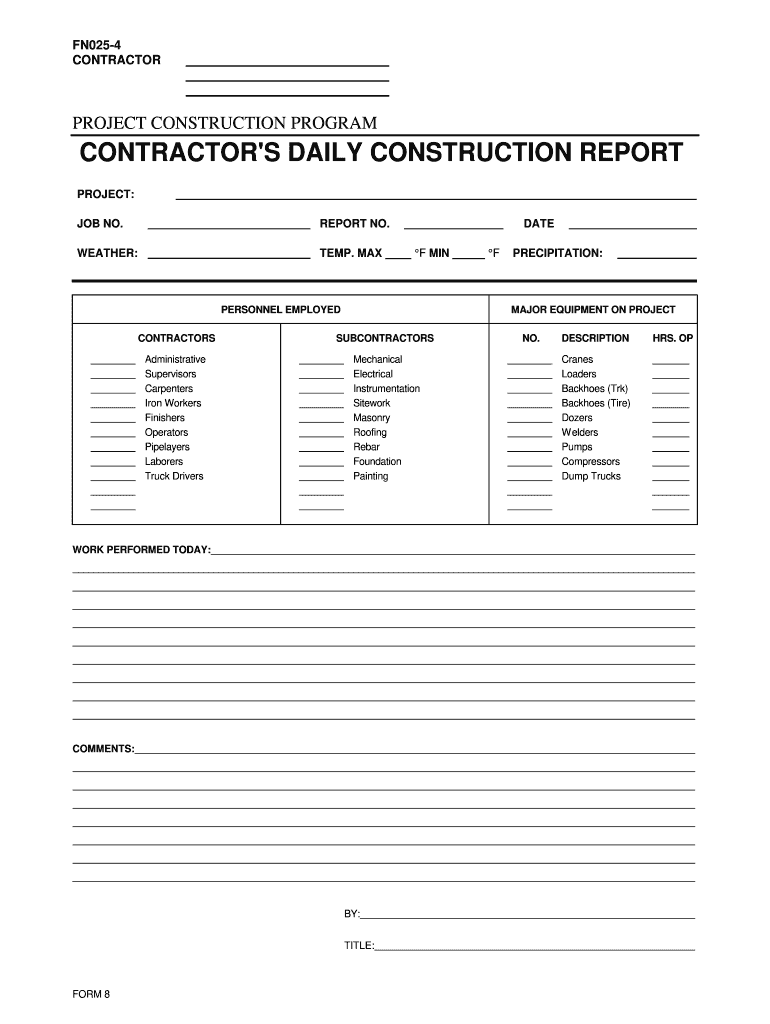
To maximize its impact, a high-quality Contractor Daily Report Template should include:
- Project identification and date
- Weather conditions and impacts
- Labor details per trade
- Equipment usage and downtime
- Material deliveries and shortages
- Tasks completed versus planned
- Site conditions and safety observations
- Delays and reasons
- Photos or attachments (optional but valuable)
- Notes requiring follow-up from the office or client
This structure ensures every stakeholder sees the job from the same vantage point. Whether it’s a superintendent walking the site, a PM sitting at a desk, or a client hundreds of miles away, the report creates shared understanding.
Real Use Cases That Show Why These Templates Matter
- A commercial renovation avoids a costly rework
An inspection template catches improper rebar placement early. The contractor’s report documents immediate corrections, preventing a three-day delay. - A site stays productive despite equipment failure
A field report logs a skid steer breakdown at 9:15 AM. The contractor report summarizes the event, allowing the PM to mobilize a rental replacement by noon. - A client receives proof of daily progress
Using consistent daily contractor reports, a highway contractor demonstrates uninterrupted work during a period with frequent rain, earning approval for milestone reimbursement. - Trade coordination improves without arguments
Daily field data clarifies that electricians were onsite and completed rough-in phases as scheduled, avoiding disputes during inspection week.
Each scenario shows the power of consistent documentation and communication through a strong reporting structure.
Final Thoughts
A well-structured Contractor Daily Report Template becomes the project’s daily source of truth—capturing the right details, reducing ambiguity, and synchronizing the field and office. Supported by reliable inspection and field report templates, it ensures teams work predictably, transparently, and efficiently, day after day.