Travel expense report template usage is essential for documenting costs incurred during business trips, field assignments, and professional travel activities. Travel-related expenses often involve multiple categories, currencies, and reimbursement rules, making structured reporting critical for accuracy and accountability.
Without a standardized format, travel expenses can become difficult to verify, inconsistent to review, and prone to disputes. A clear reporting structure ensures that every travel cost is documented properly, approved efficiently, and aligned with financial policies.
What Is a Travel Expense Report Template?
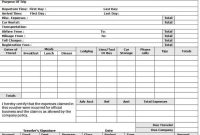
A travel expense report template is a structured document used to record and summarize expenses related to business travel. It captures essential details such as transportation costs, lodging, meals, daily allowances, and incidental expenses within a defined travel period.
This type of reporting is designed to:
- Support reimbursement requests
- Ensure compliance with travel policies
- Improve transparency in travel spending
- Simplify review and approval processes
- Maintain accurate financial records
By standardizing how travel costs are documented, organizations reduce errors and improve financial control.
Why Travel Expense Reporting Requires a Dedicated Format
Travel expenses differ from regular operational costs. They often include:
- Multiple expense categories
- Daily allowances or limits
- Variable pricing
- Receipts from different vendors or locations
A dedicated travel expense report ensures that these complexities are handled consistently. It also helps reviewers assess whether expenses align with policy guidelines and approved travel plans.
Core Components of an Effective Travel Expense Report

Although formats vary, high-quality travel expense reports share common elements that balance detail with usability.
Traveler and Trip Information
This section identifies the traveler, destination, travel dates, and purpose of the trip.
Expense Categories
Typical categories include transportation, accommodation, meals, and miscellaneous travel costs.
Itemized Expense Entries
Each entry records the date, description, amount, currency, and payment method.
Daily or Trip Totals
Totals provide a clear summary of spending at both daily and overall trip levels.
Supporting Documentation
Receipts or references support verification and approval.
Every expense report template should present these components in a clear, repeatable structure.
Common Types of Travel Expense Report Templates
Different travel scenarios require tailored reporting formats. Below are the most commonly used variations.
Travel and Expense Report Template for End-to-End Cost Visibility

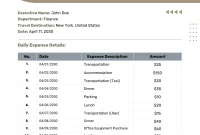
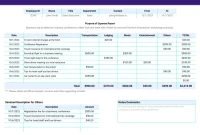
A travel and expense report template for end-to-end cost visibility combines trip-related expenses with other reimbursable costs. This format is often used in corporate environments where travel is closely tied to project or client work.
It typically includes:
- Travel-specific expenses
- Additional business-related costs
- Consolidated totals
This integrated approach simplifies submission and review.
Travel Expense Report Form for Standardized Submission

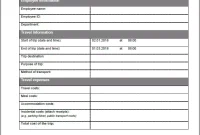
A travel expense report form for standardized submission focuses on clarity and consistency. It uses predefined fields and categories to reduce ambiguity and speed up approvals.
This format is ideal for:
- Organizations with strict travel policies
- High-volume travel reporting
- Centralized finance review
Standardized forms ensure that all required information is provided upfront.
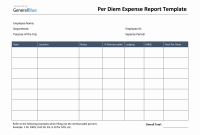
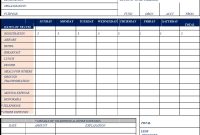
Per Diem Expense Report Template for Daily Allowance Control

A per diem expense report template for allowance-based travel control tracks daily travel allowances rather than itemized meal expenses.
This format is widely used when:
- Daily meal limits are fixed
- Policy simplifies reimbursement
- Administrative efficiency is a priority
Per diem reporting reduces paperwork while maintaining compliance.
Get also: Daily Expense Report Template
Choosing the Right Travel Expense Report Template
Selecting the appropriate format depends on:
- Travel frequency
- Policy requirements
- Level of expense detail
- Approval workflow
A travel expense report template should be easy to complete while capturing all policy-required details. Overly complex formats discourage timely submission, while overly simple ones may lack sufficient documentation.
Who Uses Travel Expense Reports Most Frequently
Travel expense reporting is common across many roles and industries.
Corporate Employees
Employees use travel reports to claim reimbursement for approved business trips.
Sales and Client-Facing Teams
Frequent travel makes consistent expense documentation critical for control and budgeting.
Consultants and Contractors
Accurate reporting supports client billing and internal cost tracking.
Field and Remote Teams
Travel reports ensure visibility into costs incurred outside the office.
In all cases, structured reporting reduces friction and improves clarity.
Common Mistakes in Travel Expense Reporting
Even with a good template, issues can arise if reporting discipline is weak. Common mistakes include:
- Missing receipts
- Incorrect categorization
- Late submissions
- Exceeding policy limits without explanation
A strong travel expense report template encourages completeness and transparency, reducing these risks.
Best Practices for Accurate Travel Expense Reports
To maintain high-quality travel expense documentation:
- Record expenses promptly
- Keep receipts organized
- Follow category guidelines
- Review totals before submission
- Provide explanations for exceptions
These practices support faster approvals and fewer disputes.
Managing Multi-Day and International Travel Expenses
Longer or international trips introduce additional complexity, such as:
- Currency conversion
- Varying tax rules
- Different per diem rates
A well-designed travel expense report template accommodates these factors by allowing clear documentation of currencies, exchange rates, and location-based allowances.
Using Travel Expense Data to Improve Cost Control
Travel expense data becomes valuable when reviewed collectively. Over time, reports reveal:
- High-cost travel patterns
- Opportunities for policy optimization
- Vendor or route efficiencies
- Budget alignment issues
Consistent reporting supports better travel planning and cost management.
Integrating Travel Expense Reports with Financial Systems
Travel expense reports often feed into:
- Reimbursement systems
- Project cost tracking
- Budget monitoring
- Financial statements
Accurate reporting at the travel level ensures reliability across broader financial records.
Long-Term Benefits of Standardized Travel Expense Reporting
Organizations that adopt structured travel reporting gain:
- Faster reimbursement cycles
- Improved policy compliance
- Reduced financial disputes
- Clearer audit trails
- Better visibility into travel spending
A reliable travel expense report becomes a cornerstone of financial transparency.
Travel Expense Reporting and Policy Compliance
Clear reporting reinforces compliance by making expectations visible. When travelers know exactly what to report and how to report it, adherence to policy improves naturally.
Templates that align closely with policy rules reduce misunderstandings and manual corrections.
Conclusion
A travel expense report template is a critical tool for tracking travel-related costs, maintaining transparency, and ensuring accurate reimbursement. By standardizing how expenses are documented, organizations and individuals gain clarity, consistency, and control.
Whether using a travel and expense report template for end-to-end cost visibility, a travel expense report form for standardized submission, or a per diem expense report template for allowance-based travel control, the right format simplifies reporting and strengthens financial discipline.
When applied consistently, travel expense reporting transforms trip-related spending into actionable financial insight and long-term cost efficiency.
Gallery of Travel Expense Report Template: 9+ Proven Formats to Track Trips


Related posts:

High School Book Report Template – 2026 Best Academic Reading

Police Crime Report Template: 8+ Accurate Crime Documentation

Police Report Template – 2026 Free Daily Observations with Precision


Safety Incident Report Template: 2026 Free Workplace Hazards and Accidents

Academic Progress Report Template (9+ Structured Formats to Track Student Growth)